Co-Founder & Creative Director, ...Gasp!
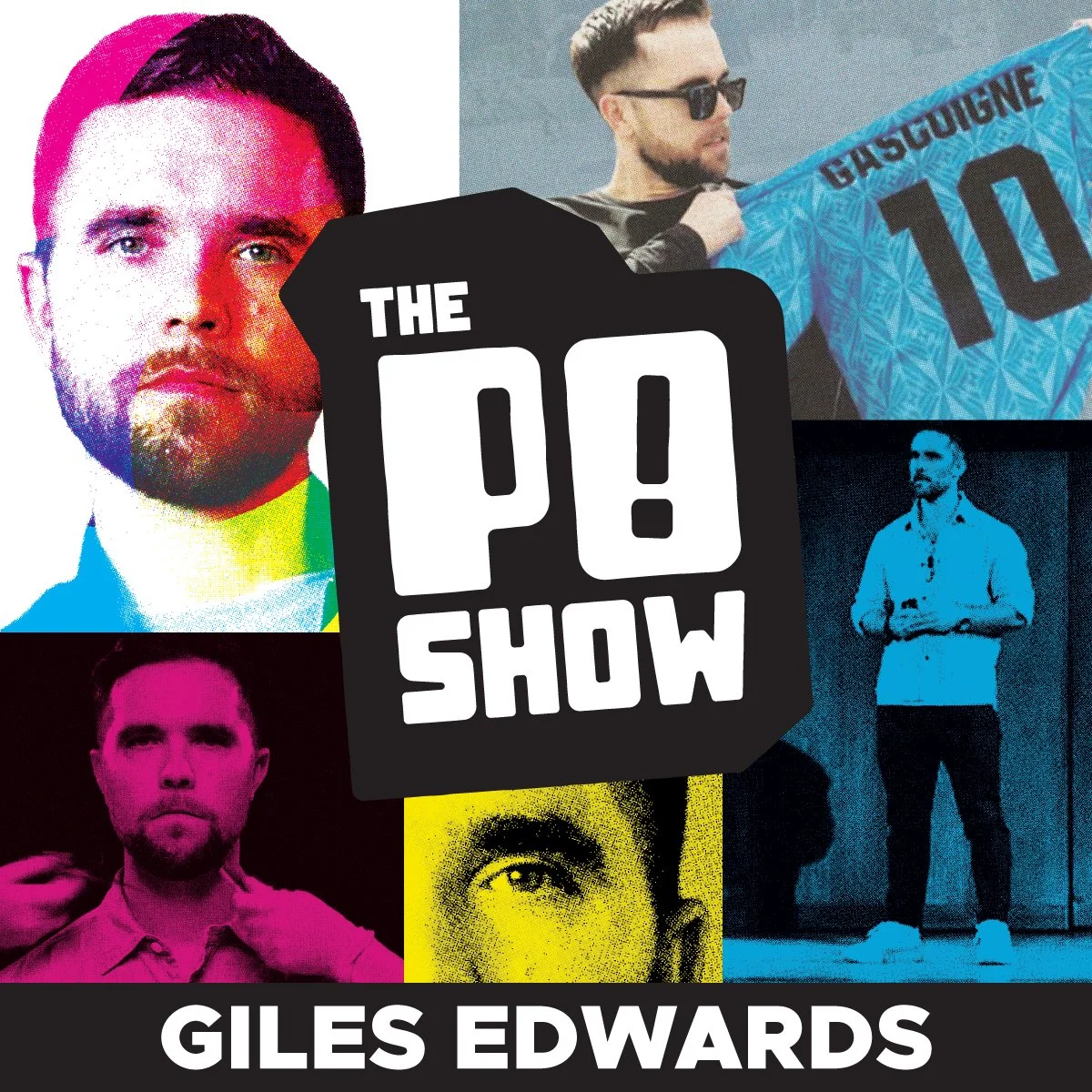
Episode #10 · November 4, 2026Haha as a Truth Delivery System
Giles Edwards has the last few decades arguing that dullness isn't just a creative failure, it's an exorbitant tax with real money attached to it. The Co-Founder & Creative Director of ...Gasp! makes the case that humor isn't a risk you take when the brief allows it, it's a strategy you deploy to connect with audiences.
Humor is like sneaking medicine onto pizza. It’s a shortcut to trust. And boring, quietly, is the most expensive decision a brand makes.
Worth a look
Some of the goodies mentioned, just one click away.Giles's Work
"Funny Business" — Giles's column in Marketing Week
Isolated Talks Speakers Mentioned
A free-to-access series of talks from around the world.
Wiemer Snijders (a.k.a. "The Banana Guy")
Books
Delusions of Brandeur — Giles Edwards & Ryan Wallman
How Brands Blow — Giles Edwards & Ryan Wallman
Adele Writes an Ad — Giles Edwards & Andrew Bolton
How Brands Grow — Byron Sharp
Decoded: The Science Behind Why We Buy — Phil Barden
People & Thinkers Mentioned
Ryan Wallman — co-author, Delusions of Brandeur + How Brands Blow; copywriter & creative director
Andrew Bolton — co-author, Adele Writes an Ad
Byron Sharp — author, How Brands Grow; bought 100 copies of Adele Writes an Ad for a children's hospital
Dave Trott — "91% of ads aren't remembered," the indifference stat Giles builds The Dull Tax around; Isolated Talks speaker
Rory Sutherland — advertising as a signal; Isolated Talks speaker (also played air guitar on stage at a Gasp! event)
Phil Barden — author, Decoded; "no-brainer decisions"
Wiemer Snijders — "The Banana Guy"; marketing effectiveness; Isolated Talks speaker; Giles first saw him speak at a Colin Lewis event in Ireland
Lenny Bruce — "Medicine on a pizza” & humor as a delivery mechanism for conversations people won't otherwise have
Hedwig von Restorff — German psychologist behind the Von Restorff Effect (a.k.a. the isolation effect)
Mark Denton — creative director, referenced as a benchmark for fun + skilled creative work
Dave Harland — copywriter, co-founder Copy or Die, first person Giles gave the "be more party cannon" brief to
Mel Barfield – copywriter, Managing Partner at Copy or Die, podcast host at Indie Business Club
Glenn Fisher — copywriter; Isolated Talks co-founder
Jake Sanders — contributor to our Questions from Friends segment
Colin Lewis — hosted event in Ireland where Giles first encountered Wiemer Snijders
2 Ways to Listen, Wherever You Already Hit Play
The Brand BuilderFrom teaching prepositions to a 75-year-old in Indonesia without speaking a word of the language, to building a podcast that’s become required listening for the UK marketing industry, Giles’s whole career is a master class in finding the fastest distance between two people. This one’s the full story.

The PO NotesThe Von Restorff effect explained in thirty seconds, the dull tax your CFO is paying without knowing it, and the chess-with-a-pigeon rule for knowing when to walk away from a client. If you’ve only got fifteen minutes, start here.If you’ve only got fifteen minutes, start here.
Show Transcript
The Introduction PHILLIP:
In 2008, during the middle of a global recession, today's guest launched a marketing agency with a manifesto — six things the industry was getting wrong and a declaration of how they'd do it differently. Seventeen years later, it still lives on their website. Well, because they were right.
He's the founder and creative director of Gasp, a UK-based independent agency with a reputation for making marketing that's creatively memorable and boringly effective. He's built more IP than most agencies build client work — like Call to Action, a UK Top 3 and US Top 50 marketing podcast. Published books like Delusions of Brandur, How Brands Blow, and even a children's book titled Adele Writes an Ad. He launched Isolated Talks during the pandemic, writes a column about funny business for Marketing Week, and is a keynote speaker on topics of proper marketing — including taking the stage just this week at the Festival of Marketing in London.
He's the biggest Tottenham Hotspur fan I know. Come on, you Spurs. And whether you call it football or soccer, you'll understand why we've slotted him in at number 10. He's a man who genuinely believes comedy is one of the most underused tools in the marketing world — I'm looking at you, B2B. Giles Edwards, welcome to the PO Show.
GILES:
Thank you, buddy. That was the loveliest intro I've ever had, and it's entirely undeserved.
PHILLIP:
Well, it was three times longer at eleven o'clock last night. So you're lucky you didn't have to sit and listen to more. I love to write about guests — it just gets a little rambly. We'll tuck some more of those good bits about Giles into the conversation.
Call to Action & the Dream Guest PHILLIP:
So speaking of which — first of all, Call to Action has been my favorite podcast for ages. Not blowing smoke. You do an amazing job with research. It's obvious, now that I've started doing this, holy shit — how much goes into this. Really getting into the host, being selective about who gets to appear on the pod, keeping the chat going. You've chatted with some of the best and brightest in marketing and started to expand beyond — including focusing on comedians so you can bring funny business to the table. Very on brand for Gasp. But is there anyone you've yet to interview? Who would be your dream guest?
GILES:
Well, there's probably a few, and my answer would change daily. But there are two people we have almost managed to get on the show. One is Louis Theroux, who probably needs no introduction. But I would much rather that Mark Rylance had said yes to us. We approached Mark probably three or four years ago, when we were maybe a hundred episodes deep, and received quite appropriately the politest "go fuck yourself" I've ever had in my life. I couldn't even be upset — it was such a lovely, well-articulated no. And it just made me want to speak to him even more.
He's a thespian. He's spent most of his life performing Shakespeare, which isn't at all an interest of mine. But I remember somebody talking about Mark Rylance being the best actor in the world about twenty years ago, and I had never heard his name. So I went on a little hunt and subsequently saw him perform two different lead roles in two different Shakespeare plays, and he somehow just pulled me into it in a way that nothing has ever managed to do before. You're listening to him and the way he performs is just so accessible. I've always struggled with Shakespeare — as a kid we studied it, and it's really hard to decipher. But when you see him perform, it's like you're watching something in plain English. He's just an absolute legend.
Steven Spielberg apparently used to hate him because he said no to Spielberg dozens of times throughout his career. And then in later years he's agreed to take on all these big movie roles. I just think there's something magical about him and the way he communicates. I wanted to try and steal a bit of his soul and learn anything I could from him. But as I say, he has so far eluded us.
PHILLIP:
Well, it sounds like we need to learn how to say no from him — which is something a lot of us have a hard time doing.
GILES:
Yeah. There's nothing wrong with saying no. We've had nos before, but there are ways of doing it right. We'll probably come onto context and the ways people communicate, but there was just something so lovely and effervescent about his language in saying no. You could read it and see that beneath the lovely sheen, there was a big "go fuck yourself." But if you don't ask, you don't get. We've asked lots of people who would probably — we call them stalker-esque. We have adopted that technique with people, obviously with love and respect. And it has worked. We have ground people down. But after a while, you feel like you don't want to be that pest.
Something People May Not Know PHILLIP:
Got it. So tell me something about yourself that you feel everyone should know, but maybe even the people close to you may not know.
GILES:
I knew you were going to ask this, and to be honest I've really struggled to think of an answer. I'm a nice person — people don't really get that. People don't believe that, especially people close to me and people that work with or for me. I've got such a varied past life, I'm not sure there's anything we can speak to, but...
PHILLIP:
Well, your dad was an international rugby player, right? Surely that put some pressure on you and your siblings for performance, and carried over into a lot of things.
GILES:
For sure. He's, in his own words, the lesser-known Edwards in the history of Welsh rugby. Right at the pinnacle, of course, is a chap called Gareth Edwards, who rugby fans will instantly know. He's also the reason why one of my brothers is called Gareth Edwards — they played together at Cardiff. But my dad did represent Wales a couple of times.
He also lost all of his teeth at eighteen, thanks to a boot in the mouth. And I don't think dentists were quite as skilled back then. So he's had false teeth since he was eighteen. That deterred me from playing rugby. We were effectively force-fed sport from a very young age — me and my four siblings. A few of us had relative success in sports, never quite professional. Two of my brothers were incredible rugby players. I was a bit of what you might call a flannel.
PHILLIP:
A flannel? I'm not familiar with that label.
GILES:
Just a pansy. A complete weakling. When I went to senior school, my brother Gareth — phenomenal rugby player — already had a reputation. So all the sports teachers, when they found out I was his younger brother, threw me straight into the first team. And then just watched me get absolutely battered. I didn't have anywhere near as much fight as my brother.
Weirdly, he's gone on to become a publican. He worked in the pub trade for years in England. And you get people who were born with what we call farm strength — the kids who grew up on farms in the UK just have this insane strength. He and one of my other brothers have that. I don't think he's ever really been to a gym in his life, but he has this immense strength. I'm always envious of it. I just didn't get that part of the gene pool.
PHILLIP:
Well, that's not what we ask of our number ten, Giles. You don't have to be the strongest on the pitch.
GILES:
Precisely. Different skill entirely. Thank you for rescuing me.
Three Favourite Brands PHILLIP:
So last of the appetizers — what are three of your favourite brands? And if you can remember, when did you first hear about them and when did you last?
GILES:
I find this question quite challenging to answer, and I shouldn't, because brand is my world. But as a consumer I'm loyal to very few brands. The brands I'm going to mention are actually more people. The first one I'm going to plug is Tilly's Vegas — an independent jewellery brand in the UK. The only reason I'm going to mention Tilly is because she is the older sister of an ex-girlfriend of mine. I was in and around her and her family when she started this business. It literally started from her going to Bali, buying some silver, and very much grassroots-level trading at jewellery fairs in and around London — building a brand from nothing.
She had huge aspirations back then, and this must be going back about twenty-five years. I think it was only last week she was named in the Sunday Times 100 fastest-growing brands in the UK, because she's had the most immense steady success — but also significant and rapid success in the last few years. She's done it by just being her own really uniquely stylish, interesting, aesthetically amazing person. It's been really lovely watching from the sidelines as this brand — that you once knew as just someone talking about wanting to start a business — suddenly pops up in Selfridges, in Harrods. Harry Styles wearing her jewellery. We're talking global. And she's just stayed herself. She's never claimed to be anything she isn't.
The other two — I've always been really into pubs. Not a cry for help. My dad, as we've now covered, was an ex-Welsh rugby player who spent a lot of time in pubs. So I spent a lot of time in pubs growing up. Some would call it neglect, but I think I was given money to play football games on the arcade while he was having a few beers at the bar. And my brother subsequently got into the pub trade.
An incredible chap called Gareth Walters — I first came across him because he was, and remains, a fan of Call to Action. We've been out for lunch a few times, and the only consistent thing about where we meet is that it's always places or pubs run by Oisin Rogers. He's an Irish publican with a habit of taking pubs over and either restoring success or bringing it. His most recent venture is the Devonshire in Soho. I think he currently holds the Guinness World Record for the most pints of Guinness sold in a week — 500,000 plus, I think. Don't quote me on that number.
The first time I met him, I turned up a little bit early. I was stood at the bar feeling quite intimidated — it was a really quite fancy establishment in Mayfair, and I felt slightly underdressed. And suddenly this voice from the other side of the bar just said, really casually, "How you doing, bud?" It was Oisin. He was so warm and welcoming. He has this habit of taking over places and putting his soul into them. Every member of staff is like a little version of him. He knows something about hospitality that too few do.
PHILLIP:
We could have a whole podcast about what you just said. You can run ads, you can put corporate platitudes on the wall in the break room. But if the people at the bar aren't following the same cultural standards that the vision holder presents, you're not going to feel it. You're not going to build affinity for that brand. And it sounds like he's done it not just at one pub, not just in one city — which is why it's leading to business success.
GILES:
Yeah, yeah. And then a third — Hans Brinker. It's a hostel based in Amsterdam, and I use ads their agency created probably fifteen years ago. Sadly that agency went under recently, which is really sad, because independent agencies often do some of the best work around, and yet it's still not sufficient for them to sustain commercial success.
But the positioning was wonderful because it was completely on point. It was finding ways to articulate what Hans Brinker is — and specifically what it isn't. They ran headlines like "Free WiFi with next door's password" and "Now with a bed in every room." Ridiculously playful, funny. And obviously I'm a sucker for humour. So they were just so appropriate for the level of hotel it was. The art direction was crude — two-tone bright colour, black copy, very much slapstick in how they'd been put together. A great example of positioning in a really authentic way, without trying to be overly grandiose about what is effectively a basic product at a basic price.
PHILLIP:
Love it. And going back to something you said at the top of this — I don't know if I've said this out loud before, but there are so many people out there saying "build brand love, everyone loves brands," et cetera. The reason I share that question with marketers is: okay, what do you actually love? And it's hard. I really like the word affinity. There's stuff I really want to represent myself. I really love my Adidas. But I have nine different brands of trainers. It doesn't mean I'm just going to buy Adidas. What we want to do is remind ourselves we have to make something that cuts through. Even poke fun at ourselves a little bit to get attention and stay memorable.
GILES:
Brand love is mostly nonsense. Of course there'll be exceptions — maybe categories associated with something emotive in your life, like products for a newborn. But as you say, that doesn't mean you love the brand. There's a lovely image we often use to make this point. It's just a closeup of someone's foot under a table wearing Nike trainers and Adidas socks. That's just more reflective of the truth.
Teaching in Indonesia PHILLIP:
Getting into the meat of the conversation. Before agency life, you started as a teacher in Indonesia — without being able to speak the language. Talk about what you learned about communication during that chapter of life.
GILES:
It was a cameo of life. It wasn't really a path I wanted to follow. Post-university, I had the post-uni blues — the panic of real life beginning. I was feeling a little disillusioned. I don't think there's any shame in admitting that. The pressure of needing to know where you want to commit your career to is a lot of pressure, and I think it's unrealistic.
I happened to live next door to the headmistress of a school for autistic children who were struggling for staff — mostly male staff. Primary schools in the UK are predominantly female-staffed, and the more senior children at this school could get quite physical. They really needed some male support. So she asked if I'd go in just as a teaching assistant.
I spent a year as a teaching assistant. The money was awful. It was an amazing job. So rewarding. I met some of the best people I've ever met in my life — and I'm talking entirely about the children. Some of the kids I worked with were just the most interesting, fascinating, brilliant people. And it made me think: I've really enjoyed that. I still wanted to do something in design, in the commercial or advertising world, because that was my dad's world post-rugby.
I ended up going to do a three-month course in teaching English abroad. At the end of the course, there was an opportunity to go and work in Indonesia. Myself and someone I met on the course were both offered a role. I like to think I'm less ignorant now than I was then, but I didn't really know anything about Indonesia. We agreed to our contracts about four weeks prior to the infamous tsunami hitting, so we actually arrived in the aftermath of that disaster.
The school we worked at would mandate that the teachers didn't know how to speak any of the local language. There's lots of evidence to suggest that full exposure to a language is the most effective way to learn it. As part of our twelve-week course, we spent a week learning Serbo-Croat — just three or four hours a day for five days — so we could experience what it was like to learn in that full-exposure way. And it teaches you so much. It probably teaches you how much of communication isn't verbal. For me, it certainly taught me about humour, because I wasn't the best teacher.
But I quickly became one of the most popular teachers because I was an absolute idiot and a very immature, pathetic human being. So I would focus more on trying to make the class laugh. I say children — they weren't children. My oldest student was seventy-five. We taught everyone at every stage of their life. But the reason you're bringing this up — I had forgotten how I was meant to teach preposition of place, which is how you describe where an object is in relation to another. The mug is on the table, et cetera. And I completely panicked. So I started playing a game of "Where is the teacher?" Mr. Giles was on the chair. Mr. Giles was next to the door. Mr. Giles was under the table. I was definitely having a breakdown of sorts. And yet I had the full engagement of the whole class. Not only were they learning — they were laughing. And because they were laughing, they were enjoying it. They were attentive. They remembered.
It taught me something about communication. You and I have talked about that lovely quote about laughter being the shortest distance between two people. From a comms perspective, I think it's certainly true. It unites people. And it genuinely gives you a common way of communicating with someone. You can make someone laugh who doesn't understand a word of your language. And if you do that, something happens between the two people that is just so innately human and wonderful. Capitalising on that proved really helpful for me to wing it as a teacher with absolutely no teaching credibility.
Launching Gasp in a Recession PHILLIP:
You've carried so much of that through — humour being part of strategy. You launched Gasp in 2009, right in the teeth of a global recession, carrying that fistful of brand manifesto. Do you mind if I read the titles of the six fails and then get you to speak to those?
Indifference leads to invisibility. Too much time is spent solving the wrong problem. Belief that the channel itself is the answer. Falling into the Me Too trap. Content is not king. Not delegating — you can't have all the answers.
Quick note: this was written well before the Me Too movement. That has nothing to do with that. But those six — anyone who's worked in an agency can relate to every one of them, or may have tried to sell one of those lines to their clients in the past.
GILES:
I think it's important for everyone to have a point of view. We called it our six fails — six big, common mistakes we saw in our world of marketing. We thought if we could address those in our launch, it gives us a suite of talking points with clients about where we could perhaps improve the effectiveness of their efforts. I'm happy to unpack any of them. We don't necessarily refer to them as much as we did in the early years, but hearing them back now, they remain just as relevant.
Content is not king — I think we wrote that at a time where WordPress-type CMS systems were immediately accessible. There was a year or two where more websites were published than had ever been published in the history of humanity. More photos were taken in twelve months than had ever been taken. People were going berserk about producing content. And it seemed to disguise what sounds so obvious now: context is king, not content.
I think it was Tom Goodwin who said the trouble with a lot of client-agency relationships is that ninety-nine percent of the time you're producing things as a result of the relationship. Something has to come out of it. And actually a lot of clients would be far better served having a marketing effectiveness expert come in and say: stop doing this thing, stop spending money here. Take away from their collective output. But it's hard for that to be your product.
PHILLIP:
Yeah. You know who would really like to hear that is the CFO, or anyone in operations. It's not about taking the budget away and handing it to another department — it's about moving it to the right places. Yeah.
GILES:
You want focus. You're not trying to make departments redundant. You just want focus. And so in taking something away, perhaps you then amplify and double down on something else you are doing. Indifference leading to invisibility, though — I think it's sadly much easier for an organisation to produce dull, boring work that doesn't move the needle and doesn't even get attention. It's very easy to produce that type of work because it's very easy to defend it. There's very rarely an emergency board meeting because they've produced some dull ads. Whereas if you produce something someone hates, you're going to get a call. But the difference is — if someone hates an ad, they have to have at least seen it and engaged with it. And depending on how someone has chosen to be offended, it's likely more effective than the dull boring ads that preceded it.
There's a quote — at least a million and twelve people have re-quoted over the last decade — that I think originates from Dave Trott. He talks in a book about how we are on average exposed to about ten thousand brand-related things per day. Ninety-one percent of them aren't remembered. Of the remaining nine percent, something like six percent are liked and three percent are hated. The indifference point is that being part of the three percent isn't the problem. The only problem is being part of that ninety-one percent that people don't notice or remember. That's the area of indifference we mean when we talk to clients.
PHILLIP:
And Gasp has put a flag in the sand on humour to try and stay out of that ninety-one percent. You call it funny business. Talk about how humour can be part of that strategy — especially for B2B.
Humour as Strategy GILES:
Humour is just massively underused. In my first article on funny business, I shared the classroom anecdote I just talked you through, and quoted the late great US comedian Lenny Bruce. Lenny Bruce was highly political and would use humour as a delivery mechanism. It was a way of having conversations that people would otherwise not be comfortable having. And he was the one who I believe first said it's like sneaking medicine onto pizza. Because if you make people laugh first, their defences drop. And all of a sudden you've got them in a conversation they would otherwise not be open to.
A lot of what we're trying to do is win the attention of someone who is entirely indifferent to our ads, doesn't want to be interrupted, has far more important things going on in their day — whether it's watching Tottenham lose another game of football or whatever it might be. So using humour just allows people to drop their defence and engage. And I think B2B has a massive confidence problem. Humour just solves so many of them.
B2B marketers often forget they're still marketing to people. I know there's that hideous acronym H2H — humans to humans — that tends to do the rounds. A little bit of sick comes up when I use it, but the point is valid. The difference in B2B is that you have a selection of stakeholders — a sign-off process, procurement, a CFO who couldn't give a shit about marketing, but if he's heard of your brand, it helps. We're still dealing with people. And I think humour makes ideas stick in a way that straightforward communication doesn't.
Humour has the ability to surprise. It's been on the decline in our industry for years — well-documented studies by Kantar show that use of humour has dropped significantly in the last couple of decades. So using humour gives you another opportunity to stand out and be distinct. If you're distinct, you're more likely to be remembered.
Just the Von Restorff principle — we always share that famous Party Cannon poster, and it's always been part of our briefs. In its crudest visual format, you're demonstrating how important it is to stand out against the category norm. And when we make that point, we're clear to say: we don't just mean visually, we mean it in any manner possible. If no one else is using humour and you are, that gives you the opportunity to be distinct. So humour is massively underused. I don't think humour is a strategy necessarily, but finding something true and building something from it that is amusing will help you become memorable. Humour allows you to dramatise truths in a really playful way.
PHILLIP:
Dramatise truths. I like that. I want to go back to Party Cannon for just a moment. For the people who haven't seen it — think of a festival poster with a bunch of heavy metal logos. All the logos look the same. Black backgrounds, white logos, you can't read any of the type, it's all dangerous and death-looking. And then there's this nice colourful Party Cannon logo that looks like balloons. Completely out of the norm.
What's really important to take away from that is: out of, let's say, forty logos there, the Party Cannon logo isn't one-fortieth of the attention. It's fifty percent of the attention. Because there's Party Cannon and there's everyone else. Just by standing out from what everyone else is doing, you're taking — or you have the opportunity to get — a much larger percentage of the memory, the attention, the shareability.
GILES:
"Be more Party Cannon" has always been a line in our briefs since we started. I remember first talking to Dave Harland and giving him a copy brief. It was "be more Party Cannon." He was like, what the fuck do you mean? So we talked him through it.
The theory behind it, if you want to get all scientific, is called the Von Restorff effect. Von Restorff was a German psychologist from the nineteenth century. She would study how different stimuli — specifically having something that was non-homogeneous, standing out from the rest of the group — affected how much more likely it was to be not only remembered but recalled at a later date.
You can do it quite trivially in a room full of people. If I said: Philip, I want you to remember as many of these as possible — twelve, nine, twenty-three, giraffe, fourteen — you're going to remember giraffe. Because the brain is a pattern-making machine. When you receive information, you're desperate to put it in a box that already exists. And if you just have something that differs significantly from the others, you're going to remember it. It stands on its own right.
Phil Barden talks about no-brainer decisions — the things where you're categorising these things into the same group. If anyone asks you what does that meat taste like and you've just tried kangaroo in Australia, you're going to say it tastes like chicken. It tastes nothing like chicken, but that's just where your brain goes. That's how patterns are stored and recalled in the human brain.
And it's so obvious. It almost seems absurd to give it any air time. And yet you choose any particular category — certainly across B2B — and they're all using the same stock photos of suspiciously delighted executives staring at a laptop screen. Why are you using the same images as everyone else, if you know the whole Party Cannon thing is true? It's just one of those painful points that needs to be really stressed when you're producing work for clients in that space.
PHILLIP:
Well, now for anyone who's seen me facilitate, you know where the Party Cannon and Von Restorff came from. It came from Giles. Big fan.
GILES:
Well, we would have nicked it from someone else, mate. So there's no originality theft there at all.
The Gorilla Suit on a Moped PHILLIP:
I love the articles in Marketing Week. One of the funny bits was the guy in the gorilla costume on a scooter — I think he was teaching scooter safety or something like that. And I think I saw that show up in a slide during your Marketing Week presentation. How was the presentation at the Festival of Marketing? Can you tell everyone about the guy in the gorilla suit?
GILES:
So a couple of days ago, we gave a talk at the Festival of Marketing, which is Marketing Week's annual event. The chimp on a motorbike is a true story.
Almost thirty years ago, I went for my CBT — your compulsory basic training in the UK to legally ride a motorbike. I had visions of becoming the cool rider, Michael from Grease 2, which tells you more about my adolescence than I'm comfortable admitting. But the reality was far less glamorous. It was a handful of really nervous teenagers in a damp, drizzly business park. A Portacabin reception. All these teenagers waiting around trying to appear cooler than they felt. We stood around waiting for our instructor, and the office manager said, "He'll be here in a minute." And then, somewhere from the distance, tearing into the car park came this chimp on a moped. Not metaphorically — a guy in a full chimp costume with enormous rubber feet, a massive big grin, and fur flapping in the wind. "Here comes your instructor. It's his last day. I think you will all pass." And we all did pass.
What's so interesting about that story is not one of us questioned the chimp's ability to ride a motorbike. If anything, we thought he must be exceptionally good — because only someone completely confident in their ability would even consider turning up dressed like that. It was the most wonderfully absurd way to begin learning something that, if done badly, could kill you. And yet he arrived with so much credibility because he looked so ridiculous.
That's something B2B markers just misunderstand about humour. Because humour communicates confidence in a way that is so hard to replicate in any other way. B2B marketing often feels like someone's chasing you with a briefcase.
PHILLIP:
How was the audience? How did they receive it?
GILES:
Good. I think they were a bit surprised at first. But yeah, the point's valid. And it's just so misunderstood. We don't necessarily consider as much as we used to how much signalling goes around with communications.
Rory Sutherland will say advertising itself is a signal. Spending millions on TV ads says "we're expecting to be around long enough for this investment to pay back." Humans are so good at noticing signals that come across in communication, which aren't necessarily the intention of the communication.
The next slide I used to make that point is one of my favourites. It's a pig standing on top of a house made entirely of wolf skulls. And the caption reads: "The fourth little pig's house was made of wolf skulls. It wasn't very sturdy, but it sent a fucking message." The point being that the house is doing two jobs. One is obviously architectural, and a house made of wolf skulls isn't particularly sturdy. But the other is signalling. It's communicating. B2B marketing has the opposite problem — structurally it always looks fairly sound, it's in accordance with the messaging hierarchy, it looks like it's been approved by fourteen stakeholders and a brand governance portal. But it often signals that you are insecure. Whereas using humour demonstrates that you are so confident in your ability, you don't need to use that thirty-second ad telling people how serious you are.
Selling the Funny Idea Internally PHILLIP:
Making something that's brilliant is one thing. But selling it to an insecure client who has to sell it internally — that's a whole different skill. Can you talk to that audience about what it's like to sell a funny idea internally when they're nervous?
GILES:
I want to address the "we should just dress up as clowns" remark first. It's so dismissive of the work of really good humour and good comedy, as if anyone can dress up as a clown. If you dress up as a clown, mate, that's not going to work, obviously, because you're dressing up as a clown. That's not what we mean. Something as well-crafted as a really good piece of comedy takes so much intelligence. That's why not everybody can do it. And actually, I don't think everyone should be using humour. The last thing we need is everyone making bad jokes. The target is to do something relevant and truthful to your brand. It's not humour for the sake of humour.
In every instance we've done anything successful using humour, humour can be broken down into so many subsets. Not all wit is dressed as a clown. Sometimes it's really intelligent, really subtle wit. The only consistent thing about wit and humour is that it involves the audience in a way that is essential for the point to be made. If you look at old Economist ads, they are nothing without the reader getting it. We talk about "the get" — the punchline, whatever you want to call it. As soon as there's a get, you're not communicating at someone; the audience becomes an essential participant. Without them, it doesn't land. They need to close the loop. That's really hard to do.
In terms of how you defend it — sometimes just frame it the other way and say: what's the risk of not doing it? Talk about the cost of being dull. What's the cost of being boring? What's the cost of people not enjoying our ads? What's the cost of it not being memorable? If you're talking to a CFO, you can position it as a dull tax. "We could carry on doing these ads with generic photos, this category-norm aesthetic and tone, but you do know we'll have to spend thirty percent more than we would if we used humour." All of a sudden they don't want to be doing that. They don't know they're paying a dull tax, but they are. To replicate the effectiveness of a humorous ad — assuming the humour isn't just trivial and it's based on a truth — the cost difference is significant. That's the commercial truth.
PHILLIP:
I've used the phrase "boring is expensive." But I love quantifying it with numbers. We're going to spend thirty percent more to get someone to even halfway pay attention. Nicely done.
GILES:
Boring is so expensive. And it dies quietly. No one is bringing flowers. The other beauty with humour is that humans are so sociable, and humour is such a collective experience. We can't help but retell jokes. We can't help but share. Whereas you're never going to share some B2B SaaS software's new subscription pricing. But if it's presented in a way that is humorous and funny, it becomes a conversation starter. It spreads. Have you seen that ad by B2B tech company X? Yeah. I saw. What does it mean? We underestimate the ability for humour to filter — via osmosis, whatever you want to call it — in a way that is truly effective.
There's research published in Harvard Business Review, sourced from Bain & Co, that you very kindly brought to my attention in one of my Marketing Week articles. I think if you do the math, it's about eighty-one percent of B2B buyers ultimately don't buy from a brand they hadn't previously heard of. So actually being heard of and being known is arguably your biggest objective. You're more likely to be known if someone enjoys sharing or retelling your ads. I would love to see a business case from the CFO about why they're not using humour.
Gasp Work: The Golf Club, The Air Guitars PHILLIP:
Can you give me some examples of Gasp work where humour did the heavy lifting?
GILES:
Happily. One of the very first jobs we did — probably year one or two of Gasp — was witty, but again, this demonstrates how wit doesn't always look like a clown. We were working with a fairly up-and-coming golf club in the UK. When we talk golf in the UK, there are close to sixty golf clubs in the county alone. You get your Champions League clubs that have been established for decades. This was more of a category-B challenger. One of its advantages was that it was placed right on the M3 — one of the motorways in the UK, on a particular junction. So accessibility was particularly easy.
Historically, the golf club had only targeted people within a ten to fifteen-mile radius. So they'd literally just draw a circle and do local ads, leaflet drops, outdoor — whatever. Our point to them was: you're right by the motorway. So let's time a fifteen-minute journey from someone who lives fifteen miles away in a little rural village, still half an hour drive on the archaic back roads. Then let's see how far we can get east and west in thirty minutes on the motorway. All of a sudden you're talking to people as far west as Southampton and as far east as Southwest London.
And we made use of a golf pun — it's a short drive to the golf club. So we pitched that we would leave branded golf balls in the gardens of all these houses up and down the motorway, just to demonstrate the golf club is so close, someone must have hit that ball into your garden. That was one of our first really witty campaigns. The truth is the client thought we were batshit crazy and didn't want to pay for it. I stewed on it for weeks. In the end I went back and said: look, we're going to do the campaign. You don't have to pay us unless it works. They said all right, fine. It worked. We got paid. The rest is history.
More recently, we gave away free air guitars at Nudstock, one of Ogilvy's events. We had these big boxes that said "Caution: contains heavy rock." We were walking around with empty boxes, pretending they're really heavy, giving out air guitars. Genuinely absurd, fun, playful — and it made the point that our client needed to land. The client is a background music provider into retail and hospitality venues, but their system is famously easy to implement versus the competitor set. So "easy music" was all we wanted to land. And there's no easier, more accessible form of music than air guitar. It worked because it was fitting, and people loved it and remembered it. We had Rory Sutherland on stage jamming with an air guitar. Humour takes different forms. If you can find something based on a truth, you're in a good starting point.
The Trust Agreement PHILLIP:
Let's talk about the trust agreement you wrote — your Gasp version of the famous Avis car rental agreement by DDB. I believe it's titled the Trusted Partners Manifesto. Every agency — honestly, any consultant who's had to deal with clients — has felt the pain those eight points are trying to solve. Can you talk about how those came to life and how you're using them?
GILES:
We wanted to celebrate the spirit that agreement was built on. If people haven't seen the original, I do urge them to Google the Avis DDB agreement. Interestingly, despite me assuming it had come from the agency, it was actually the client who drafted that agreement for DDB. The CEO of Avis decided to put it in place because he thought it would get the best work out of DDB. Which subsequently it did.
The agreement effectively manages expectations for both client and agency — not just who's doing what, but who is trusting who with which part of the relationship. I mentioned earlier there's a bit of a confidence crisis in marketing — both brand side and agency side. We need to understand and accept that if a client comes to an agency, it's because they don't know the answer and they can't do it themselves. So there has to be a role for agencies that isn't always so subservient. I think over the years, because of this confidence crisis, agencies have become subservient. And I think they only have themselves to blame for that.
So this agreement is basically just an updated version of the Avis DDB agreement. It says to a client: this is how we're going to work. If we communicate something objectively untrue about your product, of course we will change it. However, the idea we recommend is the idea we're going to run. I've probably made that sound arrogant, but it just says — and it's a line I've shared with you before — I don't need you to like the idea we're coming to you with. I just need you to trust us. Because if it doesn't work, you're not coming back to us anyway. But if you trust us and it doesn't work, fine. This is going to work. It allows you to have that conversation about faith and trust in your supplier. It can only build a fruitful relationship in the future, or end a disastrous relationship earlier.
PHILLIP:
I'm going to call out number eight on the list: "Tell us what you think, but trust us when we show you what will work." That one short sentence breaks down so many things. People are coming to you because something else isn't working. They're coming because they don't have those capabilities in-house. But it is still so difficult sometimes to get someone across the threshold to trust you. My partner at Comma Giant, Mara, wrote what she calls: it's not a three-strike rule. The first thing we bring to you is our idea. The second thing is our idea with your input. But the third thing is what you've told us you want. Because we're not going to do twelve or fifteen rounds of things that aren't going to work. And if you find yourself constantly in that number three spot, just doing what the client wants, you're going to be replaced — not just by another agency, but by AI.
GILES:
It's difficult when clients ask you to do things you disagree with. That's why it's so important. I have a law firm client where the head of marketing trusts us so much now that he'll forward us an idea and you can just say, "It's a shit idea." And he goes, "Okay, let's talk about it." You can just dismiss things. But that is rare. And it's something that has to be built over time.
We recently had a client so impressed that we only presented one route. They made a point of saying, "We can't believe you only presented one route." And we said: well, because there's only one answer. There's become this tendency for agencies to feel like they have to produce something the client likes, which is so rarely the stuff that will stand out and be remembered. So they end up doing: what about this? Or what about this idea? As soon as you say option two, you're saying you don't believe in option one. Otherwise there wouldn't be an option two. It's a really tricky balance — of course you want clients' input, but as far as I'm aware that happens at kickoff, and the rest of it should be coming from the agency.
PHILLIP:
I remember early days in my career where the agency insisted we had to present three ideas. And the third idea was always not the best idea — always something no one poured their heart into. And it seemed like fifty percent of the time that's what the client chose. It was the safest version.
GILES:
Yeah. It was the thing closest to what they'd been doing. Something closer to their safe harbour. That's shit.
The Fetish for the Future PHILLIP:
So let's talk about the fetish for the future. You describe marketers as part magpie, always distracted by shiny objects. How do you keep a team — not just clients, but your own team — focused and protect them from the constant noise, the latest software, the newest platforms? Especially holy shit, what AI is doing.
GILES:
That magpie quote is as true of me as of anyone. I think it's healthy to be distracted by shiny things to a point, as long as you have a healthy cynicism about the shiny thing. What I find running Gasp for close to two decades is: I'm yet to see a shiny thing replace anything that existed beforehand. I've seen plenty of shiny things turn up and become part of the toolkit. But the danger isn't exploring or tinkering about with new tools. It's assuming, expecting, or telling anyone that it's going to replace anything.
There's a lovely quote — I'm sure its origins are from Thinkbox, probably a decade or so ago with the emergence of digital tech and YouTube. They put out a statement that said "TV isn't dying. It's simply having babies." Just such a lovely way of articulating that just because this new thing exists and is seeing accelerated use in certain demographics, it doesn't mean it's replaced the original thing. It just means there's this new thing to consider, and it might be appropriate for something, and it also might not be appropriate.
New tools are awesome. I use AI. I'm interested in things. There's a tinker in all of us. You love tinkering with things — creative people especially love taking things apart and fiddling about. So give them a new toy and they're going to be excited. But you still love your old toys. Don't throw them out.
PHILLIP:
I love the Thinkbox quote. Because that could have been said in a boring way that anyone could have said, and you'd have remembered what it communicated but not who said it. But because of the line — "TV's not dying, it's having babies" — you actually remembered where it came from a decade later. What a lovely little hat-tip for comedy there.
One thing they do replace, unfortunately, is marketing budget. How much budget did we used to have for ad spend, or for bringing in resources to actually do research? And now software and SaaS has gobbled up eighty percent of the budget. We have a dashboard for everything, and fifty percent of that budget could have just been done in Excel and saved money for ad spend.
GILES:
The budget does still exist. It's just going elsewhere. So many clients buy into Meta's claim that they can just replace the agency with their optimised ad manager, which churns out complete dog shit and makes up its own impressions and engagement statistics to satisfy whoever's signing off on these budgets. It's really important that agencies help shine a light on the significant level of digital ad fraud that the likes of Meta get away with on a daily basis. It's effectively funding their whole operations. The fraudulent way they're able to take money from businesses is nothing short of disgraceful. And that's before we talk about the legality of it.
Ten or twenty years ago, they decided to change the definition of what an ad impression was. Historically it had always been a set amount of pixels visible for a set amount of time. And Facebook decided: no, we're going to change that definition to above zero pixels for above zero seconds. All of a sudden all of its engagement stats looked too good to be true. Because they were too good to be true.
And AI — I think my next Marketing Week article is going to be exploring AI and how terrible it is at being funny and using humour. That's not to say it's the only space AI can't replicate from humans, but I think there's a whole area we can really double down on to fight back the threat of AI.
Practising What You Preach: The IP PHILLIP:
Something that I see as a common thread through how I see Gasp and you — but also through what we've talked about today — is practising what you preach. Not just telling the marketing world one thing on LinkedIn and then going off and doing what everyone else is doing. But when it comes to making your own... I'm going to use the C word... content. When you're making a blog or a podcast, you're not just doing the thirty-minute "come look at my business" podcast that so many people are doing. You did Call to Action, you did Isolated Talks, you do all these books. You've given each bit your own soul. These are not just soulless things. Did you kind of fall into "we need to make more content," or what was driving creating all of these things?
GILES:
I've been called much worse C words, by the way. Content's fine. The reason or trigger for each of those examples is probably different.
For Call to Action — the longest-standing example of our own IP — the origins probably trace back to a train ride home from appearing on a Tottenham Hotspur podcast for the first time. I was held at a big agency holding company's HQ. I went expecting the recording facility to be really high end. And effectively what it was, was a few people sat around a table with an iPhone in the middle recording the conversation. And I remember thinking: I had no idea it was that easy and accessible to produce a podcast. At the time there weren't really any marketing or advertising podcasts around — with huge love and respect to Dave Burrows who had an absolutely brilliant advertising podcast then. So I thought we should create one.
Initially it was meant to be a bit of a Trojan horse, playing on people's vanities. I thought: if I ask the CMO of a client we want to win if I can interview him, his vanity is going to go through the roof and he'll say yes. And then all of a sudden I'm in a room with him. However, that never happened. Because what happened instead was the magpie kicked in and said: let's talk to Rory Sutherland. This guy's mind-blowingly interesting. Let's talk to Amy Kean — that was one of the early ones. Let's talk to Vicky Ross, let's talk to Richard Shotton. And all of a sudden I found I was just overindulging on interesting people to satisfy my stupidly over-curious magpie mind. And then, because I think it was so enjoyable and we put so much energy into it, it became, we were lucky — luck plays a huge role in everyone's success. We timed it really well. It was pre-pandemic, before podcasts just kind of exploded, and we built up a really significant following early on.
The original intention didn't match the actual reason why it continued, because we never once approached a potential client to do a podcast. But it was a great way of learning. You learn so much talking to people in our world. You're training your own brain. And you're amplifying the voices of people you enjoy and think should be heard by more people.
And then the books — I guess the intention is to do some good and have a positive effect on the industry. We crossed paths with Ryan Warman at a time when he was thinking about doing a book, and I was like: mate, it's done. Let's make this book. So we made Delusions of Brandur. And then the follow-up, How Brands Blow. I like to think I contributed more to that one. We've done five books now, and I'm pleased you mentioned the children's book, Adele Writes an Ad. I've said this before: the only person who adores that book, aside from myself and Andrew Bolton, is Mr. Byron Sharp, who ordered a hundred copies. But if anyone wants to buy a book off the back of this podcast, please buy Adele Writes an Ad. Because it's absolutely brilliant. And no one else thinks so.
PHILLIP:
Byron Sharp bought a hundred copies? What did he do with them?
GILES:
Well, that's a good question. He gets a lot of flack for the way he conducts himself on LinkedIn. He can be a spiky character. And I hope you hear this, Byron, because this is true: you're also a lovely man. Because he gets a lot of flack, and I think quite rightly so, it's also important to share a part of his character that I don't think people ever get to see. So he bought a hundred copies to donate to a local children's hospital at Christmas. How fucking cool is that? Byron Sharp isn't just spiky. He's also a lovely spiky man.
PHILLIP:
That's amazing. He's incredibly smart. And having tens of thousands, if not more, people claim to have read the book and misquote it constantly — that brings out a different human moment. It might come off as spiky, but like, once a week he was saying: "I didn't say that. You didn't read the book." That's also a human moment. Very cool.
Isolated Talks PHILLIP:
So let's come back to Isolated Talks. What was the idea that triggered that? Can you tell the audience who may not have heard about it what it was about and what it accomplished?
GILES:
I'll try. I tend to get emotional.
During the first weeks of the pandemic, one of the things that I don't think was given any air time in the UK was the mental health toll it was taking on people very early on. Quite rightly, the priority was on the physical risks associated with COVID. But you had people isolated not just from friends and family, but from their norm, their habits, everything that was recognisable in their life. Some people, like myself, were fortunate — isolated with family, in a nice house with a garden. But we're talking about people having to isolate with abusers, people who flat-shared and were on top of each other with people they weren't friends with. And it just seemed baffling that nothing else was happening.
We subsequently partnered with the Samaritans — a mental health charity in the UK whose phones were ringing off the hooks. Their operations rely heavily on volunteers, and they were struggling to help people. I was involved in certain marketing events that were understandably cancelled throughout the summer. And I remember thinking: there must be a way, given that there are going to be dozens, if not hundreds, of speakers who have prepared a talk for an event next month but are now not able to deliver it. There must be a way of getting these people to share their talks on a platform that can do some good.
So Isolated Talks — very much an intentional play on TED Talks, except it was TED Talks from isolation. I partnered with some friends: the marvellous copywriter Glenn Fisher, Tommy Mason, a great creative I worked with at the time, and Matt — I've forgotten your surname, but it's no reflection of how much I love you — who did all the web development. And we produced the platform, isolatedtalks.com.
I won't lie — I was hoping TED would come after us and threaten legal action. Because the idea was I would then say I would donate it to them. I even provoked them the night before launch, hoping they'd come after us. They never did. But essentially we started messaging people in our world to see if they would donate a talk from isolation. The talks were all freely available. We also promoted the Samaritans — not only encouraging people to speak to them, but encouraging people to donate their time to help with the phone lines.
It just took on a life of its own. We had talks from Dave Trott, Rory Sutherland, Amy Keene, Wiemer Snijders — just some absolutely wonderful people who delivered some wonderful talks. Most people ended up writing talks specifically for the moment, not just redelivering an existing one. The web traffic was insane. It became really popular. People started donating other facilities — one of our clients actually donated a radio station facility. So we started streaming the talks. We partnered with a few other organisations to have a freely available radio station playing music that a behavioural scientists-type company — the background music provider I mentioned earlier — knew had beneficial properties and effects on people's mental health.
And it helped my own mental health. It gave me something to focus on during the pandemic, which was particularly lovely.
PHILLIP:
That's fantastic. I didn't know about the radio show — that's really cool. I remember some of the talks getting quite emotional. You could feel people having things bottled up — and that would have landed so differently than if they were on a stage in front of eight hundred people.
GILES:
Yes. One of the most important examples of that is Wiemer Snijders — who most people probably know as the banana guy, a marketing effectiveness talker. Wonderful Wiemer. I had actually seen him deliver a talk a week earlier, before everything locked down, at Colin Lewis's event in Ireland. And I saw the talk live. Then I asked him to rerecord it and donate it to Isolated Talks, which he did. And the difference between the two talks was just amazing.
One of the things it really helped with was that it took away all the Instagram gloss and sheen we're exposed to every day — where you're constantly led to believe everyone lives these shiny, happy, beautifully aesthetic lives. And you saw people that you either knew personally, or recognised from the world of marketing — Dave Trott, Rory Sutherland — looking also just like yourself. Like a piece of shit at home with no filter. Desperately isolated. And it created this collective moment. I don't want to shy away from the real human effect of seeing other people stuck at home in a bedroom recording a video. I think that also did some good.
The Shoots — An Idea That Didn't Make It PHILLIP:
Of all these ideas you've had to promote Gasp — and again, it doesn't come off as promoting Gasp, which is why it's so good — have you ever had an internal project that you really wanted to work but eventually just had to kill?
GILES:
The most recent one is The Shoots, which had a life of its own for a bit and was very well received, but we just didn't have the collective momentum and resource available for it to really fly. I think something very similar to it will exist shortly — and that's not me being cynical. I just think the idea is solid.
It makes complete sense that we don't talk enough about marketing effectiveness — we have award shows that people will fairly defend. Cannes Lions apparently has never claimed to award effectiveness — it's just awarding creativity. The trouble I have with organisations like Cannes is that in the world I operate in, we should be trying harder to shine a light on real success stories when it comes to marketing effectiveness. Not just celebrating creativity for the sake of creativity. Because those pieces of work are often not real. They often didn't actually move the needle. They didn't create the change they needed to create. And even the Effies — the evidence that goes into winning them is often significantly flawed.
We were trying to take real, objective metrics and shine a light on work that was particularly effective across the board — big agencies, small agencies, different clients, different geographies. Because if your career is in its infancy and you can't help but learn from the work that gets awarded, and you assume it to be best in class and something you should aspire to create — when so much of that awarded work is either spec work, fictional, or not anywhere near as effective as it claims to be — it causes a problem. And that problem affects how seriously people take marketing.
Marketing struggles to argue its own significance. And it's just one of many causes why agencies struggle to communicate why they are worth more. If you're in a different sector looking in at the ad world, and you're seeing the type of stuff we get excited about awarding — and it wasn't even real, or it didn't really move the effectiveness needle — are you going to take us seriously? Probably not.
So The Shoots one hurt. Because I thought it would actually do some real good. The wider point is: it's important to practise what you preach. How can we expect a client to trust us if we haven't demonstrated we can do it for ourselves? You're asking a client to sign over money for you to do advertising for them, but you can't justify spending money to do advertising for yourself? That doesn't sit well.
Call to Action: Exclusively Comedians PHILLIP:
Last bit on IP. You've recently switched to almost exclusively talking to comedians for Call to Action. What are you learning from comedians that marketers either aren't teaching or can't teach?
GILES:
That's a question. I'm learning that comedians come in all shapes and sizes and personalities. It's easy to assume comedians are really extrovert — but in more instances they're not. They're quite introverted characters. Always very intelligent characters.
The reason we're only talking to comedians in part is because, as you'll know yourself, it's hard to carve out a niche in podcasting. What we found is that yes, we've had some relative success, and I know people have historically listened to us and enjoyed the show — yourself included, and you've been very kind to plug it. But because we're increasingly working and talking about funny business, it just made sense to move into a bit more of a niche territory.
And in some instances the comedians we've spoken to have reinforced what we talk about anyway — the fact that there's no topic you can't use comedy for. There's no category, nothing that's too serious where humour can't exist. They've helped us break down the significance of comedy. What is comedy? How do you write a joke? How do you construct a joke? The context of comedy.
The background of the comedians has been really interesting. There seems to be quite a big correlation between people being teachers and then becoming comedians. Greg Davies of Taskmaster and Inbetweeners fame was famously a teacher before he went into standup. We had a comedian on recently who took the same path.
And it's very easy to say no to the dozens of people a week who ask to come on the show if they're not comedians. We actually had Robson Canu recently ask to come on — an ex-Arsenal player, ex-Reading player, scored one of the best goals of my lifetime against Belgium for Wales. And I had to say no. For the right reasons. Well, he's a dirty Gooner, but no — I was very respectful. I just said: honestly, you don't need me. You can walk onto Sky Sports. You really don't need Call to Action.
Questions from Industry Friends PHILLIP:
Moving into a segment we call Questions from Industry Friends — the people so many of us met through Twitter and migrated to other accounts. The first question comes from Jake Sanders.
Jake says: most of us would say we're funny — rarely do we follow through whenever and wherever possible. There's a "commitment to the bit" angle of effective humour, and that's hard to translate for serious people. But Giles manages to do it in his writing, his ethos, and for B2B — where follow-through really matters. Executions in trade show bathrooms for retail consolidation being a case in point. Jake's question: we've all had a funny idea for marketing. What does it take to get it over the line and get a buying committee to commit to a bit?
GILES:
I love Jake. I'm delighted he fired a question in. It's difficult to not just repeat what I said earlier about talking about the risk of being boring and not standing out — positioning that as a kind of tax. You're taking people's time away from them. It might just be a short glance as they drive under a big piece of outdoor media they never signed off on. We talk about road safety, but we have no issues sticking shit ads in front of people's eyes when they need to have their eyes on the road. So at least make them interesting. At least make them smile.
We undervalue — and I don't know why — what it means to make someone smile or laugh or enjoy something. If you're going to stick your brand in front of someone's face, at least do it in a positive way. So I think the only thing you can do is talk about the cost of being boring and dull. I haven't cracked the way of doing that which works every time. Sometimes you'll find people you just don't win that argument with. And that's just human nature. That's an opportunity to qualify whether a relationship is going to be the right one for you, and walk away if it's not. Otherwise, to use a quote I love using — you're just playing chess with a pigeon. And no good comes from that.
Funnily enough, that example Jake gave about ads in bathrooms — we actually did that at the Festival of Marketing this week. The client we did that case study with was on stage, and we said: let's just take over the toilets at the Festival of Marketing as well. That was fun.
PHILLIP:
You have to give them the full pigeon quote, by the way.
GILES:
Okay. Arguing with an idiot is like playing chess with a pigeon. No matter how well you play, the pigeon is going to shit all over the board and strut about like it won anyway. It's not to say that anyone who disagrees with you is a pigeon. I just mean it's so easy to bang your head against a wall when you're in conversations with an individual or business that refuses to get it or just doesn't understand when you're trying to communicate about marketing effectiveness. If they're just not going to get it, then it's on you to just accept that and walk away, rather than continue to butt heads.
Some people feel like there should be magic words or a magic way of convincing people. And of course the right thing to do is try. We've talked a few ways about how that might happen. But ultimately, if you're talking to a business that just isn't going to do it — I've been in those conversations so many times, with everything from small independently owned businesses all the way to multinational brands who have brought us in because their ads are ineffective. And then when you try and recommend change, they say: yeah, but we liked our ads. You think: well, why are we here? Sometimes you've just got to accept it and step away.
PHILLIP:
Our second question comes from Mel Barfield. She says — I'll resist the urge to ask you about snacks and ask something useful instead. From Mel, who might I add has her own fantastic podcast called Indie Business Club. Her question: what lessons have you learned from running Call to Action that might help Phil grow the PO Show?
GILES:
So Mel and I have worked together quite a bit. And I remember having a very ranty conversation about snacks with her — I think we disagreed on everything from cheese to crisps. I will just say the virtues of cheesy string were discussed, which is heavily processed stretchy cheese, so deformed from its natural state that no Frenchman would ever acknowledge it had any cheese properties.
In terms of advice — I think you have to follow whichever direction you're genuinely interested in. Both with the types of people you talk to, the calibre of guests, the questions you ask, the way you manage the show, the length of the episodes, the frequency you release them. It has to be entirely in your own interest, whatever that might be.
After six or seven or eight years, I've already had most conversations around the effectiveness wheel. So I wasn't interested in having the same conversation again. The only advice I would give is: just make sure you're interested. Because if the host isn't interested in the conversation, the whole thing just falls flat.
PHILLIP:
That's so smart. If the host isn't interested, there's no way in hell the audience is going to have a good time and come back. Some of these pods are going to be quite long. I want someone to pause it because they need to do something else, but to make it interesting enough that they come back. And you also gave me some advice recently about oysters — would you share that quote with the audience?
GILES:
It's an accidental quote. We were talking about editing, and I suffered the same problem with Call to Action early on. I think the first ever episode with Richard Shotton, I probably spent the best part of a whole day editing it because I wanted every tut, every cough, every um to be removed. And I was very happy with what I was left with, but it probably sounds like the most unlikely conversation between two humans, because it was too slick and too perfect.
The metaphor I plucked out of nowhere: don't worry about all of those things, and see it as an oyster. Oysters are wonderful, great, beautiful, delicious things to lots of people, and they always come with a bit of grit. Just allow that grit to stay in the show and go from there. Because otherwise you just go round in circles stewing over tiny edits that don't matter. The listeners don't mind. As long as there's an oyster in there, it doesn't matter. Focus on that, not the grit.
PHILLIP:
Those human moments are what make it acceptable. If you can see the shine of the veneer, you don't trust what's underneath. I gave a podcast a try recently — it was way too slick. No space in the conversation, no pregnant pauses, no thinking. It sounded like it could have been done by AI. I gave it about twelve minutes and tried to come back later and couldn't. That was really good advice. But you can clearly see it out in the world if we pay the smallest bit of attention.
PHILLIP:
Our last question comes from Nick Ellis of Halo. So Nick, of course, can't give us a straight answer. When I asked for a question for you, Nick said: "You have really well-defined muscular arms. Does this mean it's difficult to get taken seriously in the world of marketing and commercial arts?" On a serious note — his actual question: how do you deal with seeing people you know are shit at marketing get away with being LinkedIn famous?
GILES:
Nicky, you beautiful bastard.
I don't know, but if anyone knows, they can tell me. It's infuriating at times. For my own mental health, I've increasingly had to detach LinkedIn from the real world of marketing. There's a people we know — one of my favourite people, who very recently guested with you — who is very good at doing the same. People who are celebrated on LinkedIn as marketing experts and the reality of who marketing experts are — often there is no correlation. Often the true marketing legends aren't even on LinkedIn.
The trouble is, LinkedIn has become — partly due to other social media's demise — a very active forum with a huge population of marketers. And there are a lot of inflated egos, and certainly a lot of people claiming to have discovered marketing truths that we've known for decades. But they're also very good at marketing themselves on this platform. I don't think fame necessarily correlates with authenticity in any walk of life anyway.
Does it wind me up? Beyond measure. I think there are people — Nick included — who should be put on the highest pedestal but aren't celebrated and don't enjoy the same level of fame. You just have to try to detach it and not take it too seriously. It's just another social media app. They've messed about with the algorithm so much recently that I don't even enjoy spending so much time there. It's become more of a necessary evil.
PHILLIP:
The Twitter days of old, when we really enjoyed just having a good banter. Some conversations have shifted to LinkedIn, but LinkedIn was trying to figure out how to get some of the Meta money or the TikTok audience and has lost so much of what used to be brilliant. I found myself openly being drawn in — I have to post every day, post at a certain time. And when it started feeling icky was probably two weeks or three weeks too late for it to actually appear icky. I stepped away in chunks, for months. It's really sad — a platform that could be so good, that could replace portfolio sites for designers or agencies. Instead it's becoming a place for pseudo-journalism of ideas instead of real thought-sharing.
Closing Question: What Would You Broadcast? PHILLIP:
Closing question. If you could communicate one thing to every channel in every city around the world simultaneously, what would that message be?
GILES:
The industry does itself up in knots far too easily. We overthink most of what we know to be true from a marketing effectiveness perspective. We're obsessively trying to overly-ladder how important products and things are in our clients' worlds, and we expect the audience to believe that this SaaS product is delivering world peace.
I think there's so much in our industry that causes stress and anxiety. I would appeal to everyone to just chill out a bit. Try and enjoy the work. Because I think my message to marketers is that we're actually really privileged to work in the space that we do. Increasingly you hear from people who are either later in their careers or have subsequently left the industry that it used to be a lot more fun. I don't doubt that. You only have to look at legends like Mark Denton's portfolio to understand that must have been the case — some of his work is just so beautiful and amazing and creative and fun. I just think we have a responsibility to be more fun and have more fun. Just enjoy what we do.
PHILLIP:
"Enjoy the work." That should be on a t-shirt and handed out to anyone getting into the industry. Because we do go through this bell curve. I came in as a designer, an art director. And then it was like I had to justify everything I did. So I went on this fifteen, twenty year journey of trying to be objective about everything I did, to the point where I looked behind me and realised I'd beaten all the fun and creativity out of what we'd been doing. But that's what made it so enticing for me to get in the industry in the first place. And it's also why I used to get invited into rooms that I didn't belong in — because we weren't doing the same thing as everyone else. For me to enjoy hopefully several more years of what I do, I have to get back to that. Watching more Mark Denton videos. That really cuts through the feed.
GILES:
And it's really contagious when you have fun with the work. I still remember the meeting with Starbright about the air guitars. Within about a minute we said: what about air guitars? Should we give out free air guitars? And the client just smiled and got so excited and said: we should definitely give out free air guitars. And I remember thinking: are you fucking serious? We can actually do this? My job is now to plan giving out free imaginary guitars that don't actually exist. How can we have fun with that? Do we attach them to emails? Do we say "free air guitar, please take one" on a poster?
I think creativity is the area that AI is probably going to come for last. And if used right, it's really commercially effective. It satisfies the client's brief. And it's just a wonderful break from the seriousness of the real world. We should think about our life and our world being an escape from work, but actually it's become so suffocating nowadays. There is so much to enjoy about the creativity, the fun, and the playfulness that we are allowed to get away with in our jobs. We just need to enjoy that a bit more and really lean into it.
PHILLIP:
Yeah, smart. I love it. I'm going to put a post-it on my monitor, along with the other post-its, as a reminder to ask myself: "Am I having fun?" And that can be a filter for making good decisions — not only for my career and our business, but also for our clients.
Giles, thank you so much for your time, man. It's good to see you. I think we have a few more days till the next Tottenham game, so enjoy your weekend, okay?
GILES:
Yeah. Until they fuck it up. Thank you, mate. I've really enjoyed this. I'm honoured to have been asked to come on. You're doing a great job and it's always good to see you.
PHILLIP:
Thanks, brother. Means more than you'll ever know. Good to see you, man. Cheers.
Keep It Coming