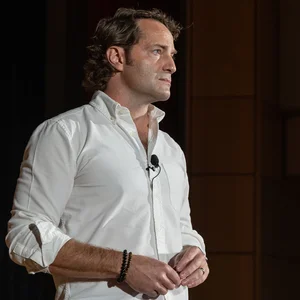
Founder & Chief Strategy Officer, Eximo Marketing · Host of Strategy Sessions

Episode #12 · September 18, 2026Get Off Your Backside, Talk to Customers
Andi Jarvis is an international speaker and MC who travels with a DeLorean, but his best advice hasn’t changed since the 1930s: the answers you’re paying for are sitting with the people already paying you.
Worth a look
Some of the goodies mentioned, just one click away.Andi’s Work
Strategy Sessions — Andi's podcast
What George's Marvellous Medicine Can Teach Us About Marketing — Andi's blog
LinkedIn — Andi Jarvis (Andi with an i)
Books & References Mentioned in the Episode
Hoodwinked: How Marketers Use the Same Tactics as Cults — Dr. Mara Einstein
Around the World in 80 Fights — Steve Bunce
George's Marvellous Medicine — Roald Dahl
Elmer Wheeler's five selling principles (sell the sizzle, not the steak)
Marketing Week Mini MBA in Marketing — Mark Ritson
Strategy in Praxis — JP Castlin's newsletter
Dave Trott — Andi's dream Strategy Sessions guest
2 Ways to Listen, Wherever You Already Hit Play
The Brand BuilderFrom a uni student who planned to teach PE, to marketing professional cricket, to Belfast agency life and the strategy rabbit hole that became Eximo, this is Andi's full story. Plus boxing, BBQ in December, a 1930s salesman, a DeLorean, and whether marketing behaves like a cult.

The PO NotesWhy "the customers don't care about that" is music to Andi's ears, how digital ads killed the thinking up front, and why most competitor analysis is opinion dressed up as fact. If you've only got fifteen minutes, start here.
Show Transcript
Intro Phillip Oakley: Today’s guest is a self-confessed strategy nerd with a degree in sports management, a former sports blogger, and a man with very specific opinions about when his walk-on music should start. In the summer of 2017, he founded Eximo Marketing, a strategy consultancy based in Belfast and Liverpool, with one obsession: dragging the voice of the customer back into the room where marketers make decisions. These days, he helps brands launch into new markets and brings his customer-chatting talents into the world of fractional CMO-ing.
Phillip Oakley: He’s also the host of Strategy Sessions, where he’s sat down with marketing heavyweights like Seth Godin, Rory Sutherland and April Dunford. He’s lectured from Cambridge to Liverpool to Finland, and taken the stage everywhere from Seattle to the Dominican Republic to Sofia. Off the clock, he’s a proud dad, a barbecue fanatic, a rugby league, boxing and cricket devotee, and a dealer of dad jokes who will happily talk about all of the above if you let him. And I intend to let him. Andi Jarvis, welcome to The PO Show!
Andi Jarvis: Thank you very much for having me, Phil. It is a delight to be here.
Phillip Oakley: Is it odd being on the other side? Andi, you’ve got a great podcast. You’ve had some really cool people. I love having you on the show, man.
Andi Jarvis: It’s a different gear, right? When you’re interviewing someone, you’re thinking, “Oh, this is interesting, let’s spin off that.” Whereas I’m stood here thinking, “What’s he gonna ask me next? What’s he gonna ask me next?” It’s terrifying. But no, I’m looking forward to it.
Before the Appetizers Phillip Oakley: Nice. So before we get into the appetizers, I want to ask: I didn’t know you were a boxing fan before I started doing this research. Do you have a favorite boxer?
Andi Jarvis: I do. Look, I love all boxing, mainly because I am absolutely terrified of boxing. I would love to give it a go, but the idea of standing in a very small space with someone who wants to hit you in the head is not for me. So I have mad respect for boxers and the work that they do. My favorite boxer at the minute is probably Anto Cacace. He’s a Belfast guy. I think he’s a world champion, and, probably by his own description, had a fairly middling early career. Then, probably five years ago, he went to Dubai to fight the world champion, kind of almost as a make-up-the-numbers guy. I think it was Cordina, and he beat him. He didn’t just beat him, he dismantled him. And since then he’s just fought champion after champion after champion and keeps winning and winning and winning.
Andi Jarvis: So he’s actually fighting — my two worlds collide, Belfast and Liverpool — he’s fighting Nick Ball, who’s another one of these little guys who bang, just absolutely hit. That’s coming up in December. It’s going to be a hell of a fight. Cacace versus Nick Ball. He’s just like an old-school warrior. You want to brawl? He’ll brawl. You want to box? He’ll box. He’s tough, he’s hard, and mate, he’s a great boxer to watch.
Phillip Oakley: Nice. Okay, well, I will get that on the calendar. Big Canelo fan on my side, but we’re also big fans of Katie Taylor in this household.
Andi Jarvis: What Katie Taylor has done for — I just said boxing, right? Not for women’s boxing, just for boxing generally. If you think of what has happened to the game over the last couple of years, women’s boxing particularly has gone from being a joke — I was reading a book about it recently, and as soon as 30 years ago, women’s boxing was often done topless and was a bit of a carnival sideshow — to Katie Taylor selling out Croke Park, the biggest stadium in Ireland, one of the biggest stadiums in Europe. And not selling it out of any sympathy or anything, selling it out because she’s Ireland’s biggest sports star. It is phenomenal, the journey, and she’s taken boxing on that journey. Almost single-handedly in Europe, she’s taken boxing on that journey. And I think Irish boxers generally, male and female, are following up behind her on the tide of that.
Andi Jarvis: It’s incredible to see. She’s retired, goes out a legend, a hero, and there’ll be a lot of people in the next 50 years who make millions and millions and millions boxing, and every one of them needs to tip their hat to Katie Taylor.
Phillip Oakley: Absolutely. Well, I had some things I wanted to say, but I want to ride out with that. That’s well said, sir. The other thing I learned about you in my research was being a barbecue fanatic. Is there a specific type of barbecue you’re a fan of?
Andi Jarvis: So this all comes down to, I think, just me being a bit weird, right? I got a barbecue sort of late-ish in life. I always lived in houses with not enough space to do it — little yards, very classically British terraced streets, that sort of thing. And I just fell in love with being outside and cooking. It was just great fun. But my birthday’s in January. It’s cold, it’s wet. It doesn’t rain all the time during the summer. So I then fell in love with barbecuing at weird times of year. Not when the sun’s out — as long as it’s not raining or windy, you can go outside and barbecue. So I’m often found in December going, “Let’s do the chicken and some lobster on the barbecue,” and stuff like that.
Andi Jarvis: I think if you are a proper barbecue aficionado and you came to my setup and you ate my food, you might be a little bit sniffy and go, “Have you seasoned this right? Did you get the temperature right?” I’m learning. I am learning. I’ve watched the videos of the guys in the States who have the big setup, like, “So we’ve seasoned this for 36 hours before we’ve put it on the grill.” And I think, “I didn’t think about this 36 hours ago.” But I love the commitment to the cause, and I’m getting better every year.
Phillip Oakley: Nice, man. Well, if you ever visit North Carolina — well, take that back. We’ve talked about it. You’re gonna visit again sometime next year, and we’ll get together and go find some barbecue. Barbecue anywhere in the UK versus barbecue in the United States has a slightly different meaning, which is another reason I wanted to bring it up. For the listeners, I live in North Carolina, and there’s a big argument here for Eastern style versus Western style, which really comes down to the sauce you want. So we’ll have to go find a place that’ll serve us both, and you can pick out whether you want Eastern style, Western style, or Texas style. They do it wrong, by the way.
Andi Jarvis: And look, Texas, yes. Listen, I’m a proud Brit, and I will defend the greatest country in the world against all slander at any chance. But if you want to tell me that barbecue’s done better in America, I’m not going to argue with you over that. I see the videos on YouTube. When I was at Disney in Florida, and you wander around the World, some of the barbecue there was just tremendous. So yeah, I am a fan of the way you guys do it.
The Appetizers Phillip Oakley: Nice. All right, so speaking of barbecue, let’s get into the appetizers. You’ve hosted Strategy Sessions for six seasons now. Congratulations, by the way. That’s a big deal, and I’m learning just how hard it is to be consistent for six months, much less six years. So well done. You’ve already landed Seth, Rory, April, loads of the best minds in the business — and not just talking heads, we’re talking practitioners who’ve actually been in the rooms. Is there anyone you’ve yet to interview who would be a dream guest of yours?
Andi Jarvis: Dave Trott. The man has said no to me not once, but twice. I feel jilted by him. If you don’t know him, Dave Trott is a legendary ad man who worked on ads in the seventies, eighties and nineties, in the peak heyday of advertising. And he’s got a great way of looking at things. He writes a column sometimes — I don’t know if he still does it — but he’s just a great thinker on the history of advertising. I love him. I emailed him and said, “Will you come on?” He said no. I emailed him again and said, “Will you come on?” And he said no. But one day I’ll get him on. Dave, if you’re listening, come on the Strategy Sessions.
Phillip Oakley: Yeah, we’ll have to just track him down the street with a microphone. That probably won’t go well either.
Andi Jarvis: No, but do you know what? I’m going to go after him. In fact, I might see if I can find where he lives and just doorstep him, turn up with a microphone. Dave, come on.
Phillip Oakley: That’s great. Can you tell me something about yourself that you feel everyone should know, but even the people close to you may not?
Andi Jarvis: It’s not work-related, and it almost goes back to where we started, but I love cooking. I’m just not very good at it. You spend all day working — a lot of the time you spend working in your house these days — and I think it’s just a great change of gear to get out and start trying to chop things and make things. And there’s alchemy that goes on, right? You put things together and it all comes up. I don’t think I’m a good cook. I enjoy the process. The end result is… variable, shall we say. But I really do love getting in the kitchen. It’s unlike anything else I do. I know that sounds daft, because you have to eat every day, but everything I do involves sitting down and pressing buttons on computers. It’s mostly mind work. Whereas there’s a physical element. I’m rubbish at DIY. I don’t make things. I don’t build things. It’s kind of the only creative process in that way that I get involved with, and I absolutely love it.
Phillip Oakley: Nice. That’s very cool. I think the last few words of my LinkedIn bio are “aspiring cook.” And I say that because it’s kind of like marketing — it’s a practice. You can be really good at something one day, make the same dish the next day, and it’s, “What happened? Did the ingredient go bad overnight? I don’t understand.”
Andi Jarvis: Sorry, Phil, I was going to say: baking is not for me, right? Baking, where you have to be precise, and if you put a fraction more than that exact amount in, the whole thing goes wrong. No, that’s not my vibe. But cooking? Mate, I’ve got to give it a go.
Phillip Oakley: Yeah. And depending on how adventurous you want to be, you’re taking risks for failure there in the kitchen, and there’s hungry people waiting on it. But thanks for taking it to the baking thing. That’s wonderful. A lot of people expect what we do to be like baking: “You’ve made this before, can you do it again?” I’m sorry, the humidity in your kitchen could flatten a cake. But savory cooking, you get to taste it, you get to sprinkle and add the salt, you get to bring in a little AI and a little bit of research, and go out and do some A/B testing. You get to sample a little bit and get it just right. I love the cooking metaphor for what we do. So bravo.
Andi Jarvis: Yeah, and listen, there’s a blog I wrote, probably just after I started the company — so nearly a decade ago — about George’s Marvellous Medicine, the book written by Roald Dahl. I don’t know if you know the story, but in George’s Marvellous Medicine, George gets obsessed with mixing things out of his parents’ medicine cabinet, and then gives it to the animals on his farm. And they grow enormous — these massive pigs, these huge cows. So his dad thinks he’s made a fortune and starts selling them at the market. He needs George to make some more medicine, but George didn’t write down what he put in. So he tried to make it again, and the next medicine started to shrink all the animals.
Andi Jarvis: It’s just a daft kid’s book, but I loved it as a kid. It was one of my favorites, and I read it to my daughter when she was little. So I wrote this blog about how marketing can be a little bit like that: you’ve got to be able to document your process to give you a better chance of succeeding. I could pick some holes in it now, looking back with 10 more years’ experience, but it’s there, and I think there’s something about the cooking metaphor for marketing that definitely works.
Phillip Oakley: I love that. By the way, we should all read more fiction, in my humble opinion. And I love kids’ books, because they’re simple and we can all understand them. I’ll look up the book. Hey, going back a moment, you mentioned there was a book about women’s boxing. Do you recall the name of that book?
Andi Jarvis: Yeah, it’s by Steve Bunce. It’s not actually all about women’s boxing. Steve Bunce is a legendary British boxing broadcaster — kind of the famous voice of boxing in British broadcasting now. Buncey, as he’s known to everybody. And he’s written a book of tales from around the world of boxing. It’s a brilliant book. It’s like 90 two- or three-page stories, and a lot of them are about the growth and rapid rise of women’s boxing.
Phillip Oakley: Nice. Well, we’ll get it in the show notes, and we’ll also get it on my coffee table. So thanks for the recco.
The Meat Back to the Future – The Origin Story
Phillip Oakley: All right, so let’s get into the meat of the conversation. Back to the Future, the origin story. Sports management degree, sports blogger — you were working on some very different stuff. How did you end up getting into strategy and into marketing?
Andi Jarvis: So I went to university — college, as you Americans like to call it — to study sport to become a PE teacher. I wanted to go into schools and teach kids sport and physical exercise. That was it. That was my career plan. I did three years at university and thought, “I don’t like being in university anymore.” You had to do an extra year for a teaching degree, which I didn’t want to do. But before that, what I’d realized — it was a sports studies course that I did — was that in year one, my grades in the very scientific parts, biomechanics, physiology, that sort of stuff, weren’t great. They were okay, but they weren’t great. My grades in sport management, sport marketing, those sorts of disciplines, were fantastic. They were my best grades. I quite liked this part of it.
Andi Jarvis: So I carried on down that path. I did a lot more marketing modules. I did my placement for three months with the rugby league, where I was doing sport marketing for them, and I fell in love with it. I didn’t know how to make a career out of it, but when I finished my last year at university, the rugby league asked me if I would work with the Fijian national team. They were going to be based in Newcastle for a World Cup. So I spent two weeks with them, came out of uni, and just wrote to all the sports clubs in the area and said, “I would love to work in sport marketing. Here’s what I’ve done, here’s my background, and please, if there’s any jobs, let me know.” Four months later, I got an interview and got the job working in professional cricket. Cricket, for the American listeners, is our version of baseball — which is actually fast-growing in America, but that’s a different story.
Phillip Oakley: It’s picking up here, yeah. I think most of our listeners, because our listeners are smart, would know.
Andi Jarvis: They know cricket. So that’s how I got into sport marketing. I’d had a year doing other jobs — estate agent, photographer, just anything to earn some money. Then I got into sport marketing, and that was where it started really. But my career took me away from Newcastle, where I lived. I ended up moving to Belfast, and from there I’d worked in education, I’d worked in media. I’d not stuck in the sport industry, but I’d followed this path into different places. Then I left the media and started working in an agency, and it was the explosion of digital at the time. It was a social media agency: how do you make Facebook work, how do you make Twitter work? That was really the two things we were looking at. And it was great fun. I moved to a bigger agency — they did SEO, we did social, kind of tried to put it all together.
Andi Jarvis: And I’d gone back to university to do a master’s, an MSc in marketing, at the time. Facebook had started doing business pages, the game got harder, and I started to realize we can’t keep saying the answer to every problem is Google Ads and more Facebook. And I didn’t really understand at that point why it wasn’t working. So I went looking around to try and work out why it wasn’t working, and strategy was the bit that we were missing.
Andi Jarvis: So I spent a year or two devouring anything I could find on strategy, trying to understand it. That’s how I stumbled across JP Castlin, who’s been on the podcast. That’s how I found Mark Ritson, who’s been on the podcast. You start finding these different views on strategy — and those two do have vastly different views on strategy, by the way. And you get into Roger — I’ve forgotten Roger’s last name —
Phillip Oakley: Roger Martin?
Andi Jarvis: Martin, yeah, sorry. Bloody hell. And you start looking at all these thinkers, and you go back to the academics you’ve studied, Mintzberg and Porter and things, and I started working it out. And to go back to the cooking discussion we just had, that was the moment where all the meals I’d been making suddenly started to come together in a really different way. I thought, “Oh, this is the bit,” right? I think it’s a classic journey. I was early-to-mid thirties at that point. I’d been on the tactics, I’d been on the tools doing the stuff, and it was at that point I thought, “This is the magic.” And then you start looking around and realizing nobody does this very well. We don’t do it very well. Clients don’t do it very well. Agencies don’t do it very well. Everyone’s awful at this. And if everyone’s awful at it, there might be business in that if you can be better. And that’s kind of how I ended up here, being a massive strategy nerd and probably the world’s most boring man when it comes to talking strategy.
Phillip Oakley: No way. What are you talking about? I’ve been enthralled for twenty minutes already. As long as we’re having a good time, maybe the listeners have a good time. You later did the Mini MBA too, with Ritson?
Andi Jarvis: Yeah. Good program. Really good program. It’s so good a program now that I actually worry that too many people are doing it. Not because it’s a problem for me — I worry about the massive groupthink problem if everyone studying strategy only reads Mark Ritson. Look, I probably agree with 90 percent of what he says, right? But if you only know strategy through Ritson, I think that might be a dangerous place to be. If somebody says, “I’ve got no training, I want to do the Mini MBA,” I would say go and do it. It’s a fantastic program. He delivers it brilliantly. You learn a lot, and there’s so many good messages in there. But I would encourage you to read other strategists and other thinkers, and listen to podcasts called the Strategy Sessions, which is available in all good podcast locations.
Andi Jarvis: And just try and think differently about it, because what Ritson talks about might not be fully applicable in every sense. He spent his career working with major brands and major companies, and a lot of marketers work with medium-sized businesses that don’t spend 50 million a year on advertising. So you’ve sometimes got to work out a different way to get to the same result. But generally speaking, I love the Ritson program. I think it’s fantastic, and if you haven’t done it, give it a go.
Phillip Oakley: Yeah, it’s a great example. And I think what you’re saying is really smart: not to get all your info from one source. Bruce Lee once talked about how he’d learned from so many different fighting styles — going back to boxing — and he was able to sample and pull bits and bobs from those different things. He left what didn’t work for him, what didn’t work for him physically or wasn’t good for his speed, or frankly what he didn’t like or wasn’t flashy enough, whatever. And he built what made him special. So pulling from those different places is really important.
Andi Jarvis: Listen, earlier, Phil, you said we should read more fiction. It’s the same thing, right? I hate it when people say, “I’m just reading business books.” Why? JP Castlin — third mention of him so far already —
Phillip Oakley: We’re gonna do a fourth, don’t worry.
Andi Jarvis: He said to me, “Innovation is recombination.” It’s just ideas being recombined, pulling from different sources and putting them together. And if that’s right — and I believe it’s right — well, you’ve got to be able to understand the different sources to work out which bits you want to take and pull together. So if you’re only reading one genre of book — and let’s be honest, half of the business books you read are garbage anyway — read some fiction. Read stuff that you wouldn’t usually read. Marketers are always talking about, “The CFO won’t do this, and finance won’t do that, and HR won’t do this.” How many marketers have been to a finance conference that’s just for CFOs recently? None that I know of. Who goes to the HR practitioners’ conference? Nobody. Who goes to the procurement conferences? Go and see what they’re talking about. Challenge yourself in different ways, and you’ll get a broader approach, which will help you be better at your job.
Phillip Oakley: I love it. And yeah, JP — there’s our fourth. JP’s newsletter is fantastic. So many newsletters are obviously thinly veiled drip-marketing reminders: “I’m here, please buy from me.” It’s fine, I get it, it’s a business. But JP’s literally makes me think. I genuinely enjoy his stuff. I don’t always understand it, which makes me want to go learn more about it. And same thing: I want to learn from JP and go use that for me, not be JP.
Andi Jarvis: JP is a big brain, and he has been told before by someone relatively famous in the industry, “Your stuff’s great, but it’s fucking complicated.” And I don’t think JP minds that either. I don’t want to speak for him, but there is a level of complexity in the things he talks about, and you either get it or you don’t, and that’s up to you to be able to get there. I would simplify it personally, but he doesn’t, and that’s his way. I’m not gonna tell him he’s doing it wrong. He’s doing great. So keep going.
Phillip Oakley: Yeah, he’s great. Speaking of doing great, you launched Eximo in 2017. Congratulations. And you told me that you recently realized what you thought you were selling wasn’t quite what you were actually selling. Things have to change after a decade, right? You talked about your journey into strategy. What do you think has changed the most in roughly 10 years or so for Eximo?
Andi Jarvis: I would say there’s probably been three versions of the business. When I launched it initially, 2017 up to COVID hitting, I was effectively trying to replace my job, my salary, my income, right? If somebody had a pot of money, I would go and do something with them. I had this vague idea that I wanted to work with bigger brands on bigger stuff, but I also needed to eat. So I was just working on whatever I could get my hands on. COVID came, everything went quiet, and the beauty of that is you have more time to think. So I cut away a lot of the stuff that I’d been doing and talking about and thinking about, and focused more on a much tighter target customer, which I jokingly called “large smalls and small mediums” — UK-style companies that are kind of 50 to 300-ish people. They became where I focused.
Andi Jarvis: And over time, I just kept trying to refine that, refine that, refine that. I landed in direct-to-consumer, DTC. It was all the rage, and it was hip and trendy at the time. I’m not an e-commerce marketer, so I’m not going to be in the AdWords or anything like that, but what I could see is that they were all fully engaged in performance marketing, and actually there was a gap for strategy there. I’d worked with a couple of DTC brands, and I thought this is where I want to take it. But when I kept looking at it — and this is kind of the third iteration, where we are now — you look at it and think, “Actually, what I was doing was working with companies launching in new markets.” Being based partly in Ireland, partly in England, there were brands from Ireland launching in England, and some English brands launching in Ireland, and that’s actually the space I was in. The fact that some of them just happened to be DTC brands was not the important bit. But it’s interesting that I didn’t spot that when I was right in the middle of it. It took me time to work it out afterwards.
Andi Jarvis: And then there’s maybe version 3.5, because, as you mentioned in the intro, I’m moving to doing a bit of fractional, and enjoying it in a way that I didn’t think I would. So that’s an interesting change to have in the business.
Going Fractional Phillip Oakley: What do you enjoy the most about doing the fractional thing?
Andi Jarvis: So I loved the consultancy part, because you’re in for six, 12, 18 weeks, depending on what it is, and then you’re out again, right? There’s this adrenaline hit about getting in and getting the work done, and it’s fantastic. And the perfect client would have me back maybe once a month to check how things were going for the rest of the year. It didn’t always happen, but occasionally it did.
Andi Jarvis: I’ve been working with a company fractionally — accidentally — and it started probably about a year, 18 months ago. And what you start to see is the amount of change you can make that compounds over time by being in the business more regularly, and the relationships you can build with people, and influencing people. Strategists get this bad rep about trying to be the smartest person in the room. I try not to be the smartest person in the room, but you can see why that happens. You’ve got a 10-week engagement somewhere. You’ve got to convince them that the bit of paper you’re giving them works. And you have to do that often by trying to be smart and going, “Well, here’s the thing, here’s all the background to it.” It doesn’t always work like that. Whereas when you’ve spent 18 months with a bunch of people, and you understand them, and you know about their families, and you know about the problems they’re going through and the great things that are happening, and they’ve just moved house and all that sort of stuff, you can influence them and work with them and develop better stuff and build those relationships.
Andi Jarvis: So from that side of things, I love it. And I’ve had nearly a decade of working almost exclusively on my own, so there’s actually a really nice community aspect to working with a team — every week being in the team’s calls and being at the Christmas party and things like that. So personally I’m loving it, professionally I’m loving it, and it’s been good for me.
Phillip Oakley: I’ve definitely felt what you’re talking about, having that eight, 10, 12 weeks to convince a group of people to make big changes. And not all of those changes are going to have immediate, obvious returns — sometimes it’s six to twelve months. But you know there’ll be bigger results from more focus away from the shiny things. It’s tough. You have to do the — we call it two-speed, or the long and the short, whatever — you have to keep everything else moving so they see results while you’re doing the bigger things that you know have a bigger impact. I had a tough time with it with certain-size companies who, first of all, didn’t have a plan at all, or thought they had a plan, but what they had was a bunch of tactics they’d been trying for years with different agencies or different people, and it didn’t work.
Phillip Oakley: So can you give us any tips on how to make it work? Because there’s people everywhere doing the fractional CMO thing. And there’s consultants who poo-poo the name “fractional CMO.” Although, in my opinion, if you tell someone you’re a consultant, that comes with its own negative stigma. But if you tell someone, “I’m a fractional CMO,” they understand they can get more power at a lower cost and less commitment, and it really helps start the right conversation. So do you have any tips we can take away?
Andi Jarvis: Yeah. Look, I think fractional is an interesting model, right? For consultants, you do a little bit of spreadsheet planning, and all of a sudden you think, “This is a gold mine. Yeah, the day rate might be lower, but the compound effect…” But if that’s why you’re going into it, you’re doing it for the wrong reasons. It’s not just this cash machine. I think businesses, certainly in the UK and Ireland at the minute, are having a tough time. The economy’s growing, but slowly. Costs are going up fast. There’s fuel costs, there’s inflation, everything’s driving up. And in the UK particularly, a lot of rising taxes have been pushed on businesses rather than the public, which has had the impact that the cost of employing people has gone up. So we’ve hit this perfect storm where fractional works, because you can reduce that cost too. But again, if somebody’s only doing it for cost reasons, I think that’s a big red flag.
Andi Jarvis: The key to me is it’s a relationship play. It’s about influencing over a longer period of time. If someone said to me, “Do you do fractional for three months or six months?” Well, that’s not fractional. It’s just consulting. The idea is you can do two years. And the problems you mentioned there — if a company’s been running for 30 years, 50 years, 100 years, and for the last little bit they’ve been doing okay by having a bunch of tactics, or they’ve got a bundle of people in marketing who are just delivering tactics, and they’ve got an agency that’s doing ads, and that’s it, and it’s been working — it’s not a strategy idea that you have to land. It’s a mindset change. You have to get to the senior team.
Phillip Oakley: Culture, almost.
Andi Jarvis: Culture, yeah. And sometimes that involves changing personnel, and sometimes that involves understanding why the sales team do the things that they do — and actually it’s because of the way they’re paid. So now I’ve got to influence changing their remuneration to be able to do the things I want to do. If I’m just the six-week marketing consultant and I walk in to the CEO of most of the companies I work with and say, “You’re remunerating your salespeople the wrong way. You are set up to fail in terms of your staff recruitment,” well, “Yeah, this all sounds great, but where’s the marketing that I paid you for?” But when you work fractionally with them, and you sit in the leadership team meetings, you’ve got a voice at the table. “Right, let’s talk about this.” And you’re influencing over a longer period of time.
Andi Jarvis: So do I have any tips? Watch out for short-term fractional engagements. Watch out for those where it might be called a fractional CMO, but you just sit with the marketing team looking after tactics. Where does a CMO sit in an organization? It’s part of the C-suite. It’s part of the leadership team. If you’re not going to be in that forum, I’d be questioning if that’s the right fit, and whether you’re just going to end up having problems down the line.
Phillip Oakley: Yeah, that’s great advice. Especially the bit about if they just think they’re gonna stick you in a seat in the back corner where the marketing team is and think that’s gonna change anything.
Andi Jarvis: Yeah. “We’ve been doing tactics, we’ve brought you in to do more tactics.” Well, are you going to have the levers to be able to make the changes that you want? And look, we’ve all seen companies where they say yes, and when you get in, they don’t want that. But that’s different, right? You’ve got to be having those conversations up front.
Phillip Oakley: Yeah. And our sales friends who are listening to this can relate to the same thing: “We brought you in because you have a Rolodex and you know everyone in the industry, but we’re not going to listen to all the other stuff you’re saying needs to be adjusted in order to have a sales organization or a sales culture or a mindset around the customer.” That’s a slippery slope.
Andi Jarvis: Yeah. Look, businesses are tone-deaf sometimes, and not because they’re terrible people or anything like that. Running a business is tough, right? You wake up every morning and there’s six things on fire, and you’ve probably only got enough capacity to deal with two of them at best. So every day you’re making a call: which thing’s burning okay, and which thing looks like it’s going to get out of control? And you hope that three more fires don’t start before you get to the office. That’s the reality of running a business.
Phillip Oakley: Yeah. They’re not going to bed wondering how the campaign’s doing. They’re going to bed wondering how to keep the employees paid and the taxes paid.
Andi Jarvis: Yeah. There’s a shipping container stuck in a canal somewhere. There’s a new tariff coming. There are salaries to be paid, but we’re late on someone sending us money from that invoice. That supplier was going to stop our exclusivity period. None of that is, “I wonder how that Google ad is performing.” Marketing is a small cog in a bigger machine. That doesn’t mean we can’t try and influence, but we’ve got to know where we are in that machine.
Strategy, Not Tactics for the Sake of Tactics Phillip Oakley: Nice. So there’s a podcast episode titled “Andi Jarvis Wants to Poke Bad Strategists in the Eye.” Who’s getting poked, and why are they getting poked, Andi?
Andi Jarvis: I actually think that might have been a polite way of saying it. I think I might have said slap them around the face — slightly more violent than that — but they put poking in the eye for the episode title. It goes back to something I’ve mentioned, about trying to be the smartest person in the room. To me, a lot of strategy consultancy falls down because strategists have this air of importance about them. Not everybody, but there’s definitely a group that fall into this, where they feel like they’re gonna ride into the organization, create this amazing plan using their process and all this good stuff, and deliver this work of genius to the organization, where the angels will come down and sing as people throw rose petals as they walk out the door. “Well done, you’ve saved our organization,” and off you go.
Andi Jarvis: You go back a year later, it hasn’t worked. “It’s because the execution was shit.” There’s this kind of, “We strategists are at this level, and tactics is down here.” It doesn’t work like that. And they’re the people who want poking in the eye, in a kind of Marx Brothers style or whatever. You can have the world’s greatest strategy, and if it’s not brought to life, nothing happens. Strategy is a direction, right? It’s not a series of actions that are going to get you there. “We’re going to go in this direction.” You need it to be brought to life to work. And that involves influencing the organization. It involves not walking around like everything you say should be acted upon because it’s gospel. There’s a lot of being humble about what you’re doing, and listening and influencing and talking, that becomes part of what we do — instead of saying, “Well, I’m a strategist with 15 years’ experience, so here’s the way you do it, and if you don’t do it this way, you’re an idiot.” I’m caricaturing a little bit — I’ve got someone in mind as well while I’m talking about the caricature.
Andi Jarvis: But do you know, I think we could help ourselves more as a discipline if we spent a little bit more time understanding the challenges that everybody else has in the organization. And maybe the way to do that is for marketing strategists to spend more time with business strategists, who probably have the same view of us. They just look down their noses at us going, “We’re doing the five-year thing. What are you doing?” Maybe we should spend more time with them, so we have someone look down their nose at us and we think, “Oh, we don’t like that. How do we change that?”
Phillip Oakley: Yeah, I like that. And just the word “strategy” should be unpacked so many ways. There’s so many people looking down their nose, across someone else’s nose. Strategy feels like something that someone sold a two-week course on so they can make an extra buck, but it’s really just another framework to fill in. My friend Nick Ellis thinks a lot of what we now call strategy is just bullshit — something else we can get a line item for, when it doesn’t actually meet the tactics, like you said. And going back to someone we talked about at the top of the call, Dave Trott has talked about how, earlier in his career, there wasn’t a strategy department. The copywriter went and sat in the kitchens, and shopped the stores, and walked the streets, and talked to the people, and drove the cars, and ate the ice cream, whatever the product was that they were selling. You’ve got to get into the business team, get into the customers, and get into the tactical execution to understand how it all comes together.
Andi Jarvis: You do. Strategy is a great discipline. I love it. And I love that the way I view strategy isn’t necessarily agreed by everybody. There’s this woolly definition of what you’re going to get into, and where does business strategy end and marketing strategy begin, and when do you get into channel strategies and all that sort of stuff? And you think, “Yeah, okay, whatever.” I love the creative element of it — and I don’t mean creative as in what the ad campaign looks like, but the creativeness of: we need to pull all these sources in and find a way to harness these limited resources so we can get to where we need to go, and set that direction of travel for the organization for the next 12 months. I love it. But to me, my way of doing it is you have to be in at the ground floor. You have to be talking to the receptionist. You have to be looking at the product, reading reviews, understanding what the customer says. You can’t just do it in an off-site with 10 people. It doesn’t work for me that way.
Phillip Oakley: No, absolutely, because if they haven’t talked to customers, they’re not gonna be able to tell you in an off-site what you don’t know.
Andi Jarvis: And we know that people don’t do it as much as they should, right?
Phillip Oakley: Yeah, we’ll get into that, don’t worry. Are there any clichés you wish you could lock away in a bin and get rid of forever?
Andi Jarvis: Oh, yes. Let’s riff off the same subject: “Strategy is more important than tactics.” It really isn’t, right? It just is not. You end up with the Neville Chamberlain approach — the British prime minister who stood with the white piece of paper in Downing Street, waving it around going, “I have secured peace in our time,” after he’d negotiated with Hitler. How did that work out for you, Neville? It didn’t, right? And it’s the same thing. I can deliver a really expensive piece of paper. “Genius work, well done, Andi. Pat yourself on the head.” No. But the other one I would throw in, maybe at the other side of that, is “performance marketing.” Stop. Performance marketing, get out of town, please. It’s ads. Digital ads, right?
Phillip Oakley: Yeah. Direct response is what we’re trying to say, right? It’s all performing, just in different ways. Cosign. Cosign.
The Customers Don't Care About That Phillip Oakley: So you alluded to this just a moment ago. Something we very much agree on is the customer. Talk to customers. Be on the floor, walk the store, walk the floor, go listen to the people, how they answer the phone, pay attention to how the cashier is checking people out. Understand the customer, because honestly, that’s who you’re trying to steal wallet share from — even that sounds cold. You’re trying to earn their money, their attention, and eventually their patronage. You recently wrote that when you hear a marketer say “the customers don’t care about that,” you know you’re gonna get along. Can you unpack that for us and tell us about the Turo story?
Andi Jarvis: Yeah. So Turo are Airbnb for cars — much bigger in America than they are in the UK, but they’re growing. And they had this thing where it’s peer-to-peer car sharing, which is their approach. Their initial launch in the UK really led with this peer-to-peer car sharing angle — rather than going to Avis or Hertz or whatever, where it says you’re going to get a Volkswagen Golf or an Audi A3 “or similar,” and when you get there, it’s a Ford. So they were talking about peer-to-peer car sharing: “I’ve hired Phil’s car for three days,” or whatever. And it was working okay, but not really flying. And then they talked to customers. Brought some people in, did some focus groups. Imagine that, right?
Phillip Oakley: Imagine that.
Andi Jarvis: And the customers said, “I mean, it’s important, but I’m hiring a car because I’m going away for the weekend. I’m hiring a car because I’ve got family coming, and I’ve only got a small car, and I need a bigger car for five days. I don’t really care about the fact it’s peer-to-peer. What I care about is it’s going to let me do the thing I want to do.” And you get that process — I’ve probably run workshops where I’ve stopped at the point of, “What makes you different? Peer-to-peer.” “Well, that makes us very different to everybody else in the sector. Great. We’ve found something unique. We’ve found a USP.” Andi says USPs don’t exist, but in certain sectors, maybe we’ve found one here. Turo are unique compared to the other ones, so that’s what we’ll hammer away with. But there’s an extra question: what is different about you, or better about you, or unique about you, that matters to your customers?
Andi Jarvis: So when you hear people saying, “Well, we spoke to the customers, and the customers don’t care about that,” you know they’ve done their work. They’ve done the research, they’ve walked the floor, they’ve talked to the people, and they’ve taken it that extra step. And that’s where the magic happens, because you’ve taken it that extra step. A lot of companies don’t do that. Genuinely, I think it takes time to do, and they don’t like to do it because it’s harder than sitting in your chair and reading a report.
Phillip Oakley: Yeah. Well, they paid for the report, Andi, and that came from ten thousand people, and there’s data, and there’s numbers.
Andi Jarvis: And they didn’t even read it. They just threw it into an AI tool and asked it some questions.
Phillip Oakley: When do you think that happened? Or do you think it’s always been a problem? Now, mind you, for anyone listening, Andi and I are not poo-pooing data. Data’s important. We want the data. My opinion is your competitors can buy the same data, unless it’s first-party data, unless you’re running your own research. But talking to the customers seems to be something that’s really unique. When did that go out of style? When do you think that shifted?
Andi Jarvis: I don’t know exactly, and I think it’s been accelerated by the growth in online commerce. It makes it harder, right? If you were a department store at any point up until 2005, maybe, and somebody wanted to buy from you, you’d run the ads, people would come in store and buy the thing. You could send your marketing team — when you’re in a head office, you are naturally away from your stores, but you could make a plan and say, “Right, once a week, once a year, we’re going to send our team to work in store.” And you could just go and meet your customers there. McDonald’s still do that. They still send their marketers from head office to go and work in McDonald’s — they drop the fries, they flip the burgers, they sweep the floors — for a week every year, I think. Great. But roll that forward from 2005 to now, 20-ish years, and you’ve got whole businesses that don’t ever have a physical presence anymore. So there is no way to go and meet your customer face to face.
Andi Jarvis: But I think there’s also, at the same time — stick with me on this for a second — the point of payment has shifted, right? If you were doing advertising 25 years ago, when I first started, we would go on TV, we would go on radio, and you knew you had to pay your agency. Then at some point you had to pay for the media, and then you had to wait and hope the money came in. So that point of payment meant you were up front and out of pocket, and you had to make sure it was coming in. The stakes were high, and if the stakes were that high, you had to make sure that you had as much information as you could to be comfortable saying to your boss, “We’re spending this money, and this is what I think we’re going to get from it.”
Andi Jarvis: Then Google comes along, then Facebook comes along, Twitter, digital ad platforms. And they come banging the drum: test and learn, test and learn, test and learn. Just spend a bit, spend a bit more, spend a bit, spend a bit more. So you didn’t really have to invest in the thinking up front, because the risk was lower. You’re not spending the big number, you’re spending a little number, and if you get it wrong, it’s okay, it’s small, you can twist and turn. So the incentive to actually ask those questions up front disappeared as well — at the same time as teams are getting busier, at the same time as people are sitting behind a screen instead of working in a business where you can go meet customers in the store. So this kind of trifecta of problems all landed around 2005. It might’ve been a little bit before, might’ve been a little bit after, but that sort of explosion of digital starts in and around that time and then gets faster and faster and faster.
Andi Jarvis: I’ve been saying talk to your customers for a long time, but aggressively since we came out of COVID. And in the early days of saying it at conferences, I’d have people look at me as if to say, “Yeah, but why?” Now people are listening to my examples of how you can go and do it, and I get messages from people saying, “We tried that and it worked.” Imagine that. Not because I’m right, but because talking to your customers works.
Phillip Oakley: Well, you are right, period.
Andi Jarvis: Well, people are now receptive to the idea. But I honestly think part of that isn’t what I’m saying, or what you’ve been saying, or what others have been saying. I genuinely think it’s partly because the cost of winning with ads has gone up. So now the incentive to get it right before you start spending is getting higher. I would love to say it’s down to me and you saying, “Walk the floor, talk to your customers” — “Listen, look at that pod me and PO put out, we’ve been saying this for years.” But it’s the financial incentive, or disincentive, that has changed, where you’ve got to get it right up front. AdWords and Meta used to be your way of getting in front of competitors, because you could do it better, faster, different to them. That’s getting harder, right? Everyone just has to use their AI tool, which is now doing the same thing for everyone. And guess what Google and Meta tell you to do if you want better performance? Spend more money. Imagine that.
Andi Jarvis: I reckon less than 10% of e-commerce marketers — e-commerce only — have spoken to a customer in the last six months. I don’t mean emails. I mean exchanged words: phone call, in-person conversation, whatever. So if you’re one of the 90%, you can get better than that 90% by starting to have customer conversations. That is how you get your competitive advantage. In other sectors it’s different — in law and other businesses, it could be 50, 60% who’ve talked to a customer recently. Still, that’s a lot of people. Still nearly half of the industry haven’t spoken to a customer. So get off your backside, get out and speak to a customer, hear what they have to say, and filter that back into what you do. That makes you better than half of the industry, half of your competitors. What are you looking for? You’re looking for sales to go up a little bit. Most companies are just looking to be five, 10% better than they were last year, and if you can get a jump on half the market, you’re probably on the way there. So I would love to say it’s me, Phil, I would love to say it’s you. I think the cost of doing digital ads is probably having more impact. But that’s where we are.
Phillip Oakley: You talked about how early on some of these businesses could test, test, test — move fast and break things. By the way, you actually do break things when you do that. If you’re Tesla or you’re Meta, great, but there are real repercussions for breaking things. But what about the companies who have been around for a while, and they did tactics forever, and it was just fine — until it plateaued and they didn’t know why? Especially now that DTC has been around, there were successful companies who found small startups making basically copycats of their stuff, hiring the same influencers, doing the same tests, running the same ads — frankly, copying their content and their ads — and it’s plateauing everything. Now, what’s really going to make a difference? Go talk to the customers you’ve built. You’ve built a brand. You’ve actually got people who you can look up in Triple Whale and find your heavy buyers. Invite them to a Zoom call if they’re all over the world. Have a chat to find out why they still buy from you. They probably still buy from some of the other people too, but find out what they like as a difference. Have you seen the movie Big, with Tom Hanks?
Andi Jarvis: No, I haven’t. Is that where he’s a kid and grows into an adult? No, I haven’t seen it.
Phillip Oakley: So, like a lot of things in the eighties, it’s developed a patina that people like to make content about now. But if you go look at it through the lens of an innocent eighties movie, it had a few nice lessons. Tom Hanks goes to one of these Zoltar machines, I think was the name of it. You put a quarter in, it gives you a fortune, and he makes a wish that he wants to be big. So he does. He wakes up and he’s, I don’t know, 25 or 30, instead of being twelve. And somehow he ends up getting a job at a big toy company — like FAO Schwarz, which doesn’t exist anymore — a big toy store where they make their own toys. People are in the big showroom shopping in New York all the time.
Phillip Oakley: And he’s sitting in an executive meeting where they’re announcing this new toy. It’s like a Transformer, but it’s a building. And this executive’s really proud, and he’s like, “Our focus group said this is really gonna do well.” They pass it around the table, and this guy, who’s really a twelve-year-old on the inside, is playing with it and making this face, because he doesn’t have his business game face on. And he holds his hand up and says, “I don’t get it.” “What do you mean you don’t get it?” “It’s a building. Who wants to play with a building? It just sits there. It’s not fun.” And the guy who started the company, the older gentleman who’s been around forever, is like, “Wow. I didn’t go talk to those kids and find out what they thought about it. I didn’t watch kids play with this building. I’m just judging what this guy said.”
Phillip Oakley: So later, he walks the floor of the store, and they have a conversation, and they start playing on this piano. It’s a very famous scene where they’re dancing on the piano —
Andi Jarvis: I’ve seen that scene, yeah.
Phillip Oakley: Yeah, it’s like a twelve-foot-long piano, and you step on it and it plays the note. And they start having fun again. And it’s because they were out on the floor, and then other people start playing with it. You know they sold that piano that afternoon because they were playing on it, right? The moments of getting out on the floor, talking to kids, playing with kids — that’s where the good, fun toys come from. Not from, “What else can we milk out of this deal we have with the Transformers franchise?” Anyway, I think it’s a really neat movie that literally shows an executive getting on the floor and learning about his own company.
Andi Jarvis: It’s an important thing to do. I was at a conference yesterday in Exeter, which is in southwest England — and I don’t want this to sound like I’m a massive McDonald’s fan; I think there’s a lot of problems with that business and a lot of things it doesn’t do right — but the speaker was talking about the Happy Meal. There’s two parts of the Happy Meal: there’s the food, and there’s the box, the toys, whatever. Both of them came from watching customers. I think he said the Happy Meal came from McDonald’s in Guatemala, where the manager of the store saw that parents were buying kids a burger, and the kids were leaving half of it because they didn’t have the appetite. So: let’s make a smaller product that kids can eat. And then someone in their ad agency was watching their kid eat breakfast cereal while doing the word search on the Kellogg’s Corn Flakes box, and realized kids’ minds work differently. So let’s put the Happy Meal in a box. And then the box started to get games on it, and they started to put things in it, because that all came out of watching how kids behave. And none of that sounds expensive to do, right? Just watch.
Phillip Oakley: And it wasn’t just someone sitting in a meeting being smarter than everyone else. It was being out amongst them.
Andi Jarvis: Yeah. We put people in a meeting room and say, “Right, we’ve got an hour to come up with this genius.” Literally, if you said, “What’s the worst way of being able to come up with something genius?” — put six people in a meeting room with a clock running. Bonkers, man.
Back to the Future – The Keynote Phillip Oakley: Well, so now we’ve talked about Happy Meals, we’ve talked about eighties movies, it sounds like a really good time to talk about Back to the Future. Get your prop.
Andi Jarvis: I’ve got a prop for this part of the conversation. “Marty!” That’s my best Doc Emmett Brown impression, which isn’t very good, but look, that’s fine. I’m going to put my DeLorean on my shoulder here, like a parrot. No, I’ll put it back over here so I can talk to you.
Phillip Oakley: No, that was pretty good, I like it. “Where we’re going, we don’t need dashboards.” So I want to cue up your keynote. I haven’t seen it yet. Tell us about the Back to the Future keynote.
Andi Jarvis: So there’s Back to the Future, and there’s Back to the Future 2 now. I’ve got two versions of it.
Phillip Oakley: Stop there, by the way. They go downhill after that, so stick with two.
Andi Jarvis: I am running out of material for it. In my speaking, I was told years ago: collect stuff. So you collect things, and you see things — clippings, I take photographs of ads and stuff — and sometimes you never use them again. Sometimes you come back to them years later. I watched a video — I can’t remember who showed it to me, I’m gonna say 15 years ago, on YouTube — of a guy called Elmer Wheeler. This is just after the Depression in America, the early 1930s coming up to the 1940s, right? Elmer Wheeler is wearing a three-piece suit — the big wide legs, the spats and things like that. He’s of his age. And he’s stood in front of a flip chart, and it starts like this: “Elmer Wheeler is America’s number one salesman. He’s gonna tell you five business principles to make your business more accurate, foolproof and faster.” What is this shit? And he’s got these five principles. The first one is “sell the sizzle, not the steak.” And I’m thinking, “I’ve taught that in marketing at university. So that’s interesting.” “Say it with flowers.” Okay, well, let’s see.
Phillip Oakley: We’ll look them up and get them in the show notes.
Andi Jarvis: I’m watching this and going, every one of these five principles is absolutely relevant now. Every one of them still holds true in marketing now. And when I first saw this, it was 70, 80, probably 90 years after he recorded it. I’m like, “Hold on a minute. These are sales principles from the 1930s that are still relevant now.” So I thought, “Right, okay,” and I just parked it.
Andi Jarvis: And then I got asked to go to MozCon in the US. It was in Seattle — that’s what took me over there. A big digital marketing conference. I always find it funny when I’m asked to speak at digital marketing conferences, because I’ve moved out of that world. I don’t necessarily believe in a lot of the digital tactics and the way they’re positioned. Sorry, I’ve just found all of them. So: “Don’t ask if, ask which.” “Say it with flowers.” “Don’t write, telegraph.” “Watch your bark.” “Don’t sell the steak, sell the sizzle.” They’re the five.
Andi Jarvis: So, “Don’t write, telegraph.” What’s that? Send a short telegraph message, which you had to send in the thirties — don’t send a letter. The first 10 words are more important than the next 10,000. You’ve just described email marketing, right?
Phillip Oakley: A hook.
Andi Jarvis: Yeah. Wow, right? “Say it with flowers”: you have to bring it to life. You can say you’re going to do one thing, but if you don’t give the customer that experience, they’re not going to come again. “Don’t ask if, ask which”: this is about choice architecture. Don’t say, “Do you want this or that?” Give them three options. Well, have you seen a landing page for a SaaS product recently? Here’s one, two, three options, and one’s got a circle around it saying, “Most people buy this one.” That’s Elmer Wheeler’s advice from the 1930s.
Phillip Oakley: That’s excellent.
Andi Jarvis: So they asked me to come up with something. We kicked a few ideas back and forth, and I agreed on a title and what I was going to talk about, which was going to be something about marketing strategy and how you can use it. And I started building this presentation, and it was just a bit shit. Everything was right in it, but…
Phillip Oakley: Just the first iteration. That’s all.
Andi Jarvis: Yeah, first draft, it’s supposed to be like that. But I would say — and this is going to sound incredibly, incredibly wanky, but if you’ve seen me talk, you’ll know what I mean — I don’t do business talks. I perform them. That’s the way I see it. You’re in a conference room for eight hours, drinking average coffee at best. You’re trying to keep on top of your emails. There’s a lot going on. You’ve had somewhere between six and 16 speakers tell you that the thing they’re talking about is the most important thing you’ve got. It’s so easy to ignore people. You’ve got the world’s biggest distraction machine in your pocket. You’ve got your laptop in front of you taking notes. If you are not performing to try and keep their attention, it’s not there. So the information was right, but I couldn’t bring it to life. It wasn’t great.
Andi Jarvis: And I started trying to think of a way I could hook this in, and I just thought, “All I’m writing about is old-school stuff.” So I went back, I found this video, watched it, and I thought, “This is the hook for the whole thing.” So then I built the next iteration around these five things, but it still didn’t have the theater that I wanted. And that’s when Back to the Future came. So basically, the whole presentation is time traveling between the 1930s, 1940s and now. It also pulls in some quotes from other famous marketers, like Bill Bernbach — stuff that people have said in different eras that’s all still relevant now. That’s where it came from. It’s that time traveling and jumping around. The DeLorean comes on stage with me. I ask people to try and time travel with me and jump backwards and forwards, and it became a little bit of fun. Handily, the DeLorean was built in Belfast, which is where I live. So it kind of ties it all together. Belfast is famous for building the DeLorean, which went bust, and building the Titanic, which sank. So if you’re ever gonna build anything, for goodness’ sake, don’t take it to Belfast.
Phillip Oakley: That’s fantastic. I didn’t know that. So I want to give a shout to something else you said, flipping back: “Innovation is recombination,” by JP.
Andi Jarvis: Yeah, exactly. Oh, man, I love that phrase.
Phillip Oakley: Wow. Well, I love the Back to the Future thing, and I completely agree: don’t be boring, make things interesting. So I love the idea of not presenting, but performing. That’s great. We’ll make sure we get those five principles in the show notes.
Is ROI Toxic? Phillip Oakley: So you gave an interesting performance of Back to the Future at MozCon. There’s no doubt that MozCon talked a lot about performance marketing and direct response, and they probably had some lovely metrics around things like, I don’t know, ROI. Now, ROI is important, let’s be honest. I think we would be stupid as marketers to say it should be thrown out the window. But like most things in life, there’s a gray area as to where the good stuff lies. What are your thoughts on ROI?
Andi Jarvis: I think as an industry, we don’t want to be walking away from that as a metric. I understand some of the challenges with it. Does it make you short-term in outlook? Yeah, perhaps it can. Does brand building over a long period immediately show up in your ROI? No, not necessarily. So is that going to be the first thing that gets cut if things aren’t going well? Yes. Okay. I accept all those challenges. But let’s just say we try and talk an organization out of looking at ROI. That’s not going to stop all the performance marketers talking about it. And therefore, we’re going to go back to the world where they start hoovering up all the money, and we go short-term anyway. We also have an industry problem where we’re still, in lots of places, seen as the colouring-in department. So if we’re the ones advocating, “Let’s stop talking about return on investment. We just want to spend money, and trust us, it’ll work, and we’ll start to see returns, but we can’t say when” — we’re not there yet. We are not there yet.
Andi Jarvis: Maybe in a couple of years’ time, maybe in a few decades’ time, we’ll have more information, we’ll have more data, and we might be able to make better decisions. But to me, the idea isn’t about dropping ROI. It’s about getting better ways to measure longer-term investment. I don’t know what that is, but I think that’s the way to do it: get better at being able to measure it, better at being able to influence how those decisions are made, and better at explaining why it’s not showing up in ROI. That’s probably where we need to be.
Phillip Oakley: Yeah. And if we need a better long-term measurement, what are the other things we track — short, medium, long-term? And then how often do we recycle that, instead of throwing away our distinctive brand assets? Because we know that one: “Well, you just threw something away we’ve been investing in for two, five, ten, twenty years. Why did you throw that away?” There’s a lot to that. You also mentioned earlier about getting into the boardroom. And that’s where a CMO — maybe not a marketing specialist who’s just looking at digital ads — if you want to get into that boardroom, you can’t throw away the ROI conversation.
Andi Jarvis: No. The reality is, business is run on cash flow, and everyone else in there — the ops team are talking about numbers in and numbers out. Finance live or die by making sure there’s enough money to do the thing you need to do. The sales team, the same. You can’t then just rock in there and say, “We don’t want to be measured on ROI because it’s quite difficult to measure.” No. The Nvidia CEO, as we’re recording this, has just stepped down. And who’s replaced him? The CFO. Now, you might say it’s a safe-pair-of-hands replacement, but how many times do you see that happening in organizations? Finance is the route to CEO. Why? Because they see the numbers, they see the metrics, they understand what keeps the lights on. And I think that’s a problem of influence in the way we view things. And I think the debate about dropping ROI as a metric is not the way to change that. That would be my view on the matter.
Phillip Oakley: Yeah. Good shout on the CFO stepping into the CEO role — not only understanding how the business runs, the cash being the lifeblood that keeps the lights on, but also the perception for shareholders that someone’s there minding the numbers. It’s really, really important.
Launching in the UK and Ireland Phillip Oakley: So you’ve helped different brands launch in different places. You mentioned a few earlier, the UK and Ireland. A lot of our listeners are gonna be on both sides of the pond. Where do American brands get things wrong when they try to bring products into the UK or into Europe?
Andi Jarvis: I think US brands have a view that everything is homogeneous in the UK. Half the people in the UK don’t know the difference between the United Kingdom and Great Britain. I would say more than half of the people don’t. English people tend to use England, Great Britain and UK interchangeably to mean the same thing. They mean different things. And there are lots of similarities between the customers in each of those areas — Scotland, Wales, England, Northern Ireland, the Republic of Ireland — and I think American brands come in and just assume everything’s the same. “They all speak English. They’re all on the same time zone. They’re all the same people.” And depending on what the product is, that can be the right call or it can be the wrong call. And knowing that context and that nuance is difficult from Winston-Salem, or Seattle, or San Francisco, or wherever.
Andi Jarvis: It’s not the same in every product, every sector, every category, but there are certain things where your customer is different, buys for different reasons, and legislation is different. If you want to sell alcohol in Scotland, it’s different to England. It’s different again in the Republic of Ireland. They have different advertising laws there, different legislation on it, different taxes. Just because we’re all on the same time zone — “Ireland, England, Scotland, UK, whatever, it’s all one thing, isn’t it?” No, there’s nuance that is important to understand, depending on the product you sell.
Phillip Oakley: So besides the fact that most of us would fail a geography test about what’s actually the UK versus Britain versus England, I get the sense that a lot of people are focused on what happens in London and forget about the people who are outside that massive city. And that happens here in the US too. I’ve worked with clients who are looking at big metros — New York, Miami or LA — and we would raise our hand and say, “I’m not sure that’s gonna work for the majority of the South without those big metros.” It’s leaving a lot of people out of those future plans. Do you see that with some of the brands you work with? It’s easy to look online, and it’s easy to look at London, much less outside of England, and see how things are different.
Andi Jarvis: Yeah, I think the key thing is just making sure they’re really clear on what they want to do and who they want to target. There are lots of English businesses in England that only target London. There are hardware stores that don’t operate anywhere outside of the M25, which is the ring road around London. There are lots of businesses that just choose to work in London. It’s the biggest city in the country. There’s maybe, what, eight million people live there, something like that. It’s more affluent than the rest of the country. Salaries are higher. The density of population is higher. So if you want to do a delivery business, you’ve got a lot of chimney pots in a small place. There’s a good case for that. And if that’s what you want to do and that’s where you want to focus, then as long as you know what you’re getting into, that’s fine. But if you look at London and think that’s representative of the rest of the country, it is absolutely not anywhere close. London is almost a separate country on its own within the UK. It’s just different. That’s not better or worse or a criticism. It’s just different.
Andi Jarvis: So I laugh at these robotaxis and self-driving autonomous vehicles — I’ve never worked with them — but these are all being tested on kind of eight-lane interstate highways and US roads, and they’re going to be coming to the UK soon. Mate, have you been to York? York was the Viking capital of the UK. It was called Jorvik. It’s nearly 2,000 years old. There are streets in there that you can’t get two bicycles down, because they were built 1,800 years ago and they’re still there. The buildings lean and touch at the top. Good luck getting your robotaxi down that street. This country evolved over a couple of thousand years. A lot of our roads are still built where the Romans built their roads. You can’t just go, “Right, this works in San Diego, so it’s going to work in England.”
Andi Jarvis: But if you’re selling whiskey, you can still put it in the store, and you can get distribution in one store and sell it everywhere. Great, fine. So it’s very product-dependent. The key for me is having those discussions up front and understanding what they want to achieve, when they want to get there, how fast they want to go, and what constraints they have. If you’ve got a budget constraint, London’s a great place to get started: geographically limited, a great number of people, a richer economy, and then build out. So it just depends on the company, but it’s very different. I think all metros are like that, though, aren’t they? New York compared to somewhere in Ohio — very different place.
Phillip Oakley: Yeah. And even in the States, which is a lot of landmass, mind you, it should probably be looked at as five to eight different countries, because the Northeast is very different than the Southeast. But yeah, New York City alone — the boroughs can feel like very different places at different times.
Andi Jarvis: Yeah. And New York and New York State — I’m only learning this, right? I have a cousin who lives upstate New York, up near the Canadian border. And Long Island, that’s New York State as well, right? So you go down to the Hamptons, and New York City, and there’s three different countries there. If you go to Montauk in the Hamptons, then go up towards the Canadian border driving through some of those towns, then go to New York City, that’s three very, very different places. Very different economies, very different spending power, very different purchase paths. And you’re in one state. Multiply that by 50. The US is a big economy that everybody wants to crack. Be careful before you say, “We’re going to start blowing all our money going into the US,” because it’s a high bar, right? There’s a lot to do.
Phillip Oakley: Yeah. Good shout.
Mic Check Phillip Oakley: So coming back around to the Strategy Sessions. You’ve been through six seasons, you hum your own theme music. What has hosting the pod taught you that the client work maybe hasn’t?
Andi Jarvis: Ooh, that’s interesting. So I think one thing I do better now is listen, which sounds really obvious. But I love solving problems for people, and — guilty as charged — people start talking about a problem, I know how to solve it, bang, I’m straight in and answering that. “Yes. Don’t worry, folks, I’ve got this. I’ve solved it. Let’s move on to the next challenge.” And actually, if you shut up for a little bit longer, you hear the next layer of it, and the next layer, and the next layer. Becoming a better listener — I think podcasting has taught me that: being able to listen and think at the same time. I know that sounds daft, but if you talk to people about active listening, they say, “Just focus on what they’re saying. Don’t worry about where you’re going next.” Which is fine. But if you’re trying to record a podcast, you can’t be there four and a half hours later going, “Just give us 10 more minutes while I think of my next question.” You’ve got to think and go, all at the same time. So yeah, I’ve found it really interesting. I’ve also learned a lot from the people I’ve interviewed, and that’s been really useful, in very practical terms, in helping me with client work.
Phillip Oakley: Yeah, and a few of our other friends who have pods, that’s something that’s come across: there may have been a reason they started the pod, but what they found was it was almost addictive to sit and listen to people you want to learn from, and have a focused conversation where they get to share with us, as opposed to us feeling like we have to be the smart one in the room.
Andi Jarvis: Well, when you work for an agency, we would do internal team training sessions where the social media expert would teach us about the next thing that’s come up in social, or you could ask questions. Then you start working on your own, and you lose that. So you start replacing it by reading blogs or LinkedIn content. All of this is good to do, but getting an hour with someone and picking that person’s brains about the thing that they know about — the fact that other people get to listen to it is sometimes by the by. I’m just having a great time here. “I’m picking your brains, PO, and this is fantastic.” There’s a story I used in a presentation the other day — a video of you talking about some town halls you ran for a client is now in a presentation that I give, as is JP Castlin again, [name unclear — check], Mark Ritson, Seth Godin. These people — “That was really interesting. That made me think a little bit differently.” And that’s the tagline of the podcast: it makes you think differently.
Andi Jarvis: And it’s supposed to challenge not just the thinking of the listeners — which sounds a little bit preachy sometimes — but it’s challenging me, challenging me to think about how I approach things differently. It’s a learning experience for me, which I think is why it’s kept going. Because it’s not just a business development tool. It’s not just a meeting-new-people tool. It’s not just a learning tool. It’s all of these things. It’s more than one thing, which is why a lot of effort goes in. And we’re now three episodes into season seven, and yeah, I know, keep going. I love it.
Phillip Oakley: You should keep going. That’s great. Well, I am honored to have been mentioned in the same sentence as those other folks, much less to learn that you’ve shared that pod with other people. So thank you. I really appreciate that.
Questions from Industry Friends Phillip Oakley: That sounds like a wonderful transition into the last segment, which is called Questions from Industry Friends. I actually go out and ask some people — either people we both know, or people I’ve seen engage with the content, or maybe you’ve had them on a podcast here and there — and give them a chance to ask you a question.
Phillip Oakley: Our first question comes from Sarah Carter. Sarah literally wrote the book on how to do planning properly with Les Binet, and you recently had her on Strategy Sessions. Sarah’s words, not mine: that book, How Not to Plan, is a collection of articles, each based on a myth or a load of bollocks they had encountered that week on the planning front line. Her question is: what new chapter would you add to How Not to Plan, based on what’s annoying you at the moment?
Andi Jarvis: So, a couple of things to unpack there. One: Sarah is fantastic and has a great brain. That was the first time I’d met her — we did that episode in person — and I thought she was amazing. Two: I think “bollocks” is the most British of all swear words. I don’t hear “bollocks” too much when I go to the US. I hear lots of others, but I think it’s a great word. Very British. And three: if I was gonna add a new chapter — and this might be my spicy take as well — it would be that competitor analysis is a waste of time.
Andi Jarvis: Now, have a strong opinion and then caveat it. I would caveat it by saying: if you are not measuring market share — and the bulk of the businesses I work with don’t measure market share — then I think competitor analysis is largely useless. The time you spend on it, the money you spend on it, the way you do it, would be better spent just focusing on making yourself better and not worrying about it. So I would add a chapter that says something like, “Competitor analysis is bollocks. Here’s all the things which have been in other people’s competitor analyses, and why they’re all rubbish.” And I’d make that a chapter.
Phillip Oakley: Nice. Sarah, thank you for that question. I think you brought this up a few months ago on LinkedIn, and there were some really good points in there. I didn’t see much conversation around being distinctive, and I think maybe that’s a place — I wouldn’t call that competitor analysis, though, right? It’s just understanding how you stand out in the market. Being distinctive, or DBAs, is a little bit different.
Andi Jarvis: Yeah. When I say competitor analysis, I’m not against having a look at their website, or walking into their store to see things. That’s just being market-aware, right? Understanding what other people are doing and who else is selling the things that you’re selling. You definitely want to be that, 100%. What I’m talking about is people who produce these competitor analysis documents, which are opinions presented as facts: “We are better than this company in this space.” Based on what? Have you been out and talked to customers and asked them whether that matters to them, and do they see that company as worse than your company? If you have, that’s good competitor analysis. I think I’ve seen one, maybe two, good competitor analyses over the years, right? And I’ve made many of them that have been just shit as well.
Andi Jarvis: You go on their website: “Well, we’re better than them at this, and we’re cheaper at that.” And then what are you going to do with it? “They’ve got a better financial proposition than us. So what do we do about that? Right, we’ll spend the next six months regearing our whole financial proposition so we can launch interest-free credit to match what they’ve done.” Do you know what happens the week before you launch it? They pull interest-free credit, because it’s cost them a fortune and hasn’t worked. You are literally looking from the outside. You don’t know their strategy. You don’t know if they’ve just sacked five people because the whole business is falling to pieces because of this stupid decision that you’re blindly copying, because somebody wrote it in a document and said, “This makes them better than us in that place.” It’s just subjective opinion being presented as facts, and for most companies, that’s how they do competitor analysis.
Andi Jarvis: If you’re going to do it properly — spend the time, talk to customers, get behind the scenes — great. Companies who measure market share do tend to do it properly, because they’re also trying to track where they’re at, who’s got the share, and who’s growing. But that’s not most companies, right? The fact is, that’s a very small number of companies who track market share. Probably less than half a percent of companies globally track market share — probably not even 0.1%. We could probably spend an hour and list every company in the UK that tracks market share, because you know the names of them. So what’s the rest of the marketing world doing? Making shit up and pretending it’s facts. Stop it. Move on. Spend your time doing something useful.
Phillip Oakley: Great advice. Love it. So I saw that you recently presented at the same conference as Peter Bracegirdle, and you had some nice pics from the crowd. I wanted to reach out to him because things were fresh, to see if I could get something from him. He asked: does marketing behave like a cult?
Andi Jarvis: So Pete spoke at a conference in Belfast, and then I was with him the week after — so this week, in Exeter — at another conference. I kind of knew him anyway, but now I’ve got to know him and his wife, Susie, who’s lovely. So it’s been great to get to know him a little bit more. The reason he’s asking that question is that last week in Belfast, I interviewed Dr. Mara Einstein — yeah, of the Einstein family name as well, right? So, genuinely terrifying. And she’s got a PhD and she’s written about marketing being like a cult. She’s an ex-marketer at, I think, NBC and big US brands, and she’s written eight books on the subject. I was asked to go and pick holes in her argument. And being the idiot I am, I was like, “Right, sign me up to that, I’ll go.”
Andi Jarvis: So that’s actually gonna come out — just to give a plug — we recorded the discussion, and it’s gonna come out as an episode of the Strategy Sessions in December. You’ve been at conferences where they use Slido or something to capture questions, right? They say, “Put your questions in for the speaker,” and you get one, maybe two. We said, “Put questions in for Mara,” and my phone was melting, there were that many. We must’ve got about 40 questions through. So I’m trying, on the stage, to pick a couple out to throw at her. God bless Mara, she’s agreed to do a second podcast, a remote one — she’s back in New York — where we’re going to go through all the questions I didn’t get to ask her. So there’s going to be part one, which is the live discussion, and part two, which is a Q&A, and we’re going to put both of them out in December. So you can make up your own mind by listening to them and deciding: do you think marketing behaves like a cult?
Andi Jarvis: To me, I don’t believe marketing is like a cult. If you look at the Venn diagram of how cults market and how marketers market, yes, there is some overlap. But I think it falls down for me at the starting point, which is that cults prey on vulnerable people. That’s the starting point. After that, a lot of the tactics start to be the same: give them a little bit, offer them a little bit more, pull them in. A lot of drip campaigns work that same way. A lot of influence stuff — not influencer, but the way you can influence people, nudging — starts to look a little bit like that. I think the difference comes from this vulnerability place. Rolex might chase me and make me feel vulnerable, or make me feel worse about myself because I’m not wearing a Rolex. But if I haven’t got 6,000 pounds to buy one, it doesn’t matter, right? I’m not in market to buy a Rolex. It’s not changing my choice architecture. I’m not going to skip buying groceries to go and buy a Rolex.
Andi Jarvis: That’s not to say that some brands don’t want to achieve cult status. Dr. Mara talks about brands like CrossFit, and if you look at how they put it together — they’ve got their own language and their own approach — that Venn diagram’s overlap starts to look more like a circle. I get it. There are areas of marketing, and products, that really lean into that heavily. But I think we’re looking at the exceptions, not the rule. I think the general marketing approach for 98, 99% of companies you will see and work with is not cult-like. That would be my take on it. But as I said, Dr. Mara has a PhD and eight books on the subject, and I interviewed her for an hour. Choose wisely who you want to listen to, is all I’m going to say. I’ve been really up front about this: she’s the expert in the field, and I am not. I just have a slightly different viewpoint to her.
Andi Jarvis: Quick call-out as well: she’s one of the greatest humans I’ve ever met. I had a call with her to plan this, and I said, “Look, I’m happy to make myself look an idiot about this, but I don’t want this to look like I’m just trying to bully you about your research versus what I think.” And she said, “Ask the questions, because if you’re thinking it, other people will be thinking it.” She was so lovely, so sweet, and just great fun to be with as well. I had a beer with her the night before the conference, and she was fantastic.
Phillip Oakley: Smart. Go have the beer, go to the pub, right? That’s good advice.
Andi Jarvis: Listen, all the best marketing ideas happen after you’ve been to the pub. That would be my take on it.
Phillip Oakley: I like that. And I’ll check out the books too. Do you know off the top of your head any one of those you’d recommend, or that we should put in the show notes?
Andi Jarvis: Yeah, so Hoodwinked was Dr. Mara’s main book on how marketing uses cult tactics. She’s also got a new one out — I think it’s called the Cult of Skinny, or the Cult of Thin — which is focused very much on fitness and health brands and how they use cult tactics. Now, you might argue, and I’d probably agree, that that’s a segment that does — beauty, fitness — start to dial into people’s insecurities. But I still think there’s a choice architecture to this. If you’re going to buy a mascara, you’re going to buy a mascara. It’s not one mascara company that’s made you feel bad. So anyway, there’s a nuance to the debate.
Phillip Oakley: Yeah. And we can take that nuance back to the 1950s or sixties too, with some of the stuff we saw in Mad Men: “Your breath is awful, your husband hates you, you should get this halitosis killer.” Some of that stuff’s awful.
Andi Jarvis: Yeah. Listen, she talks about that — about Lucky Strike. It’s awful. How they used debutantes — young, rich women — wandering around New York smoking, to make it socially acceptable for women to smoke, so you can sell them cigarettes. Even then they knew smoking killed you. They just didn’t tell anybody. So if you think about the ethics of that — horrific. Does that marketing look cult-like? Yeah, absolutely.
Phillip Oakley: Absolutely. Well, we’ll make sure we get Hoodwinked in the show notes.
Closing Question Phillip Oakley: Andi, closing question: if you could communicate one thing to every marketer around the world simultaneously, what would that message be?
Andi Jarvis: This is an easy question, Phil. You know the answer to this question. Everybody should know the answer by now. Everyone listening is sitting there going, “God, he’s going to say it again, isn’t he? Just tell the joke, tell it.” It’s a bit like when you go and see Bruce Springsteen — it doesn’t matter how much of a back catalog he’s got, you’re still waiting for him to play “Born in the USA,” aren’t you? If he doesn’t play it, you’re going away unhappy. This is my moment. What am I going to say to everyone? Talk to your customers. That’s it. You will be a better marketer if you do it. Your business will be better. Your life will be easier if you go and talk to the people who give you money for the thing that you’re selling. Go and do it. Get off your backside. It’ll make you better.
Sign Off Phillip Oakley: Love it. Andi, thank you for spending so much time with me. It’s always wonderful. I look forward to talking next time, when we have Back to the Future 3 in the queue.
Andi Jarvis: Back to the Future 3, the worst presentation. Listen, Phil, it’s been great. Thank you.
Phillip Oakley: How can our listeners find out more about you?
Andi Jarvis: So my website, where the podcast sits and where all my details sit, is eximomarketingstrategy.com. You can tell I bought that domain name when I used to work at an SEO agency, right? I probably need to shorten it, but I just can’t be bothered doing anything with it now. Or you can find me on LinkedIn, where I’m Andi Jarvis. Andi’s spelt with an “i,” so it’s really easy to find.
Phillip Oakley: Excellent. Andi, it’s always a pleasure to see you. Looking forward to next time.
Andi Jarvis: Phil, I’ve had an amazing time. Thank you very much. And I can’t wait to get over, and we’ll go have barbecue.
Phillip Oakley: Yes, absolutely. Cheers, man.
Keep It Coming