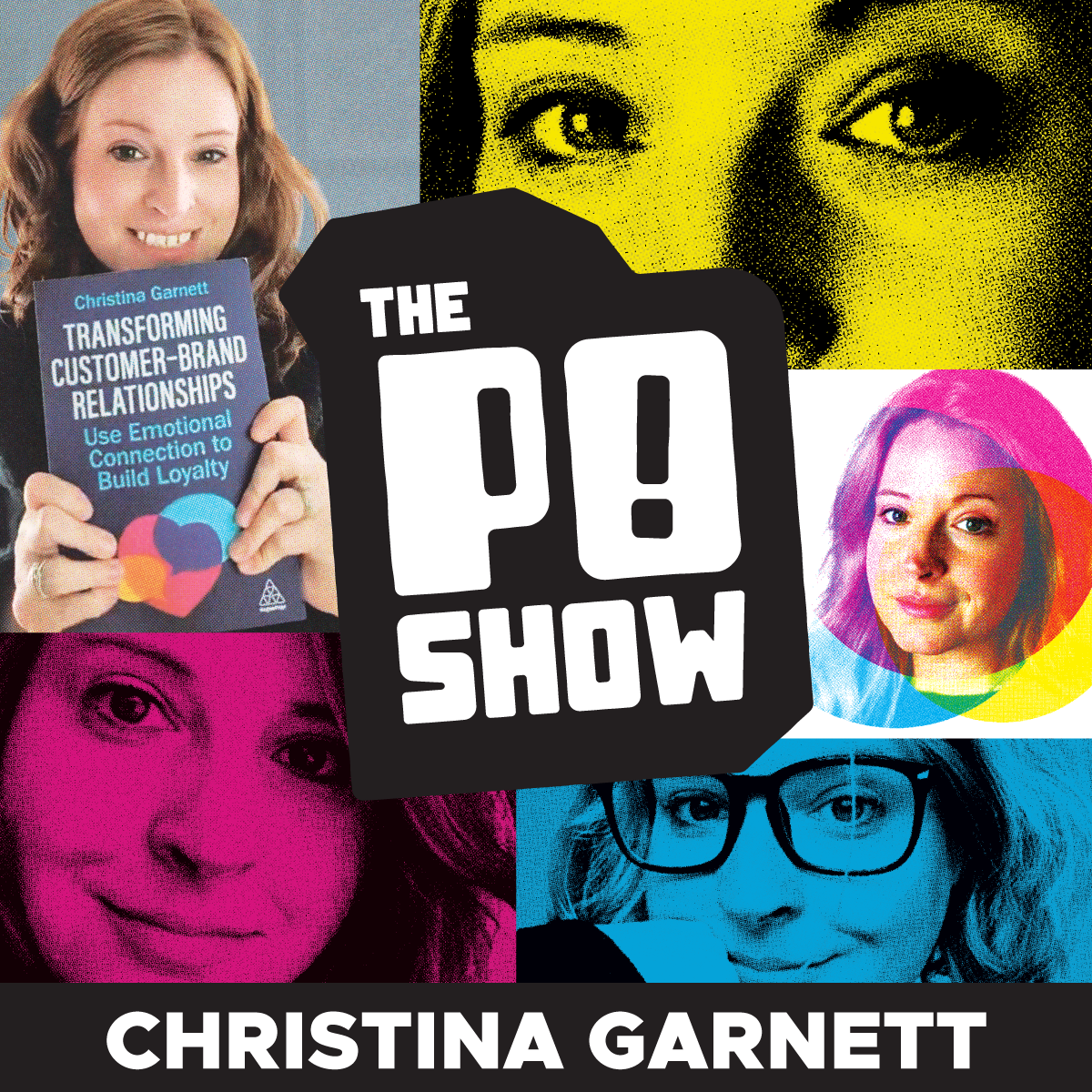
Fractional CCO, Pocket CCO · Author of Transforming Customer-Brand Relationships · Creator of the Customer Trust Equation
Episode #13 · November 25, 2026To Be Loved Is to Be Considered
Christina Garnett has sat at nearly every table a customer touches, and she's done watching brands perform trust instead of earning it. Her fix is disarmingly simple: make people feel considered, and the loyalty follows.
Worth a look
Some of the goodies mentioned, just one click away.Christina's Work
Pocket CCO — pocketcco.com
Transforming Customer-Brand Relationships (Kogan Page)
"Customer Anomie," peer-reviewed in Cogent Business & Management — read the paper (open access)
Christina's research — pocketcco.com/research
Books & References Mentioned in the Episode
Organic Social Media: How to Build Flourishing Online Communities — Jenny Li Fowler
Middlemarch — George Eliot
Émile Durkheim's work on anomie
Persuasion and Emma — Jane Austen
1984 — George Orwell
Brave New World — Aldous Huxley
Shows She Recommends
VisionQuest (Disney+)
MobLand (Paramount+)
The Gentlemen (Netflix)
The Gilded Age (HBO Max)
Silo (Apple TV)
Widow's Bay (Apple TV)
2 Ways to Listen, Wherever You Already Hit Play

The Brand BuilderShe was an Anne of Green Gables English major who planned to write the great American novel. Instead, she signed a deal for a business book, with a UK publisher, on the Fourth of July. Christina's path winds through support, social, advocacy, community, and leadership, all the way to a 19th-century French sociologist and a PhD by publication. This one's the full story.
The PO NotesTrust cosplay, why points aren't loyalty, the $500 dinner that beats any swag box, and her one message to every marketer: find your own answer. If you've only got fifteen minutes, start here.
Show Transcript
Intro PHILLIP:
Everyone in business says trust matters, especially with customers. Today's guest is one of the few actually doing the research to prove how it's built, how it breaks, and why most companies are measuring the wrong things. While CX teams count tickets, she's watching the promises that customers keep score on.
She's a Fractional Chief Customer Officer through her consultancy, Pocket CCO, and a self-described customer trust theorist. She created the frameworks Customer Trust Infrastructure and the Customer Trust Equation, both rooted in sociology, that catch what NPS and the usual CX dashboards were never built to see.
Her first book, Transforming Customer-Brand Relationships, has racked up the Independent Press Award, the International Impact Book Award, a Goody Business Book Award, and a Foreword INDIES finalist spot. As of this week, it's on the Harvey Chute Award long list too. Wow. She writes for Adweek and Campaign US, has spoken at INBOUND, Gainsight Pulse, and State of Social, and is currently building a body of peer-reviewed research toward a PhD by publication. And in all of her spare time, book two is on the way.
When she's not bridging academia and business, she's at home in Virginia cheering on the Virginia Tech Hokies football team and arguing about which Jane Austen adaptation got it right. She's also a proud Whovian, which makes her my kind of people. Christina Garnett, welcome to The PO Show!
CHRISTINA:
I'm so excited to be here. We're gonna nerd out. It's gonna be great.
PHILLIP:
Yeah, absolutely. Well, let's get started strong.
The Appetizers The Best (and Worst) Austen CCO
PHILLIP:
Right into the appetizers. You have strong opinions on Austen adaptations, from defending Alan Rickman's crown as Colonel Brandon in Sense and Sensibility to Ciarán Hinds, in response to someone tweeting that Persuasion has no great adaptation. With all of that in your quiver, which Jane Austen character would make the best Chief Customer Officer? And who would be the worst?
CHRISTINA:
I gotta say Anne Elliot from Persuasion, because she is, for those who have not read the book, incredibly conscientious. She looks out for others. When chaos happens, she is calm under pressure. She's always the person you can depend on, and she's always advocating for other people. So she is absolutely the Chief Customer Officer.
I would say the worst out of all the heroines would probably be Emma. And I do love Emma. I love Emma Woodhouse dearly, but she is a classic little rich girl. She lives in her bubble, doesn't have a mean bone in her body, but it's hard for her to empathize. She tries. Like I said, she's not mean, but she definitely isn't able to see the world the way that others see the world. And so that would definitely inhibit her from being a good Chief Customer Officer. So I gotta go Emma and Anne Elliot.
PHILLIP:
Yeah, good shout. I figured Anne was on the shortlist. Also taken for granted by most when things are going well.
CHRISTINA:
Love Anne. Yes, yes. And I think that kind of goes hand in hand with chief customer officers. They usually are the silent heroes. You don't really hear about them unless something goes wrong.
Regenerating as the Doctor PHILLIP:
Yeah, exactly. Well said. Okay, so from one page to the next, a special question for my fellow Whovian. If you could regenerate into any incarnation of the Doctor from the show's whole history, which Doctor would you be?
CHRISTINA:
Really good question. I have to say, selfishly, it would have to be Matt Smith's Doctor. So it'd be the Eleventh Doctor. And it would be because I want to meet Vincent van Gogh. That episode is everything to me.
PHILLIP:
I'm surprised. You got me. Okay. Don't make me cry. Don't make me cry.
CHRISTINA:
I know, right? So selfishly, selfishly, it would be because of that. Also, there's an episode with dinosaurs. I get dinosaurs and I get Vincent van Gogh. It's gotta be Matt Smith's Doctor. That's who I would reincarnate with.
PHILLIP:
Good shout. I think he got the best stories. And the Van Gogh one, I just referenced it again this past weekend.
CHRISTINA:
It's a masterpiece. It's so beautifully, so beautifully well told. You and I could do a talk just on Doctor Who. I find that Matt Smith's trajectory versus David Tennant's trajectory is very opposite. I feel like David Tennant's pieces had a stronger arc. Personally, he's my Doctor, so I'm more protective of him. However, for Monster of the Week, Matt Smith's were better.
I also think the whole love triangle thing that they kept trying to go back to with the Matt Smith Doctor drove me absolutely bonkers. They kept going back to that well, and I think it really hurt, because I think the Doctor, no matter who plays them, regardless of being a woman, regardless of being a man, regardless of who it is, needs a Shakespeare moment. They need a soliloquy moment. And David Tennant literally got it in his first episode, in his Christmas episode. He has a sword fight, he loses a hand, all the things. Matt Smith doesn't get one until pretty late, in my opinion. I don't remember what it's called, but it's the one with a little girl singing, and he's on a cliffside, and it's a monster that eats all their memories. That is his moment. So anytime I hear the girl singing, and every now and then it's used as a sound on Instagram and TikTok, I immediately go to that place. That was Matt Smith's Hamlet soliloquy.
PHILLIP:
Yeah. Nice. Good shout. So I was geared up to ask you which David Tennant it was gonna be.
CHRISTINA:
I really hope that whoever picks up the mantle leaves him alone. I love him. He's my favorite Doctor, and nothing will ever change that. But it's time. We can't keep coming back to that well to get the fans back. Now it's just a tactic, and we all know what it is. I want a fresh perspective, fresh stories. If we bring him back, I want other people brought back too. I don't want it to become the David Tennant show. And I say that as one of his biggest fans. The easiest way to get my attention is to mention his name, and I am summoned. But even I am just like, let that man rest. Let him go. It's time.
PHILLIP:
Let him go. Yeah, it was becoming the David Tennant show. That's exactly right. There were some people, not even casual Who fans, but people who were aware of the show, and they're like, "Yeah, that's the David Tennant thing, isn't it?"
CHRISTINA:
That's a problem.
PHILLIP:
Let's sit down and talk about Tom Baker for a few minutes, please. Tom Baker was my guy until David floated around. I really like David.
CHRISTINA:
It's a good choice.
Three Favorite Brands PHILLIP:
So, moving on to the final appetizer: what are three of your favorite brands? And if you can recall, how did you first find out about them, and when's the last time you bought?
CHRISTINA:
So I would say Chewy's always on my top list. It just is. I think they singularly prove every single argument I have about CX. They prove that you can be profitable, they prove that it can be scalable, they prove that you can operationalize empathy. They do it. So whenever I need something for my dog, I usually go to them.
And then other brands, for me personally, I gotta pick my favorite. So, Marvel. I'm definitely a Marvel person. As much as I try to keep breaking up with them, I can't. VisionQuest was absolutely brilliant. Spoiler alert: they bring Wanda back. I knew she was gonna come back. I just didn't know if we would get her in Secret Wars or if we would get her properly in Doomsday. I think we're gonna get her near the tail end of Doomsday, when she's like his ace in the hole. But I was very excited to see that. I do like that Marvel is acknowledging and realizing how much of a fan favorite she is, and that such an easy way to take care of the box office is to just make sure she's there and we'll all be happy. I've already got my tickets for Doomsday, so I'll be seeing that. And I'm always paying attention. They had a couple of fans doing Marvelized art adaptations, and they were sharing those, and I'm obviously a big fan of sharing fandom content. So I love that they were highlighting some of the fans that were creating art. I thought that was very cool.
For the third, I'll pick somebody that I've worked with that I think is really cool. It's Kim.cc. I did a webinar with them last week, and I'm a firm believer that if we're gonna use AI, we still need to have the human element intact. So I'm drawn to companies that are like, you can use AI, but your entire thing should not be 100% AI. I need a human at the wheel. There needs to be a human in the loop. You need to understand why your customers would want a human. And so I really like that a lot of Kim.cc's work, their messaging and their branding and everything they're trying to do, is: you're gonna use AI, so here's how to use it best, but here's how to make sure that you have humans at the ready so that you can have the best possible customer experience. I'm a big fan of that. So any brands that are leaning towards humanity and empathy, I tend to naturally gravitate towards.
PHILLIP:
Yeah, nice. I like that a lot, because it's not just AI. For years, people have been trying to figure out how to outsource all their customer service. No offense to offshoring, but it's hard to walk through the call center and pick up on energy and things like that if it's on the other side of the planet. I know the stuff's recorded and all the things, but there's just something about hearing it as a human that makes a big difference.
CHRISTINA:
Yeah, no, it makes a huge difference. And I also think we're seeing a clear pattern where we're seeing this kind of human-to-AI arbitrage as well as the offshoring. Meanwhile, they're not passing any of the price savings along to the customer. So they're specifically downgrading the customer experience and then not passing the savings on. If you are going to be so proudly acknowledging your cost savings, maybe pass that along to your customers.
PHILLIP:
Yeah, I like that.
CHRISTINA:
That's a way to do that. Because I find that the people who understand the importance of CX and the humanity that it brings to the brand itself ... I feel like it gets taken for granted by people who have not done that job or just see it as tasks to be done. So they're looking for ways to automate it instead of thinking: if someone's really angry, it's the human voice that's gonna be able to calm them down. If you are very angry, there is nothing you can program a chatbot to do to effectively counter that. If anything, it's gonna make it worse, because you have them in a heightened state, and now you've made it clear that they can't even talk to a human. So yeah, it's a problem.
PHILLIP:
Yeah. We had an earlier guest who said you're one bad phone call from ruining your brand. It's a really big deal.
CHRISTINA:
You are, yeah. And sometimes you don't even make it to the phone call, because you're not even allowing that phone call to happen. The amount of brands that seem allergic to their customers but want their money all the same is wild to me.
PHILLIP:
Agreed. And it's not just new brands or startups or DTCs or whatever. It's Walgreens. Walgreens has gone through some really crappy times the last four or five years. And look, I love the mission and vision stuff and doing the workshops and everything. It really gives you a nice North Star to make some decisions. But the customer in the store trying to get their prescription and buy their seasonal stuff and pick up some lotion on the way out doesn't care about the mission. They care about what's in front of them. And stripping the store of employees, or not keeping the employees trained and guided to understand that they are the face of the brand at the time, ruins a brand.
So, you said Chewy was your number one. Do you remember the first time you learned about Chewy?
CHRISTINA:
I think it was one of the first times they went viral. I saw that they had done paintings of some of the pets, and I thought that was surprise and delight on a level I had never seen before. So that immediately took me back. And then as I started to see more and more of their stuff, I saw how they react when people lose their pets and what they go through. And so it really showcases the act of care.
For me, I find that a lot of brands want loyalty. They want fans. They want people to scream their name out in a comment section when someone's asking for recommendations. However, they don't think about how that needs to be earned. They want the relationship, but they don't want to build the relationship. I've joked about this: brands want a date, but they want the perks of being married. They don't want to do the work. They want the friends-with-benefits package. And it's like, no, you need to build a relationship. So I find it so funny whenever you see this, and it's like, "Well, loyalty's dropping, and customers aren't as loyal as they used to be." And I'm like, why would they be? What on earth has provided the conditions that make that loyalty earned, worth it, anything? I don't think so.
So what we have now are loyalty programs. And they basically consist of: we're gonna give you points, and those points might eventually lead to something. Even that is breadcrumb incentivizing, and that's not real loyalty. That's fake loyalty. Because if I'm truly loyal to you, then points or no points, I'm gonna come to you. But as soon as you shut down that loyalty program, or you shift what those points are worth or what I can get for them, I immediately start recalibrating my own behavior. We saw this with Delta a few years back when they changed their Medallion program. Delta is beloved. But I know plenty of people who are like, "I don't think it's worth it. If it's a two-hour flight, it doesn't matter. I don't need to fly Delta." And it's for the exact same reasons. You had a really good product. You had a great product. You had reasons for loyalty. But when you shifted the loyalty program you did have, that was enough in itself for people to be like, "Ooh, okay, well, is it worth it? It's nicer, but is it worth the price difference? Maybe I have to fly out of a different hub." People start recalibrating.
PHILLIP:
Yeah. No, that's a good shout. I love the Delta thing. We were just booking tickets to New York yesterday, and my wife was like, "When did this change?" She has flown since it changed, but that's when she became hyper-aware of it. We didn't have the exact same conversation, but we started recognizing that these things we've taken for granted a long time are going away. And is that our fault as the customer? No, to your point, it's not our fault. But what are you gonna do to keep us?
CHRISTINA:
Yeah, pretty much.
The Meat The Book That Keeps Winning
PHILLIP:
Okay, so moving into the meat of the conversation. Your book is amazing. It's the book that keeps on winning. Congratulations, by the way.
CHRISTINA:
Thank you. Thank you.
PHILLIP:
Transforming Customer-Brand Relationships has had quite the run. We had a laundry list in the intro. I'm amazed at people who write really smart books and have the time to pull it together, and I respect the heck out of not only the craft and the time to pour yourself into it, but to do something with so many awards is really, really something. What was your trigger to write the book? And did the book become what you wanted? And have all the awards surprised you?
CHRISTINA:
So I'm a classic English major, so I always wanted to be a writer, since I was a little girl. Anne of Green Gables was very much like me as a child. That's kind of my shortcut if I need to explain what I was like. So I always wanted to write, but like most English majors, I thought I'd write the next great American novel. I have some short story ideas. I have three different untouched manuscripts in my Scrivener right now, and I'm like, one day I will get to the fictional side of my brain.
So what wound up happening is I'm good friends with Jenny Li Fowler, who I adore, who's brilliant. She does social strategy at MIT, and she wrote a book on organic social media. We'd been friends for a while. She loves my work, I love her work. So she quoted me in her book, and I got to read it early and be a part of promoting it, because her book is brilliant. If you're listening to this and you're like, "What book should I read next?" Jenny Li Fowler's. Grab it.
PHILLIP:
We'll make sure it's in the notes.
CHRISTINA:
Throughout that process, her publisher, Kogan Page, saw me and reached out to say, "Hey, saw this, saw your blurb, and have been looking at your work. Have you ever thought about writing a book?" And my response was kind of like what I told you. I was like, "Yes, but fiction?" And so I did have a book idea, and it really was around the ROI of customer love, essentially. That was the original pitch.
So I started writing a proposal and really breaking down all the pieces that I would want. I find that the writing is not the hard part. It's the deconstruction of what this needs to exist as, because otherwise you can just ramble and keep going. Kogan Page has an office in the US and one in the UK, but the main office is in the UK. And I got my book deal on Independence Day, 2024. I was like, "That's hilarious. Yes, I will sign a contract with the UK on my Independence Day."
PHILLIP:
So cool.
CHRISTINA:
So I started writing the book and really breaking it down. Writing the book is not the hard part. I think anyone can write a book. Is it good? Is it helpful? That's a whole different conversation. But it's kind of like running a race. Your competition is yourself. Your biggest threat is yourself. The thing that's gonna stop you is your brain, because your brain is gonna be like, "This sucks. I don't like this. We should stop." And my brain basically did that. I joked that there was no review anyone could write of my book that's gonna be meaner than I was when I was writing it. You'd have to try really hard to be meaner to me than I was. It's kind of like imposter syndrome on steroids, where you're like, this isn't helpful, this isn't gonna work.
And I find that you write the book you wish you had. Whether that's fiction, whether that's nonfiction, whatever, you create what you wish already existed. You usually wait for someone else to make it, and then you're like, "I guess I was the person who was supposed to do it. Okay, fine, I guess I'll write it." And for me, there's a ton of books on social media, a ton of books on marketing, a ton of books on CX, a ton of books on community. But all of these things come together. All of these things work as an ecosystem. All of these things touch each other. And I've seen that at every part of my work. Regardless of where I sat in the org, there were other people impacting my work, for better or for worse, even if it was not intentional. How someone treated a customer before they got to me when I was in advocacy dictated how hard my job was. Am I apologizing for things I didn't break? Am I trying to rebuild trust I didn't destroy? Or do they already love us, and now I just have to hug them back? What does that look like?
So for me, it really is this idea that we need to look at the 360 of the customer, and the 360 of the customer touches everybody. It's touching product, it's touching UX, it's touching social, it's touching CS, it's touching community. They're seeing what your leadership is saying in press releases. They're seeing everything. And I had never found a book that really covered everything. So hopefully, when you get to the section of the book that you're an expert in, you're nodding your head, like, "Yep, that's correct. I agree with that." But then hopefully there are other parts that have nothing to do with your work, and you're like, "That's interesting. I never would have thought about that."
So I basically called in my Avengers. These are the 30, 40 people who I think are brilliant, who are subject matter experts in these specific areas, and I might know 10% of what they know. So I can tee them up, I quote them in my book, and they go off. They share their gems. And then, all told, you have this entire book that catalogs all the moving pieces of what it actually looks like to build customer-brand relationships, because it isn't just one thing.
PHILLIP:
Yeah, nice. Nicely done. A lot of people know the Jeff Bezos quote about the empty chair in the room to represent the customer, and that's a nice gesture. But like you said, there are lots of people who come into the room and have their lens on everything from their one chair. There really is a lot to be said about the customer experience extending outside of everything. And I love that you pulled the Avengers together to make sure all the bases were covered. Did any of the Avengers bring anything to the book that surprised you, or something you hadn't contemplated before?
CHRISTINA:
I think anytime someone agrees to be a part of something that you make, it's an honor. So they all stepped up and were brilliant and kind of showed what I thought they would show. I think I came away more with, "This book actually might be good. Otherwise, why would they agree to be in it?"
PHILLIP:
Yeah. Were there any big lessons in the book that surprised you?
CHRISTINA:
It tested my own thinking on a lot of things. I don't think I'm the same person that I was when I wrote it, for a lot of different reasons. In the writing of things, you wind up realizing what's really important and what actually moves the needle. And I'm glad you mentioned the Jeff Bezos thing with the chair, because a lot of what I see is this performance of good. I'd call it trust cosplay, where you have brands going through the motions to show that they're trustworthy, but they're not doing anything under the surface to fix anything. They're not operationalizing anything. They're not changing how they handle things. They're just writing a nice, warm and fuzzy post on Instagram with a little heart or whatever. It's that.
For me, I wanted to not just write a tactical book, but a tactical book about real change. Instead of "here's how to make it look like you are good," here's how to actually be good. And I think a lot of brands right now are, I wouldn't say struggling, because I think they're doing it on purpose. They're in the middle of that trust cosplay. Perception is reality, so they don't need the reality. They just need the perception. They just need to do just enough to make it seem like they're the good guy. "See, we're nice. We're good. You can trust us. You can be loyal. We'll take care of you." Instead of doing anything underneath.
Building (and Losing) a Brandom PHILLIP:
Wow, yeah. I was gonna ask you about brandoms and how companies lose them. But you've unpacked a lot of it already. You've talked about AI and how people are increasingly saying AI can do this. Not just cut headcount, not just try to make an extra point on revenue, but let's make faster crap that sounds like we actually give a shit about customers, and then step back and ask, "Well, wait, why don't customers love us anymore?" Like, hello. So can you talk about building brandoms and how easy it is to lose them, especially now that we seem to be expediting that with AI?
CHRISTINA:
Yeah. I think Nike is the perfect example of losing a brandom. I think it's the perfect case study. And I think they are slowly working their way back, which I'm very happy about. So this isn't gonna be a bashing-Nike thing. This is gonna be like, you've been going through it, but let's rebuild.
PHILLIP:
A lesson. Yeah.
CHRISTINA:
The thing is, if you look at Nike, they've done a really great job of branding themselves around sport. I don't think that's shocking. If there's a massive moment, like the NBA Finals, you know there's gonna be a Nike post or out-of-home that's released quickly, and you'll be like, "Of course Nike did that. It's brilliant." So they have the advertising brains. They have that going for them. There is an expectation of that. But like we said, the customer experience is so much more than that really great out-of-home or that really great tweet. It exists on top of all of that.
When they shifted a few years back, they started focusing so much on e-commerce that they stopped putting as much inventory in stores. And what that did was basically show their hand, saying, "Well, you gotta go online." And you and I both know that shoe culture is experiential. Love it or hate it, it is experiential. So that removed an experiential element from their customer base. It also literally opened up shelf space for competitors to come in and fill that experiential void, all while sneaker culture is massive. You're not even letting the Trojan horse in. You're just opening the gates and saying, "That's okay. We don't need gates in the first place." So it's not even so much cutting off a fandom. It's removing opportunities for greatness. It's removing opportunities for connection. And so the brandom is going to get weaker. That becomes an issue.
Now, what we saw there was a lot of other brands stepping up and becoming that space. Think about running clubs. Running clubs became a massive thing during this time period, especially post-COVID, because we all need communities and we all need a third place. If you're sports-minded, a literally moving third place is a running club, where you can connect, you can do stuff, and you're also safer in numbers. It has a lot of benefits. And then you have these other brands that are willing, like HOKA. Great example. They immediately walked into that space and were like, "This is gonna be who we do this for." And so you wind up having people who are loyal and who are able to specify exactly what they want. And it's not necessarily a brand name. It's not necessarily an aesthetic. Like Brooks running shoes. Those people are diehard. I've never seen anyone more diehard for a brand than Brooks people. The people who will run a marathon and tell you, "I can't run a marathon unless I'm wearing this brand." That's the kind of tenacity and love and loyalty that brands need. And that's what Nike lost.
Now, coming back: I'm obsessed with the night runs they're doing for women. I think it's absolutely brilliant. It almost becomes this one-night-only running club in a city. It very clearly speaks to the need for women to have safety. So it's going into what could be perceived as a not-brand-safe conversation, because we're having to talk about women and violence and what that looks like. And what they're doing is creating a safe space for runners. The one in London was really cool, because they shut down one of the tarmacs at the London airport, so you actually got to run on the tarmac. That's so cool. So now you have a core memory that you've created with these runners. They're not just going to be thinking about that night, but what that night felt like and the people they met there. Once again, experiential.
So it's gonna take that. It's gonna be these little moments here and there where you are resurfacing in people's lives, where you are becoming a core memory for people. And that's how you're gonna have to build that brandom back up. So I'm rooting for them. I think you can tell from their past couple of earnings calls that they know they've slipped, and they've gotta rebuild. And that is how you rebuild. You rebuild with really strong moments that become a part of people's memories. When they see your brand, they don't just see the swoosh. They don't just see the logo. They don't just see the name. They see a memory. They see a moment in time, an experience that they got to have. That's what they need to rebuild.
PHILLIP:
Yeah, 'cause it's really about this, not the logo.
CHRISTINA:
Yes, it is. It really is. It's what that logo represents. And that logo has to represent something beyond the swoosh.
PHILLIP:
Yeah. I'm not sure you said it in these exact words, but I jotted down: create opportunities for community. You can't force it, but it's gonna cost you something, right? It's gonna cost you something to create those opportunities.
CHRISTINA:
Yes. It is, yeah.
Villages, Not Country Clubs PHILLIP:
So a few weeks ago you posted, "We messed up. In the pursuit of explaining the importance of community, we really made the case for it to be commodified." Where did that go wrong? Marketers ruin everything, let's be honest, right? But where do we go from trying to explain it to gatekeeping it and manufacturing the fakeness?
CHRISTINA:
Yeah. I think that everything is tied to: we have to prove monetary worth, we have to prove shareholder value, we have to do all these things. And so, in the pursuit of saving our jobs and not getting laid off, and also because you have to be on the thought leader hamster wheel, we're all doing brain drips on LinkedIn and social media every day to showcase, "See, I'm smart." And I think it was all with good intention. I think we've done a really good job of showcasing the importance of community. And I think that, plus COVID and everything else, there's enough evidence to showcase that, as humans, we need community. I don't think that's a stretch. But in the pursuit of highlighting that need, plus customers equals revenue, we've turned it into just another program, just another lever, just another tactic, just another thing to tack on. And so everyone has a community now. Everyone says we need community. Everyone says join the community. And it's like, this is an email list. What do you mean, join the community? Where is the community that you speak of that I can't see anywhere?
I firmly believe that people need to be paid, and people need to have a living, and people need to have a life. I'm not anti-money. But I do worry when every new community I see is monetized. Because at what point do we monetize absolutely everything? We keep paving paradise and putting up a parking lot, and we are doing it with community. You used to have a village, hundreds of years ago, that you could rely on and that would take care of you. But now you're gonna pay $5 a month so you can be in this Discord channel. It is not the same. It can fill some of the gaps. It can make you feel less alone. But it's not necessarily filling all of the holes the same way.
So I find the more work I do in sociology, and the more I see the ramifications of all the stuff we've done, the more it becomes very clear to me that community is the answer to a lot of the problems that we have. But we've turned community into a product, and so it actually has made things worse instead of better. And I think a lot of people take for granted how hard it actually is to build a community. I'm in very few communities myself, because I can see the mechanics. I'm like, I know why you're asking this question. I know that this is an engagement trigger. I know why you're posting that right now. I know that you want me to sign up for this. I know how the sausage is made. So I don't want sausage anymore.
PHILLIP:
And you're trained in it. You've written the book on it. But even non-marketers are starting to see that crap. I always see the same people in the Slack group as in the Discord channel, and then the WhatsApp funnel that got me there.
CHRISTINA:
Yeah, no, it's bad. We've turned community into a part of the funnel, and then we don't understand why it isn't good. And then, like with everything else in business, there is no such thing as enough. If you are a fantastic company and you have 100% retention, and you get on your earnings call but you didn't increase your revenue by 25%, you're a failure. So the other problem with community, especially if it's monetized, is that success is scale. And that is not necessarily how community works. I would argue that most communities break once they become a certain size, because now there are too many deviating needs, too many distractions. It's noisier. It's harder to find your core group. You can still build micro-communities underneath it, so you have your own little pod inside of this bigger ocean. But it still feels very alienating. So for me, we've squeezed all the juice out of community, and we need to decommodify it. We need to strip it back to actually do the things.
PHILLIP:
Yeah. When a company's actually doing purpose the right way, and you alluded to this earlier, it actually costs you something. It's not stripped away for profit. If you want it to be a differentiator, it's gonna cost you something.
CHRISTINA:
Yes. It does. And it's tough.
PHILLIP:
There are people who want to over-process it, like you said, to the point where you can see the sausage being made. And those are the people who are going to say, "Let me show you how. Sign up for this webinar, and I'll teach you how to do this." And that's not actually a proper how, right? It seems like a really good moment to talk about what good looks like.
CHRISTINA:
Yeah. I think a great example of what's good right now, and I made a post about it, is: I wish more conferences felt like salons. Whether you realize it or not, when you go to a conference, it's death by PowerPoint. You've seen all the decks. You've seen all the things. A lot of times you're there because of the other people in the room, not necessarily the speakers. A lot of the speakers, especially the keynotes, are usually saying the things they say all the time anyway. So there's not going to be an epiphany there. It's like, "Okay, cool. I got to see you say this live, though, so that's cool." But there's not anything new there. And it's not as connective. It's a massive group of people talking to one person.
However, after the conference, you go out for drinks with people. Or maybe you go out to dinner, and you have a very casual chat. And depending on the group you're with, you deconstruct the day, or you talk about your favorite talks, or you talk about how one speaker was horrible and what you would have done differently, whatever it is. But you actually talk to each other about the experience. And so I love the idea of salons, because it's that on steroids. It's like, I'm gonna come in here, and I'm gonna be smart and have ideas and opinions, but also you're smart and you have opinions and thoughts, and we're gonna talk about it with each other. We're gonna learn from each other and stress-test each other's ideas. It's that that I want instead of the traditional conference. Because it's connection. It has the bubblings. It's not community, but it's close. It's knocking on the door of community, potentially. And I love that.
And when you're looking at community and you're like, "How do we un-commodify it?" there has to be a sense of intention. And the problem now is that the sense of intention around community is revenue- and metrics-based. And granted, you need those things. I'm not telling you you shouldn't be tracking anything. But if your primary goal in a community is "we need to have this many members," or "it has to hit these metrics," if that is the primary driver of everything you do, you have already lost the plot. Because it's self-serving. "I need this community to do this, this, and this, and that's how I know it's a success." You've already deviated from what a community standard should be, because you are not thinking about the members of the community. You're thinking about how those members' behavior will benefit you. You've already put the onus in the wrong direction.
So there needs to be a level of EQ. There needs to be a level of practicality. There needs to be a level of: how is this even different? Because that's the thing, too. Everyone and their brother has a community now, in person, online, whatever. I could throw a rock and hit a community. How is it different? Why would I pick this one versus that one? How is it different in my own life? How is it transforming me? How is it connecting me? How is it making me feel less alone? How is it doing anything other than taking my money or my time? A lot of communities do not answer that question, and can't. And that's a big problem.
So I think we really need to go back to that, for customers, for community, for anything. Why would they even come back? Why would they spend any money here? Why is it so special? Is it special at all? Is it worth the price they have to pay? Does it transform their life? Did it help connect them with people who are gonna be their lifelong friends? Did it create opportunities they would never have gotten any other way? What is it? Because we stopped asking those questions. We just keep waiting for the behavior. We keep saying, "All right, they renewed, we're fine. We'll ignore them for another nine months, and then magically we'll show up three months before renewal, talk about how great we are, they'll renew again, and we'll keep the cycle going." Instead of: have we actually done what we said we were gonna do? Have we actually created something where we can say we're different and special, and put little stickers on our heads all day long? Are we actually different? Are we actually differentiated? Are we actually special? Are we actually doing something different in the market? Or is this just someone else using the big C word?
Trust Is Infrastructure PHILLIP:
Yeah. And this is where, in your book, you've actually spent the time to create frameworks. And frameworks aren't the be-all and end-all, right? Frameworks are a way to distill and present ideas and communicate them clearly. But you've created frameworks specifically for CX. Customer Trust Infrastructure is one. Can you teach us a little bit about that, and why it's different from treating trust like an outcome or a value statement?
CHRISTINA:
Yeah, absolutely. So let's say that I'm talking to you about go-to-market, GTM engineering, and all the things. You know that I can't just prop something up, turn it on, and be like, "And we're good." You know that I have to get ops involved. We have to have a structure. We have to have a plan. We have to build the necessary processes. We need systems so that we can actually do this. So when I say we have a go-to-market motion: here's everything that's ready to go, here's everything that's in place, here's the tech stack that's gonna make it possible, here's how we're gonna make it sustainable, and here's how we're gonna use these systems to get to our goal. Why don't we do that with trust? We don't. We assume that because we didn't embezzle money from customers, we're trustworthy. "I didn't break any FTC regulations, therefore I'm trustworthy." We assume that as long as we didn't do the big bad thing, we have customer trust. And that is not how that works. You can stop trusting somebody who didn't purposely hurt you. They didn't do it on purpose. They didn't even do anything bad. They just didn't show up the way that you expected them to show up. And for some people, that is enough to not trust you.
So Customer Trust Infrastructure is going into your company and looking at it the same way you would for go-to-market, the same way you would if you needed to scale. Like, "Hey, we need to go through a Series B round. Here's what we need to have in place in order to figure out how much money we actually need, and then here's what we're gonna do with the money you give us." We need to do the same thing for trust, because trust is built and broken across every single part of the org. It's the same thing with CX. And that's not by accident. There are decisions being made by leadership that will trickle down to customers and that will decide whether or not they want to trust them.
And sometimes it has absolutely nothing to do with the company and the customer experience. Great case in point: Jensen Huang with Nvidia. Those affairs have absolutely nothing to do with the customer experience. But it does. Who he had dinner with has a direct reflection on how the CX is going to change. That was not his intention, ever. He wasn't sitting there at dinner thinking, "This is really going to screw over some customers. I can't wait." That was never the intention. It still impacted it. So all of these decisions eventually trickle down to the customer. And that is going to determine whether or not that customer base wants to trust you, wants to give you more money, wants to give you less money, wants to break up with you entirely, wants to just leave your vertical behind, whatever that looks like.
And the problem, too, is that your customers don't exist in a bubble or a vacuum either. So you could be cleaning up someone else's mess, especially if you're a tech brand. I'm sure you've seen this: someone has worked with a specific SaaS vendor, they're over it, and for whatever reason, they transition onto you. So they've gotta rip out everything that was there before. They've gotta transition over to you, and there are still gonna be bumps in the road as they transition, and you're still gonna be cleaning up the messes. You didn't break that trust. But if switching over and cleaning up the mess of the former vendor is a big problem, that could be enough for them to be like, "Maybe this new vendor wasn't the right one. Maybe we shouldn't have switched, because it's such a hassle." You could lose customer trust that way. It's not that you didn't try. It's not that you were the bad product. It's that the transitional period was too rough.
When was the last time you accepted a connection request on LinkedIn from someone sending you an InMail? What was your first thought? "I don't know you. You're gonna pitch-slap me. There's gonna be a pitch in here in the next 48 hours." Why do you believe that? Because someone else did it. Not them. Someone else did it. So you have a lack of trust immediately because of someone else's behavior. It has nothing to do with them. And what's sad is that nine times out of ten, you're still right, because they pitch-slap you too.
PHILLIP:
Yeah. And you know what's funny is, again, once you understand how the sausage is made, it's really hard to take your eyes off of it. I can see when someone starts liking my things: "This person's gonna send me an invitation soon." There's the invitation. "They didn't pitch me? They're commenting? They're actually doing it the right way." It's still coming. But by the time it comes, I know the name, I recognize their face. "Okay, all right, I'll talk to you."
CHRISTINA:
They're a real one. You're like, "I see you." It's warmer. They literally did the work, and so now it's not a cold pitch anymore. It's warmer. But we forget, or we assume, that customers are not seeing all that work. And it's wild, too, how we're guilty of this as marketers. We deconstruct all this work, and we try to create work that impresses each other. Meanwhile, the customer's just like, "What is this? I don't even know what this commercial's for. Couldn't even tell you. I know who the brand is, but I don't even know what I would buy. I just know you got The Rock in there."
PHILLIP:
So part of your thing, too, is you've mapped out trust on a two-by-two. I love a good two-by-two.
CHRISTINA:
Yes. I feel like you know you've been in corporate for a while if you're like, "That's how my brain works. I understand it in two-by-twos now."
PHILLIP:
So the two-by-two is transactional versus relational, and then signal versus substance. Is there a place where a lot of brands tend to sit, because they're not paying attention to it, and they kind of get lumped in?
CHRISTINA:
They tend to overindex on transactional immediately, because, I mean, think about it. If you're thinking about revenue and that's how you see your customers, how are you not transactional? Where did the revenue come from? If you're seeing people based off the revenue in their account, then you see them in a transactional view, period. That's not controversial.
PHILLIP:
That's why I don't like the word "consumer," by the way. Really don't like the word "consumer."
CHRISTINA:
I hate it too. I hate it too. It's one plus one equals two. That's how we got here. And then I think there is a lot of virtue signaling. So they'll do the transactional, and then they'll realize that they need to be a little bit warmer, so then they hyperindex on signal. So then it's like, "Hi, friend!" and they're really chummy in the comments. And I'm like, you sell insurance. Why are you calling me "bro" in the comment section? What are we doing here? It's that stuff.
So I would say high signal, high transactional is where most tend to go, because it's just easier. It's the default setting. By default, you're gonna look at transactional. And then if you want a strong reputation, you're gonna go signal first, because signal is easy. If you look at high signal, that's why there's a rebrand anytime there's a new CMO. Is it because the old brand was bad? It's a signal. It's a signal to show, "New stuff. We're wide awake. Look at this cool Helvetica logo." We completely threw away our heritage, but it's new and shiny. It's that stuff. It's weird. But it's a signal.
PHILLIP:
So you've been publishing something called The Week in Trust. I love that, by the way. This week alone we had the FAA, banks, Microsoft, things that we took for granted. And we won't get into the layers of stuff. I won't put the tinfoil hat on about what could have caused some of those things.
CHRISTINA:
We could have a whole podcast session on that.
PHILLIP:
We should do that soon, before it gets worse. So is there a story of the year so far, as far as watching and tracking trust break in real time?
CHRISTINA:
I would argue that it's leadership, and the separation between leadership and the people who trust them. We're seeing this in politics, we're seeing this in business, we're seeing this in AI leadership. We're seeing this across the board, where people in positions of power don't realize that the masses disagree with them.
PHILLIP:
Heavens, yes. Not just in the US, by the way.
CHRISTINA:
And we're seeing this across the board. When you have people in power who see the world completely differently, and the masses speak up and say, "Well, actually, this is how we all see it," it not only creates more distrust, but it creates distrust because there's more disconnection. So it goes from "you disagree with me" to "you disagree with me because it benefits you for things to be different." I want things that will benefit me, you want things that will benefit you, and we are diametrically opposed. So I can't agree with you, because I'd be voting against myself, essentially. And so what you wind up seeing is decisions based on benefit instead of logic. And so now we have emotional decision-making.
And I think we saw this with the Jensen Huang thing. Another great example: you had a core group of leaders who were like, "It's just an affair. What's the big deal?" And everyone's just like, "Okay. We can do a Morals 101 course with you, or an anti-James Bond course, but do we need to do that?" There is very clearly a hierarchy of people who are making decisions that are changing the lives of all of us. And their decisions are very different from those of the people they are impacting. And it's very hard to trust someone when you see them making choices over and over and over again that go against you. And we're seeing that. So we're very much in a low-trust society, and I think it's gonna get a lot worse before it gets better.
PHILLIP:
I think you're right. I think you've nailed that. By the way, I have a whole section here that starts out with us talking about Animal Farm, which is a great transition from 1984. What we're saying is not your reality. But I'm gonna skip that, because we're running out of time. We'll have to come back and do this again.
CHRISTINA:
Yeah, no worries. We can do Brave New World meets 1984, 'cause I'm definitely a believer that we are in a mix of both. I don't think we're in one or the other. I think we're in this really nasty cocktail of both.
PHILLIP:
Ugh. Yes. So yes, we're gonna do another episode on these books and peel these things apart. I love that idea. Especially when life starts to imitate art. And not just, "Oh my gosh, let's go back to Doctor Who and Jane Austen and Marvel, please."
CHRISTINA:
I'm here for it. Let's do it.
Building a New Lane: Academia Meets Business PHILLIP:
But getting back to books of other types, let's talk about the connection of business and academia: connecting CX with sociology, organizational behavior. We talked about leadership. Can you talk a bit about how sociology allows you to peel those curtains back and see the customer experience a little differently, and how that's led to your second book and your PhD?
CHRISTINA:
Yeah, absolutely. Literally a couple of months after the first book was published, I had the itch to write a second one. So I started building out the proposal: what are the main things I want to touch on, things like that. And I did a search in my manuscript, because I was like, "I think I talked about trust a lot. Did I?" I did the Control-F, and it was on half the pages. And I was like, "Yep. That's a theme. Okay." So I was like, okay, good, I'm on the right track. It wasn't just in my head. And so I really wanted to dive deeper.
I find that in business we really want to reinvent the wheel, and it's so unnecessary, especially when there's so much work that's already been done. So I started doing research and looking more and more into sociology, because I find it is such priceless information as we see how we interact with each other, and how businesses impact how we are or aren't connected with each other. And in the course of that, I started reading a lot of Émile Durkheim, who was a French sociologist. He did a lot of work around the first industrial revolution, and he coined a term called anomie, which is what happens when the norms around life are so broken or changed that you're kind of rudderless. It showed people who were basically having to leave their rural villages and go into urban life, take on brand-new roles in factories, switch up everything about them. They basically lost everything that they had built their lives on and now had to start over. And it makes you feel rudderless. It makes you look for purpose. It makes you ask, "What is all this for?"
And I see this in today's society. When you talk about the millennial midlife crisis, that is a thousand percent what's happening. All the rules: go to college, get a good job, make straight A's, be a good person, do all the things, and then you'll win. You'll win life's lottery. And then when it's time for us to hand in our ticket, like, "All right, I did everything you told me to do," they're like, "Girl, what? No. Life's not fair. Go pout. Go grab a participation trophy, little brat." That's exactly what is happening. Every norm that we built our lives around has shifted, or never really existed and we just believed the beautiful lie. Either way, that is what's happening. And so I became obsessed with the idea of anomie. I posted earlier in the year that it is my word of the year. It is exactly what we're all feeling. AI has completely shifted how we work, divisions of labor, everything.
And I see this, too, with customers. There used to be a time when I signed a contract and I paid you, and because we have a contract, you're gonna give me what you said you were gonna do. How many brands are actually doing that? How many brands are still providing what they said they were gonna provide? Very few. And then on top of that, they're gonna say, "We are a customer-centric company," and then they use no-reply emails.
PHILLIP:
Personal bane, by the way.
CHRISTINA:
Or you can't talk to a human. Yeah, I hate it. Or you basically have to go through four levels of a Mission: Impossible setup in order to find a human through a chatbot. I shouldn't have to break your systems in order to get to a human, but I'm gonna try if that's what I gotta do. It's that stuff. We've really rigged the game against them, and then we wonder why they don't have loyalty, why they don't love us. And you have that in a world where AI has created tech parity. If I find a really cool SaaS product, and a competitor just launched a new feature that I wish we had and my customers want, I can vibe code that new feature and add it to mine in 48 hours. So the tech is no longer the differentiator. It's the human. And then we've removed the human. And so it's like, well, what are we doing here?
So I wrote a paper on customer anomie, which basically looks at Durkheim's sociological perspective of anomie and what that looks like for customers. We've changed the norms, and because of that, they're like, "Why am I here? Why am I paying you? What are we doing?" They're feeling the exact same purposelessness. And so that's where we're going.
Sociology has absolutely helped me look at this through a new lens. I love behavioral psychology and behavioral science. I find it fascinating. But it's like everything else: it all works as an ecosystem. Just like social listening and social media and CX and the voice of the customer and PR and crisis comms all work together for this common good to take care of the customer. Your brain is gonna help you decide how you make choices, but your environment and society at large are gonna play a huge role in what influences you and how you react. So it's not sociology or behavioral science. It's both. It's all of it. For me, it makes me look at the why. Because I can create frameworks all day and be like, "This is how you do it." But if you don't know the why, then what are we doing? Why does it work? Why would I do that? I can search "CX framework" on Google and find oodles. We're not short.
So I really love the idea of seeing the academic and the business side of it, because there's so much really fantastic research that already exists that answers questions we all have, but we're not looking for it. We don't know where to look. And so a lot of my work is hopefully translating a lot of this academic content and these research papers that no one's ever gonna read, but absolutely needs to, and being like, "Here are the CliffsNotes." So that when you look at your customer tomorrow, you know why this is happening, and how you should use that framework, or how that framework could be tweaked to be even better, because now you're looking at the sociological perspectives of why this would or wouldn't work for them. So it's huge.
For me, I'm looking at a PhD by publication, which is more prevalent in the UK and Australia and Europe, where I'm building out my body of work. Once I have a certain number of papers peer-reviewed and published, I'll be able to submit, and then basically write my dissertation around my body of work. I'm very early days. But I have one peer-reviewed, published paper on customer anomie in Cogent Business & Management. And I have a few more papers that I'm working on now that I'll be submitting near the end of the year. So it's a work in progress.
PHILLIP:
That's exciting, and so stinking cool. I've written a couple of ebooks, not books, by the way, but they keep coming back around to one statement, which is, from the lens of the customer: why should I care? And it's about so many things. Advertising? It's boring as hell. You're just giving me a list of things. You don't have my attention. There's nothing memorable. Why should I care? Your purpose? Great. You sound like the other ten people who are planting trees. Why should I care? I think there's a lot to that, and you are answering the why. I love that. That's fantastic. Well done.
CHRISTINA:
Thank you.
Pop Culture as a Business Lens PHILLIP:
Let's talk about pop culture as a business lens. We've already talked about Doctor Who, we talked about Marvel, and you and I talked offline about a few things. But pop culture as a business lens is something that you're very good at. Maybe we can finally accept that the video game industry is light-years ahead of so many other industries, if not all. What can people learn from GTA 6? From taking years to get it right instead of just releasing something because stakeholders are shaking their pitchforks waiting on their return, to not only delaying to get it right, but getting it right for the people who publicly spread that across the landscape?
CHRISTINA:
Yeah. So I think you have to look at CD Projekt Red. They're the ones who did the Witcher games, and they were beloved. Beloved. They came out with a game a few years back called Cyberpunk, and it was not ready. And they got lambasted for it. They were beloved, and they basically used up whatever trust they had.
PHILLIP:
Lost it. Okay.
CHRISTINA:
They lost it all, basically. And so they've made all the fixes. They've updated everything. Cyberpunk is a great game now. But that was a massive lesson, not only for Rockstar, but for any video game: is it really worth putting something out that people are wanting, and it not being ready, versus saying, "We're gonna make you wait a little bit longer, but when it comes out, it's gonna be a masterpiece"? You're gonna wait, and we know you've waited for like 13 years. So much so that it became a joke. The meme: "We got so-and-so before GTA 6." It was rampant. So you have an entire meme campaign about your delays, and you still push forward, knowing, "We're gonna take whatever time it needs, because we have got to get this right." And that is what they did. So I think that is a case study in taking your time, but knowing that you are gonna deliver the best possible product. Like, "You're gonna wait, and we know you're pissed off, but we're gonna stick the landing." And they stuck the landing. It was absolutely fantastic. So that's a massive lesson.
The other would be that game, for everyone who wants to love it or hate it. My husband has played it, and I've watched him. I play video games, but I can't do anything with the cameras. For whatever reason, it's a skill issue. It's the one skill issue I've got. I can't do any games with a camera.
PHILLIP:
I'm still stuck in 1988 as far as games go, so don't worry. I'm with you.
CHRISTINA:
But I watch my husband play. I find them fascinating. I love an RPG. I've watched my husband play 4 and 5, and now he's playing 6, and I've been watching him. I watched him play Red Dead, Red Dead 2, BioShock, all the Assassin's Creeds. I've seen it all. I love watching it, and I love the storytelling element. I love the game theory behind all of it. There are so many decision trees. I love game theory, and it is game theory on display. It's fascinating to me. I love the personalization opportunities, where you can not only change what the character looks like, how they do their hair, whatever, but I also love the mechanics of listening to different kinds of radio stations. If you like classic rock, you're gonna be taken care of. If you'd rather have reggaeton, you're gonna be taken care of. There's something for everybody there. It really shows the melting pot of Miami, and you see the cultural aspects everywhere. I really love that.
There's obviously the mission, but because it's open world, you really can choose your own adventure. You can kind of do whatever you want. There was a guy who tweeted about it that was really funny. He talked about how he played the first ten hours and never went on a mission once. Instead, he went around to see all the wildlife, and he started doing his Richard Attenborough voice, like he was doing a nature documentary. Oh my God, it was the funniest thing.
PHILLIP:
That's hilarious. I have to find that.
CHRISTINA:
I can send it to you. It's really cute, but it shows that everyone can play this their own way. And then there are Easter eggs. Spoiler alert: there are a lot of Dexter Easter eggs. You can see his apartment, you can see his boat, and there's a part where you scuba dive and you can see the trash-bag graveyard that he had. There's a Bigfoot. There's, I think, Gemini, the spineless raccoon, in it. There are a lot of Red Dead Redemption references. I saw a picture of Arthur Morgan riding a little chihuahua as a little figurine, and it was very cute. It's kind of like what Marvel does with Easter eggs. It's a little kiss on the forehead for those of you who pay attention. Can you enjoy the game or the movie without understanding all the Easter eggs? Absolutely. But it does feel like a little kiss on the forehead, like, "Look at you knowing things. Look at you being in the know."
PHILLIP:
Deep cuts.
CHRISTINA:
Yeah, deep cuts. I love an open-world game. I find the exploration of it really fascinating, and how you choose to become a part of that open world, I think, is fascinating. And I posted on Twitter, because it was a thing I posted literally six years ago, and I was like, "Taps sign." The best storytelling I'm seeing is in video games right now. And it is. We have all these conversations about people hiring storytellers and all this other stuff. There are a lot of people in the video game industry who have been laid off and are looking for work. If I need a storyteller, I'm going for those people. They know how to work on high-end work that's gonna have high visibility. Also, gamers are notorious for being very opinionated, good, bad, ugly. So they've seen it all. I think there's definitely something to be said there. There's so much talent there. If you're looking for storytellers, that's who I would go to first. I would look for people who've written video games.
PHILLIP:
Yeah. And you and I talk a lot about not just video games, but other forms of fiction too. Read fiction, right? Watch TV shows. Watch something that's a little older, too, that doesn't have to keep reminding you of the plot every three minutes because it's written for people looking at their phones.
CHRISTINA:
Yes, please. I can't with those. I really can't. I started rereading Middlemarch, which is one of the classic English novels, and I love it. It's usually on most people's top-ten list of British novels. I find it's a good factory reset for my brain. Whenever I'm like, I'm thinking in AI speech, or I'm writing my book and it's like, "Ooh, this feels more like a LinkedIn post than a book," I'm like, I need to wash my brain out. I'm gonna read a novel.
PHILLIP:
Wash my brain out. I like that. Are there any TV shows you recommend for washing your brain out, for a quick reset?
CHRISTINA:
I loved VisionQuest. I thought VisionQuest was fantastic. I love MobLand. Guy Ritchie's cinematic TV universe, I'm a massive fan. I loved The Gentlemen. I love MobLand. Those are fantastic. I love The Gilded Age. Julian Fellowes is brilliant. Let me see, trying to think what else I watch. I mean, anything on Apple TV. Apple TV doesn't miss. So I would definitely look there. Silo's fantastic, if you haven't watched that. Widow's Bay: brilliant, absolutely brilliant. But fiction. Fiction. We get enough reality. We get enough. Read some fiction.
PHILLIP:
Read some fiction. Put that on a T-shirt.
Questions from Industry Friends Alex Giedt
PHILLIP:
So we're running out of time, so I'm gonna jump into Questions from Industry Friends. This is a chance where I reach out to people we've both interacted with, typically through Twitter or LinkedIn. And I find myself being drawn to ... I guess I'll say X. It's always Twitter, but X.
CHRISTINA:
It's always Twitter, but yeah.
PHILLIP:
Because some of my favorite people are still active there, and I love engaging with them. So it's been nice seeing your stuff. Alex Giedt is one of my faves. He and I have not met in person yet, but we have to change that. He's someone who's constantly trying to take all the data that he stares at and bring it closer to the customer experience, and not just get lost in spreadsheets. So Alex said, "I spent a long time marketing mobile phones. Mobile service is interesting in that you have a physical product and a subscription service. We used a very robust, real lifetime value calculation with over 300 attributes, from customer service data to service data, to give us indications of how various customer experiences are impacted." His question for you is, "As someone who focuses on trust as a core tenet of engaging customers and audiences, do you use any metrics or analytics that you find meaningful? And can measurement help us understand underlying customer trust?"
CHRISTINA:
I think you have to look at data. You can't ignore it. My advice would be that you need to look at quantitative and qualitative. You need both. It's very easy to overindex and just think that you should do quantitative. The quantitative is gonna tell you what's happening, but the qualitative is gonna tell you why. You're gonna find out very quickly that I'm a why person. So I would just make sure that your OKRs and your metrics fit the role you have and the part of the year that you're in. You might be doing a Black Friday deal, so that's where your focus is on metrics. So there's not going to be one magical metric I can give you that's going to work across all things. There is no Staples Easy Button. But what I would argue is that you need to come from a place of: what is happening, and why is it happening? If you come with those two questions, that will help point you to the metrics that you need to look at.
And when in doubt, find the voice of the customer. Do social listening, do customer interviews, look at the feedback, even if you're not in a position to do anything with it, even if you're not in support. That's why I wish more teams, for no other reason, would talk to their support and social teams. There's so much good data there. They can tell you what the frequently asked questions are. They can tell you what problems most people are having. They can tell you what the sentiment is without even looking at their dashboard. They'll be able to tell you who's mad at us today. They'll be like, "It's so-and-so." So talk to the people who are closest to your customers, because they're sitting on so much valuable data that is not getting shared. And that's because, A, it's not quantitative a lot of times. And then it either gets put in a CRM or put in a deck and reviewed at one meeting, and then it's never seen again. What we wind up seeing is that you only pay attention to the voice of the customer once it becomes this typhoon of negativity. Once it becomes a viral scandal, then you act. Instead of: "This is smoke. Let's do something about the smoke before it turns into a fire. Let's fix this." That's where we want to get to.
PHILLIP:
Nice. And I'll throw salespeople in there too, with the social teams. Because if you've actually walked the floor, when you go talk to customers or clients and listen to the sales team, it's interesting to see a salesperson nonchalantly answer a question. Like, "Yeah, I get asked that all the time." Really? Because I've been looking at your website and your materials and sitting in meetings for six months, and no one said that. Who's asking that question? "Customers ask it all the time." You just opened a magic door.
CHRISTINA:
That should be on the website.
PHILLIP:
Exactly. And so this is again one of those places where the sales team and marketing need to be friends, not adversaries, because you're after the same thing.
CHRISTINA:
Yes. You lose together, you win together.
Sharon Green
PHILLIP:
Exactly. So our next question comes from Sharon Green. She says you write a lot about trust on LinkedIn, and she's interested in what prompted that, and why now. But I think the bigger thing that separates it from what we've been talking about is she asks, "Do you think there are differences in trust and trust-building across geographies?" Sharon's based in London, so that comes from an interesting place.
CHRISTINA:
Yeah. Okay, so what started it? A lot of it came down to this: I was doing a lot of very surface-level work with trust around my first book, and it became very clear that I wanted to go deeper. What I was really trying to do was build connection, but in order for that connection to even be a thing, you have to build trust. So I think that was kind of the start of it.
The other thing, too, is that I'm deeply disillusioned with a lot of brands. There's a quote that I really love by George Carlin, where he talks about how the cynic is a disillusioned idealist. I absolutely see myself as an idealist. On good days, I'm an idealist, and on bad days, I'm a cynic. So I think a lot of me talking more and more about trust is seeing what the world is like and seeing that trust is a problem, but wanting us to finally do something about it. I get sick of the whole "trust is important, you should build trust." And I'm like, "Cool, cool, cool. Go deeper. That's not enough." I'm seeing trust getting commodified and turned into a buzzword in a lot of the same ways that community is, which bothers me. So if I'm gonna run my mouth about it, I want you to at least leave and be like, "That's something tangible I can do," or "That's what trust means," or "That's why I trust someone more or less," things of that nature.
And then getting to her question about whether it changes with geos: in some ways, I think it's the same across the board. At the end of the day, we want people who are going to do what they promised. They're gonna show up for us when we need them. They're not gonna lie. They're gonna do all these things. Then, on top of that, I think there is a layer that's very different. From a sociological perspective, I think trust does change across geos. Okay, London versus here. I was raised on British ... my dad was an Anglophile. So I'm very sarcastic. I was raised on Monty Python way too young. I get their sense of humor. But if I was just a normal girl from North Carolina who had never had that kind of experience, and I walked over and tried to crack jokes with British people who did not have the same sense of humor, or did not get it, then it's gonna be harder for me to use the same tactics with them, because we are not aligned. They'd be like, "She's smiling too much," or "She's not funny," or "That accent is weird."
There's always gonna be a level of universal trust, and then a layer of sociological trust, where I'm more likely to trust somebody because we've had very similar experiences. And then there are some geos where business is very cut-and-dried, and they don't get into emotion and they don't get into personal stuff. And if you do, that comes across as encroaching, like, "Ooh, that's not what we do here." So that could be a barrier to trust. Versus others, where if you took that same person and put them over here, we'd be like, "Why aren't you friendly? Why don't you make eye contact? Does that mean you can't be trusted?" And it's like, no, that's just not what we do. So it's gonna sound like a cop-out, but the answer is that it is different, and in some ways it's the same.
Anthony Garone
PHILLIP:
Yeah. And my wife has said this a lot. She's my partner at Common Giant. She says that most of our differences are cultural. Again, we'll have to have another episode on fiction, but she used Star Wars as an example, talking about how we have a universe of people somehow speaking the same language, which happens to be English, but the real differences are cultural.
So next up is Anthony Garone. Anthony says a lot of leaders want community as though it's a bolt-on. We talked about that. But these same leaders don't often participate in the actual communities, nor do they do the work of developing them. Why? What's going on there? And how can we help our leaders understand their value? Cough, cough, Jensen Huang.
CHRISTINA:
So I think that's a really good question. I think it's very easy to use community, like you said, as an add-on, to humanize a brand. A lot of times, that becomes the human element. Like, "Here's this brand. You can't even talk to a human, but we have this entire community of customers, and you can all talk to each other and be lovely and warm, and it's so great." So community turns into this humanizing factor.
And then, like you said, there are very few CEOs and leaders who talk about community who are actually in the community doing things. He is not wrong. He is spot on with that. I think, A, it's more important to them to be seen in other places. They would rather build in public on Twitter or LinkedIn, or go to a conference where they're one of the keynotes, or maybe an invitation-only dinner or whatever. They don't see the community as their community. They see the community as the brand's community, and I don't think they see themselves as a member of it, because they're not getting the same benefits the community members ideally would. The community members get to be part of the brand. But if you're the leader, it's like, "Dude, I'm here. They'd have to fire me and kick me out for me to not be a part of the brand." So they're not getting the same membership benefits. And then on top of that, there's a humility factor. If you're in the community, I'd love you to talk to everybody, from the brand-new member all the way up to someone who's so good you'll probably try to poach them and add them to the brand team.
So I think there are a lot of reasons why they don't, but I think it all comes from: that's not their community. They don't feel like they're a part of it, therefore they don't post in it. And it's not, quote-unquote, their job to run the community, so they don't go in there. But I think more leaders need to treat community the way they treat Twitter and LinkedIn and Reddit. I think you should be building in public, but I think you should also be building in community.
PHILLIP:
Building in community. I just love that. Can you think of a leader who's doing it right, even if it's their own way?
CHRISTINA:
I would say Alexis Ohanian. I think he's doing a really great job. Obviously, what he built with Reddit was incredibly impressive. But he continues to champion Reddit, and he works with a lot of women's sports organizations, and he is regularly there. So it isn't just, "I wrote a check. Look, I support." He's doing the things. He's having conferences. He's on the ground. He's showing up. He's advocating for people. Alexis Ohanian, for me, is probably textbook. If you want to pick a leader you can actually have faith in, it's that one. He does a great job. And I think that becomes a part of his build-in-public. His build-in-public is him showing the things that he cares about. And I think that's true, too. If you care about the community, you will find yourself going in there, because you feel compelled. If you don't care about the community and it's just one more thing for a press release, then there's really no provocation for you to go in there and spend time. That's just one more thing taking away from your time to do X, Y, and Z, versus "This is something that matters to me."
PHILLIP:
I like that reframe. You know, I love that so many people, especially on the performance marketing side of things on Twitter and LinkedIn, talk about your ICP or your target audience. Instead of an ICP, maybe it's: what's the community I want to be a part of, or the community I want to accept us, versus what can I sell to this one person who matches all these boxes I can check? It's such a different approach to understanding the person, as opposed to understanding their ICP.
CHRISTINA:
Yeah, I agree with that. I completely agree with that.
Vikki Ross
PHILLIP:
Nice. All right, our last question comes from Vikki Ross.
CHRISTINA:
That's my girl. I love her. She's one of my favorite people.
PHILLIP:
I'm hoping she'll listen to this show. She doesn't know it yet, but she's on the list. I'd love to have a two-hour conversation with Vikki. She's the best.
CHRISTINA:
She's so brilliant. She's so brilliant.
PHILLIP:
So Vikki says, "Your client wants to send their marketing team out into the wild to understand real-life customer behavior. Where do you advise they go for a fast learning experience?"
CHRISTINA:
If you are in CPG, you need to go to a grocery store, period. And you need to go to different ones. I want you to go from low-end to high-end bougie. Don't just go to Erewhon and feel like you've got it figured out. I want you to go to all of these. If you're in SaaS, I would go to a conference, but I would not do a booth. I would scout, and I would listen. I would just walk around and listen. Social listening, but actually social listening: not through social media, but through social interactions and gatherings and stuff like that. I would absolutely do that.
Also, if there's a brand you want to do a collaboration or partnership with, then you need to go to the events. Everyone wants to work with F1, or everyone wants to work with the NFL, or everyone wants to do something with Coachella. You need to go to one of those events beforehand and see: are your people there? Because just because it's a cool event does not mean that's where your people are. And then all you have left is that you've spent a lot of money to say you went somewhere, which any brand can do. It all comes down to real life. It's gotta be in real life. You gotta leave your house. You gotta leave your office. And I say that as someone who's like a hermit in the Shire. At some point, you gotta leave the house and get with the people.
PHILLIP:
Yeah, get out. And do the social listening stuff too, obviously. But everybody can do that. Take your lens out into the public, and make sure you hit the salons after the conference, right?
CHRISTINA:
Yes, yes. But that's the thing. What are the things that feel the most special, the most intimate, that feel like a core memory? I think there's something there. And when in doubt, there are so many people who want to give people a box, like, "Here's the surprise and delight, here's the merch, here's the swag." Honestly, if you're like, "Christina, we're not gonna go to an NFL game, we're not gonna go to a conference, we wanna spend less than $500. What do we do?" Okay. I want you to go into your CRM and pick the most loyal people you have. Someone you've maybe never talked to, but they've been with the brand for 15 years. And then I want you to invite them to a special dinner with people from product or leadership or whatever, and just be like, "Hey, we were looking through our data, and we noticed that you've been with us for 15 years, and we wanted to take you out to dinner." Do something nice. People think you have to spend billions of dollars to be nice and to really go all out. Everyone's love language is different.
And this is another lesson from GTA that I can share. There are a lot of people who love it and a lot of people who hate it, but you have to be nice to Lucia. There are consequences. She reacts differently to you if you're not nice to her. You don't have to buy her flowers, but if you buy her flowers, then that's really nice, and she'll look at you differently. It all comes down to this: to be loved is to be considered.
You want your customers to love you. And in order for your customers to love you, the easiest way is to have them feel loved. And how do you make them feel loved? You make them feel considered. When you make a decision as a brand, I can tell that you thought about the customers in the process. I can tell that that was a thought. I can tell that you considered how things would change. You want to do a completely new workflow or add a new feature? I can tell that you considered how that would change users' and customers' daily lives. I can tell that you considered them. So: to be loved is to be considered.
PHILLIP:
I love that. That's fantastic. I would love to make that the final statement of the show, but we can't, because we have more. But wait, there's more.
Closing Question PHILLIP:
Closing question: if you could communicate one thing to every marketer around the world, what would that be?
CHRISTINA:
You have to find your own answer.
PHILLIP:
Go find your own answer. Okay.
CHRISTINA:
You have to find your own answer. We spend so much time copying each other and jumping on trends. And it's fine if we get to the same conclusion. It's fine if we're passionate about the same things. But you need to take the walk to get there. You need to know, "I read this book and it changed how I see things," or "I went to this press conference," or "I went on this trip," or "I had the best customer experience of my life," or "I saw this post on social." It does not matter what the triggers are, but you have to make your own path and figure out how you see the world.
The reason AI is doing so much damage to us, from a writer perspective, from a content perspective, is because it gives us the aggregate. But marketers have been giving us the aggregate forever. We keep picking the safe middle part. And if we do anything risky, it's because it's a meme that went viral, and therefore 200 brands did it. "We can't all be canceled." You know what I'm saying? Find your unique personal view. Find what makes you passionate about how this works. Figure out how your line of thinking is different. And then beat the ever-loving crap out of that drum.
For me, my whole career is not CS. I've sat in CS, I've sat in support, I've sat in social, I've sat in strategy, I've sat in leadership, I've sat in advocacy, community. I've sat at every table. So because of that, my perspective is: I need everyone at the table. I need all of those seats filled, because all of us impact the customer. Someone who did CS is not necessarily gonna come to that same conclusion. They're gonna go in a totally different lane, and that is what they should be doing. You need to find your lane. You need to figure out what lessons you've learned along the way that have made you who you are. And that needs to be what feeds your work, because that becomes your differentiator. That's why someone would hire you over somebody else. That's what's gonna make you outlast AI. That's what's gonna make you outlast all these other things. You have to figure out how you are different and how you see the world differently. You cannot be jumping on every single trend. You cannot be doing it because everyone else is doing it. You have to find your individualness, and then you have to secure it and protect it.
Sign Off PHILLIP:
Of course, that's what we would expect. But wonderful. Christina, thank you so much. Tell the listeners how they can learn more about you, your work, the books, and the upcoming goodies you have coming for us.
CHRISTINA:
Yeah, you can find me on the internet. I need to take some time off, but I'm always on the internet. You can find me basically anywhere at @ThatChristinaG. But you can also see my work at pocketcco.com. I share all of my business work, but also all of my academic work there. So you can see a little bit of everything and learn more. There are links to all my papers, if you want to read those too, and there are links if you want to get the book. And I'm always down to talk about community, trust, connection, all those things. Absolutely.
PHILLIP:
Excellent. Christina, thank you for spending so much time with us. We have to go ahead and schedule the next one, because we answered like half the questions we had for you. So, looking forward to next time. Take care.
CHRISTINA:
Perfect. Thanks for having me. Bye.
Keep It Coming