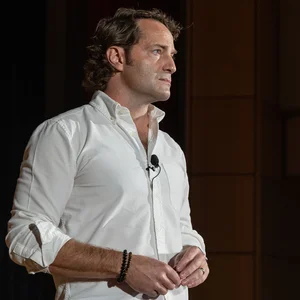
Lisl Macdonald
Founder, Spring and Atlas · Fellow, Royal Society of Arts · Honorary Fellow, The Marketing Society Scotland

Episode #5 · September 30, 2026Perspective Collecting at the Crinkly Edges
Lisl Macdonald spent a decade inside BT, Ogilvy, and Virgin's biggest brand machines, sat on the management team through a London Stock Exchange IPO, and just walked a graduation stage at 58 to collect an LLM with Distinction. So when she talks about where the real insight in an ecosystem actually lives, she's speaking from decades inside different rooms, not a theory about it.
She calls herself a perspective collector, someone who deliberately lives at the "crinkly edges" of communities instead of the center. It's a phrase she uses to describe everything from why disability gets left out of access conversations, to why founders mistake customer interviews for recruiting supporters, to how a "priest class" has quietly formed between startup founders and their investors.
Perspective collecting is only half the episode, though. Lisl's also currently researching conflict for a PhD, with a working theory that founder fallouts, not bad products, are what actually kill startups.
Bonus material: a poem from grade school that became her lifelong mission to age disgracefully, and a hard-won case for why curiosity travels better than confidence.
Worth a look
Some of the goodies mentioned, just one click away.Books & References Mentioned in the Episode
The City and the World — Gregor Hens (Fitzcarraldo Editions)
The Poppy War trilogy — R.F. Kuang
Nonviolent Communication — Marshall Rosenberg
“Warning” (“When I Am an Old Woman I Shall Wear Purple”) — Jenny Joseph
Strategy is a Verb – Martin Weigel
How to Write a Better Business Plan — Alastair Thomson
Cash Flow Surge: 101 No-Cost and Low-Cost Fast Action Strategies to Boost Your Business Cash Flow — Alastair Thomson
The Bottom Line Bulletin – LinkedIn Newsletter by Alastair Thomson
Genius Steals newsletter by Faris Yakob
The Developing Life podcast by Heather Crank
Talking Heads – Once in a Lifetime
2 Ways to Listen, Wherever You Already Hit Play
The Brand BuilderFrom the BT strategy floor to an IPO on the London Stock Exchange, to angel investing across four continents, to walking a graduation stage for an LLM at 58, Lisl's path only makes sense once you realize she was never trying to get to the center. This one's the full story.
The PO NotesThe disability access nobody talks about, why “community” became a Rolodex, the authenticity gap that makes brands “risible,” and the poem that gave her a lifelong mission to age disgracefully. If you've only got fifteen minutes, start here.
Show Transcript
IntroPhillip: Just weeks ago, today's guest walked across a graduation stage to collect an LLM, her Master's of Laws, with Distinction, at 58. She'll also tell you anyone suggesting Gen X should be quietly retired from the internet can take it up with her directly. Her most recent degree is a bit of a full-circle moment, as she studied marketing and law together at university before quickly deciding law wasn't for her. An early standout, she received sponsorship for her dissertation, which caught the attention of BT Group in London.
Phillip: She spent the next decade at multinationals like BT, Ogilvy, and Virgin, learning and practicing the business from inside some of the biggest brand machines around. She then did what she never got around to at university and went backpacking for a year. The trip landed her in Bangkok, where she's spent more than a third of her life helping businesses get a foothold in Asian markets. These days she splits her time between Scotland and Thailand, running her own consultancy, Spring and Atlas, where she works as a fractional exec.
Phillip: Since she somehow squeezes more juice from her tomatoes than I can, she's also a Fellow of the Royal Society of Arts, an Honorary Fellow of the Marketing Society Scotland, and chairs judging panels for their Star Awards. Last year alone took her to Helsinki, Tallinn, Bangkok, Ho Chi Minh City, and back home to the UK, working with startups across a confusing amount of time zones. Off the clock, she's a self-declared reading addict, a lover of languages, a qualified yacht skipper and racer, is currently deep in researching and writing about conflict for a PhD, has fully formed opinions on why community has quietly become marketing's next fad to fear, and is on a lifelong, deeply committed mission to age disgracefully.
Phillip: Lastly, she's either near or missing her doggo Bluebell, ready to drop advice on culture shock at the drop of a tweet, flexing her might with her strong Giphy game, and holds zero patience for a shambolic customer service line. Lisl Macdonald, welcome to The PO Show.
Lisl: Thank you for having me.
The AppetizersPhillip: All right, let's get into the appetizers — these are fun. Lisl, if you had your own podcast, who would be your top wishlist guest, and why would you want to interview them?
Lisl: It would be David Byrne, every day, any day of the week. He's a fellow Scot originally — I went from Scotland to the US, he went from Scotland back to the US. He's a genius musically, but he's also just a brilliant mind. He's demonstrated his skill in so many different fields: visual art, poetry, theatre. He always does things differently, and I've really learned from that in my life — if you're going to do something, try to do it in a different way, try to bring something new to it. He's obviously successful at business, he's interested in cultures from all over the world, and he's a fascinating individual to me. I would love to interview him.
Phillip: He's actually having a bit of a resurgence of awareness right now — he's been doing his thing forever, but people are becoming aware of him again. I really think young people need more David Byrne in their life.
Lisl: Well, they do, because he's 74, I think, and he's really killing it with his live tours. He's innovative, he does it in a completely different way — it's an extraordinary experience, go if you can. And he also shows that just because you're old doesn't mean you're not — you know, you're not dead yet. You've still got plenty of things you can try out, new ideas wherever you are. Never stale. The man is always fresh.
Phillip: Next question — if you were an 80s new wave or post-punk band, who would you be?
Lisl: I don't know if it would be Talking Heads, because, you know, they're my guys. I think I would probably — I would love to be the Cocteau Twins, because the Cocteau Twins blended beauty with edge and darkness. I love the way they created a sound with Simon Raymonde and the rest of the guys in post-production. And Elizabeth Fraser is just a genius — when she opens her mouth, and I've seen her live, what comes out has been an inspiration for everybody from Björk to various other people. Incredibly innovative, incredibly beautiful, but also a little gothic and a little dark. And I like that — the light and the darkness together.
Phillip: We typically ask guests for three of their favorite brands, and I'm sure you and I could talk about Adidas and Adidas Originals all day long, but I have something different for you. Recently you shared a tweet that made my day — ‘People who love literature have at least part of their minds immune from indoctrination. If you read, you can learn to think for yourself,’ by Doris Lessing. Instead of three favorite brands, let's talk about books. You're an absolute voracious reader — you've told me before how many books you've read in a week, and I feel like such a loser. What are some recent books that have been dancing in your noggin?
Lisl: I've been reading a lot of academic books and journals, which has slightly reduced my time for other types of literary endeavor. But I really enjoyed a book by a guy called Gregor Hens — H-E-N-S — called The City and the World, published by Fitzcarraldo Editions, who are a fabulous imprint. Everything they commission, everything they re-release, is really interesting. That's nonfiction. In terms of fiction, I've been reading quite a bit of science fiction as well as literary fiction recently, because I felt the urge to leave this particular planet and engage with other worlds — build me your world and I will visit you, thank you. I can highly recommend R.F. Kuang — she did the Poppy War trilogy, and she wrote Babel and Yellow Face more recently. But if you go back to her first books, it's more fantasy than science fiction, and they're amazing — there are lots of analogies in there to things happening in the world. And there's a book I think everybody should read: it's about nonviolent communication, by a guy called Marshall Rosenberg. Nonviolent communication is just a skill we should really be emphasizing these days. It was written in the days of mostly face-to-face or telephone communication, but now we have the whole digital realm, and we have the ability to either uplift or bring people down that we've never met, based on a dozen or two words that they say. I think it helps us understand the power we have as communicators, and how we should value and use that well. I can't remember which of the Asian philosophers said, think about it before you say it — is it necessary, is it good — before you speak. And all of us, myself included, could be a little more thoughtful about how we communicate.
Accents, Dialects, and WordplayPhillip: As we get into the meat of the conversation, I wanted to talk about language a little bit — how many languages do you speak comfortably?
Lisl: Four, comfortably. And a bit of some other things, but only for travel purposes really.
Phillip: For the rest of the show, Lisl kindly asked her husband Chris to bring her a cuppa before we got started, and leaned over his shoulder calling down to him in Thai, which was great.
Lisl: I was thinking of your wife and your mother-in-law when I said it.
Phillip: The Scottish accent is one of the best accents in the world, let's be clear.
Lisl: Well, we have many Scottish accents, though — that's the thing. People often say ‘the Scottish accent,’ but I think we're one of the places in the world where the accent varies the most by traveling a short distance. We're a small country of five million people, but we have very distinctive accents depending on where you are. When I first went to London to work, people used to say to me, ‘I'm sorry, I can't understand your impenetrable Glaswegian accent.’ And I'd say, well, first of all, I'm not from Glasgow, and second, I don't have a Glaswegian accent — though I have a great love for it, I studied there as an undergraduate too. It really made me realize that people think of a Scottish accent as being a Glaswegian accent, and it's not the only one. The vocabulary's different, there are dialects too — there's Scots, which some people speak, and then we have Gaelic in the islands. I grew up on an island, and the older members of my family used to speak Gaelic — but mostly when we were in trouble. If they spoke Gaelic, we knew we were in trouble.
Phillip: You and I talked about the wordplay game going around, where you can mimic an accent just by saying certain words — if you say ‘space,’ in a Scottish accent, it starts to sound like you're saying ‘Spice Girls.’
Lisl: It does. It really does.
Phillip: And here's one for the Southern American side — if you say ‘rot now,’ it sounds like you're saying ‘right now’ where I grew up.
Lisl: Right now. Yeah. Right now.
From Pure-Play to the BoardroomPhillip: Okay, onto the important stuff people came to learn from Lisl about. From being a pure-play marketer to the boardroom — you began your career in marketing and comms on both the client and agency side. Can you tell us a story about your time on the client side, and how you moved into agency land?
Lisl: On the client side, I was fortunate enough to start in the strategy department where all the plans came together for BT at headquarters. You could really see how the products and services people, the pricing through finance, channels through the sales teams, and communications through the customer communications unit all worked together in a planning and budget cycle to produce the strategy, and therefore the funding that went out into the business to achieve the objectives for that year. That was a great way of understanding the complexity of business — there's a bottom-up and a top-down planning process, and there were both. There would be assumptions and suggestions for financing that came top-down, but there was also a requirement to build a bottom-up budget: these are the things we'd need to do to achieve the commercial objectives for the business in the next one to five years. Understanding how that fitted together gave a great understanding of the business as well as the marketing side of it, because marketing was all of those things — products and services, pricing, channels, and communications. It was such a great learning curve, because I got to work with some of the smartest people in London. There was me, straight from uni, off the island, the most junior person in the room, working with all these really smart people. If you kept your eyes and ears open, you couldn't help but learn a lot about how these things work, about the complex interplay of all the parts of the marketing mix in a business, and how to make a plan that people could look at and say, okay, I have clarity on what's required. I can now make decisions based on understanding what's required, and that was incredibly helpful going forward.
Lisl: The second formative experience was being in a company that went through an IPO — I was there the year before and the year after. That helped me ask the right questions of the business, and I quickly realized that the value is in asking the right questions. When you're young, you're always inclined to jump to wanting answers, because you're desperate to prove yourself. But knowing what questions to ask quickly became the core skill you need, whether you're a marketer, on the agency side, or in the boardroom.
Phillip: You gently pointed out something important too — marketing isn't one department, it's such a complex part of the business, but it really does get relegated to just the comms part, the promotion of the P's, the ‘coloring-in department,’ as we say. When did you see that switch happen?
Lisl: I wish I knew exactly what happened — I have theories. In the nineties, I'd be asked by finance, or whoever headed up sales or product, why marketing thinks it's everything — should we all just go home? And I was always clear that what marketing was doing was sitting in the room representing the customer. I might not have a hundred percent control over the product or service design, but I'd be commissioning research into market sizing, exploratory research into how people were using a product, what their end-to-end customer experience was, and providing that back into the business. I always tried to say we were a support function — if we're not making sales' job easier, we're not doing our work; if we're not making product and service design easier, we're not doing our job. But we also had to be vocal on behalf of the customer and say, if we erode certain parts of this, we're going to lose business. That conversation about customers was useful to other functions, as long as it wasn't something to beat them over the head with. We went out with installers, repairers, spent time in shops, went to exhibitions, were on stands — making sure that every quarter you were out there at the customer face, and then bringing that back into the business.
Lisl: I noticed there was a time — and this is when I start to sound a hundred and fifty years old — when I'd bring in my ad agency, my PR, media, direct, fulfillment, and design people once a month for an all-agency meeting, and that was always interesting to see who felt they were leading the brand conversation. I wasn't particularly interested in facilitating that kind of fight and tension — they were all bringing something important to the brand. But I noticed that as a lot of the big accounting firms got into trouble around their auditing practices and were looking to move up the value chain into consulting, they managed to stick their foot in the door and get into the boardroom, and became what we now know as the big consulting companies. I would look at agencies and wonder why the top agencies I worked with, who had people capable of doing that, didn't recognize or take note of that signal and engage in the same kind of development. That's a real shame, because I think it's still a struggle — a lot of supply partner organizations get into boardrooms and do damage, cost-cutting and hacking away, with no customer voice in there. Wouldn't agencies be well placed to be customer voices on those boards? But if you're just wanging on about needing to spend more money on advertising, that's the wrong way to go about it. I see that as an ongoing missed opportunity for the whole communications industry.
Lisl: It also plays into another thought I regularly have, which is around how senior members of organizations started to be rewarded differently. In the past, if you were an investor looking at a traded company, one of the key things you'd look at was new product pipeline — do they have anything coming down the pipe, even years away. People would evaluate stocks and IPO valuations based on whether customers liked them, stayed with them, and whether new products and services were coming. That changed once share price became the key metric a CEO, board, and management team were measured by. I've literally seen organizations lay people off in a quarter to hit a ratio that would release bonuses for the management team. So the consultancy companies were just facilitating what was already happening in the boardroom — short-term value, this quarter's profits, next quarter's, rather than whether this is a sustainable business generating profits and jobs long term. It was a cascade: therefore we cut costs, therefore we reduce innovation, we don't invest in R&D anymore, we cut headcount, we don't invest in marketing or brand experience.
Lisl: One thing we did with a genius named David Patterson, who had a PhD, and one of my team who had a PhD in astrophysics, was reduce TV spend by 30% without dropping any key metrics — awareness, calls into the call center, conversion rates, average bill size, lifetime value — through econometric modeling. When it came to that kind of modeling, there was no number that would scare her; if it wasn't light-years, it was a baby number for her. What I loved about her was that she was mega explicit about the assumptions we were using, because it's a little bit like sailing or space travel — if you get one degree wrong at the beginning, by the time you've traveled, you're miles away. You have to be really honest and explicit about your assumptions. That makes your model robust and useful, but you have to recognize its limitations and use judgment when making decisions based on it — it's not going to make the decisions for you, it just gives you extra data points to consider. There was so much learning from that about wear-out too — we get sick of our ads before consumers do, so be smart with your budget: if you've got a ninety-second brand commercial, make sure you can cut it down to twenty or thirty seconds so you can keep reminding people, and plan ahead with your film and photography so it lasts, rather than people getting bored.
Phillip: People on LinkedIn knock the forty, fifty, two-hundred-page brand documents and brand guides, but those exist for big brands like F1 or FIFA for a reason — they have to plan where that brand shows up, down to the wayfinder signage in stadiums.
Lisl: Absolutely — people like Vicky Ross, the tone-of-voice guru, getting to the point where the brand has a voice. It's a little bit like personal brands — I think personal branding has gone way too far, but whether you like it or not, we all have one, and people form opinions of you based on it, same as with products and services. You can either be thoughtful and intentional about how you go about that, or shove stuff out there and let people think whatever they want. You can't force people to think about you a certain way, but you can encourage them by saying, this is who we are, this is what we do, this is how we connect with you as a customer — and if you can make that a conversation rather than a one-way thing, that's always useful. But that takes a little bravery, and a lot of brands have lost the will to listen to customers quite as much as they should.
Startups, Customers, and CuriosityPhillip: How much are large companies cutting R&D and pipeline creation, and how much is that creating opportunities for startups?
Lisl: I would like it to be more — I think that's another ecosystem that's a little in need of some massaging to make it optimal. I hear a lot of pitches, and I get a lot of decks weekly, monthly, annually. I hear a lot of founders talking about problems, but they genuinely feel like they're looking for people who need that solution, rather than actually talking about customers. When you look at decks, they talk about the problem to be solved, how awesome the team is, the addressable market, all those metrics, and financial projections that up until series B and beyond are all a wish and a hope — which is fine, but the customer isn't really at the center of those conversations. As a former marketer, that bothers me. There's also a bigger question of what we even mean by a startup — I've been doing primary research on this. A startup, to me, is a company with high risk and high reward potential, usually a technology component, and a requirement to raise financing at some point, whether debt, CVC, angel money, venture money, or government match funding. But there are a lot of people creating what you'd call lifestyle startups — not startups that are going to have an exit. If you're an angel investor or an LP in a VC fund, you're looking for someone to talk about the exit and the return on investment. When people are pitching and saying they don't want an exit, I'd say you're more like an entrepreneur, not that kind of startup. Are they really entrepreneurs, or are they freelancers because there aren't as many jobs in that area anymore? There are people doing things locally that will never have an exit or return on that money. I'm a bit perplexed about where we're going to be in the next five to ten years with how many people are running their own businesses, what support they need from government and ecosystems, and where the money is actually flowing so it's creating jobs and tax receipts rather than just sitting there. We use the term ‘startup’ or ‘entrepreneur’ without being thoughtful about what kind. It's a bit like advertising agencies — there's an agency, and there's an agency. They're not the same thing, they're offering something different.
Lisl: Founders often ask what they can sell instead of what problem needs to be solved. I've watched startups interview customers to validate a decision they've already made — you talk about proof and validation, but they're not researching, they're recruiting supporters. That's different from pure research, where you're open to what people might say. I think that's what's missing in the startup ecosystem: let's talk to people around a problem area, but stay open-minded about what the solution might be, rather than deciding we can build a tech stack and going out to see which people will buy it. That's recruiting supporters, not researching people. There needs to be more curiosity turned up on customers — get into their lives, how they actually use things around the problem you're trying to solve. Years ago, when I was an undergraduate, I remember reading about Lexus launching and sending car engineers to go and live with families, this was the 1980s, to see how they actually used their cars. I wrote about that as an undergraduate, because it's genuine research. It's a bit like the difference between asking someone what they had for breakfast and them saying oatmeal and berries, versus what they actually had this morning, which was a Mars bar and a Coke because they were in a rush. Observational, anthropological research is brilliant because you're observing humans in their natural habitat, rather than what people claim.
Phillip: So instead of saying a certain type of person won't buy the product, ask why they did what they did, how often, getting curious — it's not less shareholder value, it's more customer value, which creates more shareholder value.
Lisl: Hundred percent.
Phillip: How did you start to build your voice to pursue that passion for leadership, governance, and venture investing? How did you move from agency land into the entrepreneurial ecosystem?
Lisl: I think it came from having been through an IPO in ’98. It was a different world then, but it was an exquisitely insightful experience to sit with a company on the management team through an IPO on the London Stock Exchange — at one point this company was the first Silicon Fen company to be valued at a billion pounds. It ended after a year, as these things do, but sitting with due diligence work on your desk for a year while trying to run a department really reconnected me with the board, the investors, the lawyers, the people writing the prospectus, the investor relations people, regulatory — it gave me that broader experience of how businesses are governed, sitting in meetings with peers every day looking at product, what features we could have, how long things would take, and what we'd do as a marketing team to handle expectations that weren't going to be met for another six months.
Perspective Collecting at the Crinkly Edges: Privilege and AccessPhillip: Something you're really passionate about is access, and people who have privilege don't recognize access. You've been pretty blunt about who actually gets to be in these inspirational interview moments, and who doesn't, who gets access to the big rooms. What does privilege and the lack of access show, and how does it show up differently depending on which ecosystem you're standing in?
Lisl: People always say the best idea wins, or that they only want the best people in the room. But we all know the best ideas and best people don't necessarily always win — networks are important, geography is important, confidence is important, and culture is important. In places like Finland and Estonia, using Hofstede's cultural dimensions, there's low power distance — there's equality, nobody thinks they're much bigger than another person, and you can speak more easily regardless of status. That's a wonderful thing about Northern European culture. If you go to Asia, it looks a little different — there's quite a lot of power distance depending on job title, family name, but on the other hand there's more space and time to talk, compared to say North America, where you love the energy and positivity, but if you're not ‘bish-bash-bosh,’ you don't get heard because it's already finished — it's about getting things done. So there are different ways access can be denied based on different cultures. And unfortunately, when it comes to access, I think a lot of attention is paid to certain groups to allow access, but one group that never gets access is disability. It's a shame — it's kind of the poor orphan of gender, race, and socioeconomic group.
Lisl: It ties into something we mentioned earlier about communities, too. When you look at access through communities, communities tend to become a bit like school — there are in-groups and out-groups, in-language and out-language, and if you can form that, you'll get more out of it, and if you don't, you won't. I find that disappointing, because if you look at the stages or platforms within these ecosystems, there's ten people always on the stage, always on a podcast, always writing articles, always in the room. That's fine, but what about the crinkly edges? What about the people who aren't in the middle? A lot of innovation and change in thinking, in products, in understanding customers and the future, comes from people who don't sit in the middle — you have to seek them out, because they think differently, and they're more inclined to listen than speak. They're not concerned with being experts, they're curious. That's my passion in life — being curious. I'm a perspective collector, that's what I do. And if you're only ever listening to the same ten guys — okay, nine guys, one woman, let's be real — in whatever ecosystem you're in, you're missing the interesting, crinkly edges of the future, of different thinking, of doing it differently. That's where I like to exist — at the crinkly edges.
Phillip: Another perspective is from those who are disabled, which is also something you're very passionate about — people just being aware that not everyone walks the same way, uses devices the same way. Does that experience change how you find your crinkly edge and your people, and judge things?
Lisl: It's been interesting, because I was super fit and sporty — I got really ill about eight or nine years ago. I never defined myself as disabled; I was playing a lot of competitive sport, polo, racing yachts, tennis. But I got ill, and as a result I now have some issues walking, which I'm working on — I walk with a mobility aid, and I have a lot of immunological issues too, which limit when and how I can interact in public spaces. It's been a revelation, because I haven't grown up disabled — I was one of the people privileged enough to go and be wherever I needed to be. So it's interesting now to have those limits, and to understand what doors are slammed in people's faces is actually quite a horrific revelation. It's one I try to be positive about — I advocate, but I try not to let it define me, because you can be in danger of being seen as a disabled woman over fifty, and that becomes the only thing people ask you to talk about, and I don't want that, because there's more to me than that. I'm lucky to have had a very extraordinary life, and I'm very grateful for it. But if you're young, I worry — if you're twenty, twenty-one, seeking your way in the world, and you don't have access to spaces and places and aren't able to have a voice, those people are being missed out completely. People talk about gender and race and socioeconomic group, but there's a huge intersection with disability, because people from poorer socioeconomic groups are more likely to be disabled, and less likely to have access to medical help — poverty can be a driver. When you look at that intersection, I think there's a lot of performative help in various ecosystems that doesn't move the needle at all. Sign up to a pledge — really? In what ways? I promise I'll try really hard — okay, outcome? Disabled entrepreneurs, disabled people don't get to work in marketing and advertising agencies, because you have to be cool, you have to go out for beers, and maybe you don't drink, maybe you're Muslim. Where's the social life for those people? There's an awful lot of ways in which marketing and advertising can be a club, and in the startup and entrepreneur world, it's a very bro-driven world — if you aren't doing ice baths at 4 a.m., you're not really trying. We need to be more careful about how we include people, and when we say community, we need to make sure that really means community, and doesn't just mean people like me.
Phillip: You also shared something on Twitter — I want to make sure I'm not putting words in your mouth, but that for every hundred pounds circulating in the entrepreneurial ecosystem, only a fraction actually reaches the entrepreneurs. Where does the rest go, and who's benefiting from that gap?
Lisl: Ecosystems are a form of community, but they include government organizations, accelerators, incubators, mentors, advisors, event organizers — a whole bunch of people who work within the entrepreneurial and startup world. In a sense, a kind of priest class has emerged — the priest was traditionally the interlocutor between the congregation and the divine, and there's a priest class in the startup ecosystem now: whisperers between founders and investors, government organizations, access to all sorts of things. The amount that doesn't go to actual founders, from what I've heard from people who've analyzed this, is somewhere between 40 and 60%. I'm not saying that couldn't be smaller, but I think people need to be more judicious about how that money is spent. People come into ecosystems and take money from them with no real measure of what value they're adding — anybody can be a mentor, set up an incubator, set up an event. I see people I've invested in up on stages, and there's an awful lot of ‘yeah, go you,’ and a lot of awards — particularly in Scotland, we have more awards per capita for startups than any other ecosystem, which people from Silicon Valley to Singapore have noted. That's fine, but I think we need to move away from ‘go you’ and into practical, actionable support, the right support for the right thing, because different founders want different outcomes — some want an exit at a certain stage, some have no desire to exit at all, some think they're going to exit but there's no moat, nothing unique that can't be replicated. We need to sit down as a society and think about what support different kinds of businesses actually need — a med tech company with a two-year sales cycle and FDA approval needs completely different support from a SaaS company, or a mental health app, or a law tech solution. The support tends to be a bit serendipitous — you sign up for an accelerator, get introduced to investors and mentors who might not be the right ones. Some of it is fantastic, but there's an awful lot of boxes being ticked and then nothing happening. The other thing that bothers me is when a general partner says, we've raised a hundred million, this is our third fund — and that tends to be the end of the conversation, everyone says that's amazing. But as an investor I'm thinking, exits have gone from eight to ten years to maybe twelve-plus now, which is why the secondary market has become important — what evidence is there that this is actually generating returns? If you burn through LPs and angel investors who aren't getting a return, other than a couple of tax breaks, you're going to dry up the market. Money is leaching out into trips, delegations, accelerators, incubators, advisors, advisory board members who might be paid — is that money and time really working hard enough? What interventions would actually make a difference? That's the question in my mind.
Phillip: I mentored one season for a startup incubator, and halfway through I realized I wasn't qualified to mentor half of what these people needed to learn — I should have been a facilitator for very specific things I'm good at, not a mentor for everything.
Lisl: I'm exactly the same, Phil — I've said no to quite a few people. I'm very specific about mentoring, because I have a particular style that's not for everyone, but I've recognized what I can actually offer. When someone comes to me wanting mentorship and can't explain what the business engine is — who's buying this, how much are they paying — I found it difficult to sit and encourage people to keep skimping on their own life and family for a business that quite frankly was never going to be a going concern. I'm not comfortable encouraging people to do something when there's not enough there to make it work. It's great to be positive, but not helpful without a bit of realism. I'm not the person you need — you need a lawyer, you need a finance person.
Attention, Effort, and the Inundation ProblemPhillip: We're all drowning in the same firehose of content and noise on social media, and it's affecting politics and economics now. Where do you think people should be placing their attention and effort, and what works best for you?
Lisl: I have to put my hand up and say I spend far too much time on social media. My excuse is that I live in the middle of nowhere and I'm often doing academic work, so it connects me — but I recognize that's post-rationalization. I try to find great people and dive into rabbit holes of what they've created. Diversity of thought is important, and I try to deliberately find rabbit holes to dive into — a subject I don't know much about, whether it's the Romans, the Egyptians, the Aztecs when I was a kid, or something I can teach myself now, whether it's cooking, or a particular tech stack, or music, or mathematics. You can read a book, look up tutorials, befriend somebody you found online. I try to use social media as a way into a rabbit hole, both online and offline — tune into webinars, meet people in real life about it, then you're using it for good rather than just getting caught up in one topic the algorithm hands you.
Lisl: I also try not to engage with people who disagree with me in big online debates — I refuse to get into them. Even when I've had bad experiences where I've said something innocuous and been attacked, I'll just say I wish you a good day, this isn't the place, I don't know you, I'm too old for that. Social media isn't the place for heated arguments — it's not an intense intellectual exchange, it's a broadcast thing, you're wrong. So: avoid the negative side, find new people and ideas, and follow up on them. I've met a lot of people in real life this way who've become dear friends. And I think it's very wrong to tell people to come off social media, especially people who are disabled, isolated, or have caregiving responsibilities — those people rely on it for contact.
Phillip: Is there anything you do to manage your attention and find the balance between the socials, off the socials, books, or meeting friends?
Lisl: I give myself a lecture every night when I see how many hours I've spent on it — work in progress, I'm getting a little better. When I have a deadline, I find it easier to just get off. News is the thing that drags me in. In some of my roles I'm very much a red emergency button that clients push when something bad happens, so I do keep a lookout for signals across the world — if you're involved in advice, governance, risk and oversight, you look at what's happening globally and try to see patterns, especially when you're looking at investments globally. So it's news and analysis that helps me understand what's happening in areas I have a commercial connection to, or I'm just curious about, but it's trying not to go down the rabbit hole. Time is the only way I've found to really manage it — you just have to limit your daily use. I wouldn't say I'm brilliant at it. More work to be done.
The Arid Desert of AuthenticityPhillip: Can we talk about the arid desert of authenticity? Marketers often ruin things by overusing or abusing concepts and words, and you've colorfully described the current state of authenticity as an arid desert. What happened with authenticity?
Lisl: Authenticity became an issue — there was a time years ago when authentic leadership was a fad, people got sent on courses about it in the late nineties, and then it changed into other things. I think authenticity is missing when people and brands spend too much time thinking about how they're perceived and how they want to be perceived, and not enough time actually, demonstrably showing by their actions who they are. Your actions are what you are — I think it was Marcus Aurelius who had something to say about that. If you spend too much time thinking about perception and not enough time acting on it, you have an authenticity gap, which makes you laughable, risible, and quite frankly sometimes a little offensive.
Phillip: You recently tweeted an observation that a new trend is to create a newsletter and fill it with articles by, and the achievements of, other people, hoping to make it look clever or cosmopolitan or cool — basically just curating other people's work, dressed up as insight. Where's the line between genuinely useful curation and what you'd call curation in lieu of creation?
Lisl: For me it occupies a slightly different space — I think it's about attention again. When you're curating things, either members of your organization or something cool you've seen, and referencing it so people can click through, that's a numbers game — you're citing names, people, institutions, concepts with followings, trying to get an abundance of clicks. If you're doing something that's more genuine curation, there has to be a value add — a synthesizing, unifying factor, where you're pulling things together into a cohesive whole and adding your own take. I think Ferriss does that really well with his newsletter — one of the things I love about him is he has guest curators, which to me is a sign of a lack of ego, asking someone else to come and curate for you. Or Martin Weigel, who asks people every year to do a books-of-the-year list and why — he's giving voice to people rather than just ticking boxes about what's been done. There has to be some synthesis, some space for other voices and opinions, which is far more interesting than just here's some articles that were interesting this week, so what. It feels like a conversation when it's done well — you're being invited into one. Alex Morrison, with Strat Scraps, is a good example — someone working in a strategy department who shares interesting things they've come across, like sharing what's pinned to their war board, and the feeling is, here's something, can someone do something with this? Not selling a subscription. I think that's an authentic way to do it — not ‘did you see me,’ but ‘here's something for the community.’ And especially if it's something at the crinkly edges — if you're just listing the same ten people who are always on stages, what haven't I seen, what's something out there? Heather Crank is really good at that — she's an extraordinary artist, and she and a couple of others run something called The Developing, right at the edge of the interaction between technology, humanity, art, and society, and the people they bring in are interesting, bright, sparky, and at the crinkly edges. I don't understand how people can go to events and hear the same speakers again and again — okay, you're networking, but let's not pretend something new is happening. I want to see something new, not the stuff I've already seen.
Phillip: You've also tweeted that your own thinking and writing is a hundred percent artisanal and handcrafted, imperfect, but yours. With today's AI-driven content and the same people on the same podcasts and stages, is having original thought becoming a competitive advantage, or is it just a personal principle you hold regardless?
Lisl: I don't manage myself in any way when it comes to that. It's genuinely about what's of interest, or what I think is important to say, and if I don't have anything to say, I try not to. I won't weigh in on things, and I'll only speak when I feel I've got something different to say. The need to continually create content isn't something I personally feel — I have some things coming up that I'll talk about, but it has to feel slightly different from what everybody else is saying, otherwise there's no need to weigh in.
Community: The Next Big Thing, and Its DangersPhillip: Community is another buzzword in danger of being ruined by marketers — those are my words — and every brand wants to own their own community right now. Why do you think it's had this moment, and what's the danger you see in how it's being chased?
Lisl: I think community has become transactional, and that's the big problem. People set up communities and they're assets now — community is just something you serve, it means you have a Rolodex, a bunch of people you can tap for advice, talks, funding, potential LPs. That's okay, but what value are you adding, and how is your community being served? People tend to assume everyone's using one operating system in a community, which avoids difference within it, so you get self-perpetuating ideas of what community is, what marketing is, what tech or AI should be doing, and not a lot of disagreement — it tends to be quite uniform. Once you start seeing a community as an asset to be used, it stops feeling like a community and starts feeling more like you're paying a membership for somebody else to use your accomplishments in a newsletter, or tap you up to fundraise, or attend a webinar. There are some genuine community builders out there, but they're few and far between — a lot of people say ‘I'm a community builder, that's my role,’ which means you're there to extract value from a community. You just need to be sure it's actually a community, and not just a mailing list. Communities with very fixed rules and operating systems tend not to attract a diverse group — a lot of communities are just people like me. We were taught, when recruiting for a team, not to recruit people like you, because that's the danger — you should want diversity of thought. It's the same with communities: they should attract people who are different, not all the same, or you've got a nice self-fulfilling group. And then you've got in-group, out-group, in-language, out-language — we're back at school.
Phillip: Have you seen anyone who's doing it right?
Lisl: Most of the communities I belong to that I feel happy with are loose — they don't define themselves as ‘a community,’ saying, this is your part of this community, be part of this community, look how great we are. I have that with people I work with across the ecosystem, in different cultures and companies — a community of people who work internationally in the startup business, some in Silicon Valley, New York, Austin, Japan, Thailand, Singapore, Helsinki. We came together informally, talk regularly, and we've become a community — an organic community rather than a curated one, leaning on each other for help, inspiration, thoughts, fun, laughter, and pulling together when somebody needs something in a particular location, because we know people who know people. I'm not sure it's counterculture exactly — I think it's people who like the crinkly edges. Because I've traveled around so much, I'm never really in the center of any community, I'm always on the edges looking at it, and I'm happy with that, because it lets me be part of different communities without fully identifying with one. What matters is the underlying values and skills and ways of working that click, regardless of language or which part of the ecosystem you're in. Very different age groups, some people are tech geniuses, some money maestros, some relationship builders, some legal eagles, and somehow we found each other. There's something that transcends sector or geography or seniority, which is just relationship and genuine connection.
Back to School: The LLMPhillip: Congratulations on tackling your LLM with Distinction. What made you go back this time to study formally again?
Lisl: We think education kind of ends with formal education, but I've never been like that — I've always tried to learn things. Studying alongside people decades younger than me brought curiosity, reminded me of my desire for lifetime learning. Expertise is not the goal, curiosity is the goal. Early in my career I wanted to know the answers, wanted to be the person in the room with expertise. As I've gotten older, I'm confident asking the question nobody else thinks to ask, or has the confidence to ask. Expertise creates confidence, and you maybe need to go through that as you mature, but curiosity brings discovery, and that's what study is for me. Bertrand Russell had a quote: the trouble with the world is the stupid are cocksure and the intelligent are full of doubt. So I'm happy being full of doubt now — not negativity, just doubt. The more you know, the more you realize you don't know. My husband has lived in Asia for 55 years and he's still learning every day, so I smile when people say they've lived somewhere five years and sussed it out — you are never done learning. You need to be curious, and again, it's a collection of perspectives — careers aren't about one thing. Every discipline I've studied, every language I've learned, every person I've significantly interacted with has given me another lens through which to understand people. Formal education is one of those lenses, and I have very little time for people who say it's not worth studying something — it's not the only form of education, but it is a form of education. I grew up with a single parent on an island, I was a waitress all through university because I needed to earn money — don't bring your prejudices about that to me. Pick as many different ways of learning as you can, never stop being curious. That's why I get on with Rory Sutherland, who I've known for decades — he's endlessly curious, and that's the winning formula, and also prepared to change his mind. That's another thing you get when you get older — you can confidently say, I used to think that, now I don't. More people should do that.
Lisl: When he goes to talk to an industry, he doesn't go in and teach an airline how to think about marketing — he goes in and uses airline language, understands their problems, gets curious about what keeps them up at night. That's what makes it successful. Never say ‘what would Rory think’ — he'd be appalled at that, the point of Rory is you have to do your own thinking, don't outsource your thinking to somebody, especially someone you haven't met. There's no one way to learn — there's no reason you can't go to college and also watch a YouTuber. It's both, do a bit of everything. If you look at things through different lenses, it's like the old analogy of blind people examining an elephant, one's got the trunk, one's got the tail. You need those different perspectives before you learn — you don't just go to university and learn what they tell you, and you don't just go stack shelves in a supermarket, but you get close to customers and see where things are wrong on the ground, and that's another data point. Look at YouTube, but don't just pick one expert — pick several people who disagree with each other and form your own opinion. The Buddha said, just because something is said, don't believe it to be true — you have to think about it, cogitate, and if you find it to be true, then believe it. Don't just believe what people tell you. Form your own opinions through looking at things through different lenses, and learning as you go how the world works. Nobody's going to tell you how to move through this life in a way that works for you — that's on you. Find out as much as you can, then form your opinion, and do a variety of things — every sport you play competitively teaches you about life, people, decisions, complexity, perspectives. That kid gathers perspectives, he's going to be a winner.
ConflictPhillip: You're currently researching and writing about conflict specifically. What pulled you toward that subject, and what are you focused on?
Lisl: I came into the idea of conflict through looking at value erosion — conflict is actually part of our operating system, whatever we do. Every interaction has different parts to it: what I think I said, what you think I said, and so on. I was never super happy in corporate, it's not for me, but I found what happened in corporate fascinating. As a consultant going into lots of different companies over the last two and a half decades, I found that a lot of the problems I saw in corporate, and then in the startups I was investing in, actually came down to conflict, but nobody was calling it that — people are really good at avoiding conflict, not naming it. So I'm interested in what I call conflict competence: a governance capability, a legal and empirical framework for preventing value erosion through conflict in different types of organization. The biggest cause of startups failing is founder fallouts.
Lisl: I heard someone talk about this at Slush in Helsinki last year, and at Techsauce in Bangkok — two great events I'd really recommend people go to, Techsauce is in August, Slush in Helsinki is the end of November, called Slush because that's the weather there. Founder fallouts are the biggest cause of startup failure, and then there are disputes between founders and investors — around series A there's historically been a tendency for investors to fire founders and put in professional managers, with varying degrees of success and disaster. There's a culture around startups, a kind of Silicon Valley dude-bro culture — you can even tell by the nomenclature, Silicon Valley, Silicon Roundabout, exporting a culture to other places. If you read The Lean Startup, the bible for startups, most people misinterpret it — they say we don't want to be corporate, but throwing out all of corporate culture just creates a new startup culture with a different set of flaws. Corporate culture has flaws and good stuff, startup culture has flaws and good stuff, they're not better or worse, just different, though people like to be evangelical about one or the other. You can have unhelpful cultural norms around startups that cause conflict, and my research has shown founders tend to avoid conflict, and have conflict dissonance where they don't really understand what the conflict is.
Lisl: I'm Scottish and I'm a sailor, so I'm not selling peace, Phil — the analogy is that if you point your yacht straight into the wind, you won't move, because yachts move forward because the sail is curved and the particles on either side move at different speeds, which creates friction that moves the boat forward. You can't sail straight into the wind, there's no friction. You need friction in organizations — they're constantly making decisions. If you don't have enough conflict, you end up with something like those clunky glasses that came out recently, because somebody didn't say, this probably needs a rethink. Lack of conflict isn't good — you have to have healthy conflict and positively encourage it. But when conflict is ignored, it festers, people fall out, you get people throwing chairs, screaming, employees getting fired after they've put in sweat equity. If a startup falls out with its investors, there's money on the table that's lost — founders lose, investors lose, employees lose, and the ecosystem money that was pumped in goes down the drain. If we managed those relationships better, with conflict competency, that money would remain in the system and value could be created. It involves corporate governance and risk, legal concepts about organizational justice, behavioral decision-making, negotiation — Suskind does a lot of that work at Harvard — and it's about contracts: written, verbal, psychological, relational, conscious contracting, dispute system design. You can actually manage the risk of your investment if you have conflict competence within an organization, and that's what I'm really interested in.
Aging DisgracefullyPhillip: You recently had a birthday — happy birthday. You've used the phrase ‘aging disgracefully.’ Where did that come from, and how do industries expect women in particular to age?
Lisl: The idea of aging disgracefully came to me from a poem we read in school, introduced by a great English teacher — a poet called Jenny Joseph, who I believe is Scottish, and a poem that begins ‘When I am an old woman, I shall wear purple.’ When she introduced it to us at maybe twelve or thirteen, it hit one way, and now that I've just turned fifty-nine, it hits differently. But it's always stayed with me, because I don't think I regret things in my life — I've grabbed life, been extremely fortunate with travel, experiences, people, work, sport. I think it's about not sinking and disappearing. People like MT Rainey, from Rainey Kelly Campbell Roalfe, now on the board of the Booker Prize, and people like Cindy Gallup — Cindy actually told me, when I said I didn't really want to go on a podcast a few years ago, in no uncertain terms, that for goodness sake, go on it, because younger women need to see women over fifty talking, there are too many men on these things, it's your job, it's your duty. So it's not that I feel I have to prove things or that there are things I regret never having done — I'm good. But I do feel I shouldn't slink away, that I should still have a voice for women over fifty who maybe don't have my access to the resources or the voice, like the opportunity you've kindly invited me to here, to be seen and heard and share what our experiences are like.
Lisl: I keep the poem in a book, and it goes: ‘I shall wear purple, with a red hat which doesn't go and doesn't suit me, and I shall spend my pension on brandy and summer gloves and satin sandals, and say we've no money for butter. I shall sit down on the pavement when I'm tired, and gobble up samples in shops, and press alarm bells, and run my stick along public railings, and make up for the sobriety of my youth.’ It goes on, and at the end it says, but maybe I ought to practice a little now, so that people who know me are not too shocked and surprised when suddenly I am old and start to wear purple. It's reminded me not to feel I have to do what other people say or expect, but to be true to my own expectations of myself, because they're the only ones that matter. Whatever people want to say, they can agree with me or disagree with me, like me or not — that's on them, not on me. We say in Thai, tan pen tan eng, which means I am who I am. As long as I'm good with that, I'm a person who's not perfect but tries to do the best I can. Why shouldn't I continue to be a force in the world just because I'm fifty-nine? There's no reason whatsoever. I have very little patience with generational nonsense — not all old people, not all young people. Tan pen tan eng. I'll be who I am, speak when I want, be seen when I want, hide when I want, and just be me. Why stop? Why suddenly conform? I haven't until now, and I'm not about to start.
Questions from Industry FriendsPhillip: This is a segment where we reach out to mutual friends, some we've met through Twitter and the socials, some in person, some not, and ask what they'd want to know if they had you in this chair. First question comes from Derek Walker, who, along with most of your friends, recognized your appetite for continued education — what's your why? What motivates you to keep doing and learning?
Lisl: The reason I keep learning is that I stopped thinking about my life or career as a collection of jobs, countries, or qualifications, and started thinking of it as a lifelong collection of perspectives. Every place I've lived, every discipline I've studied, every conversation I've had gives me a lens through which to understand people. My actual profession is a perspective collector — it produces better judgment. When you only have one or two lenses, every problem looks similar; knowledge might tell you what something is, but perspective helps you decide what to do about it. You ask different questions the more you learn, you have fewer blind spots. You can never eliminate risk, but you can improve your judgment, and that's where wisdom comes in. I love reading, whether fiction, nonfiction, or academic scholarship, because you can only live one life and think so much in your own head, but tapping into what other people have thought or experienced gives you so much more to draw on. I like the discipline of studying because it gives you a window into great writers and thinkers, and working with professors and lawyers, since I'm in law school at the moment, leads you down rabbit holes into other texts and opinions, and collecting all of those means I can spread it all out on the table and see a bigger picture, then pick my way through what works for me or my clients. It also sharpens your writing — in law school, you can't just say ‘of course this happens,’ you need a source reference, so it forces you to find writers who agree and writers who disagree and see their arguments, which I enjoy, because on Twitter everybody's like, it's like this, and if you don't think this, you're stupid. Asia is a place I love because people are quite happy holding contradictory opinions, comfortable with the grey side of things, whereas the Northern European, North American hegemony is very binary — yes or no, this or that — whereas sometimes it's both, sometimes it's neither. You can't hold onto fixed ideas. It helps you think, it helps you write — writing is thinking — and it helps you hold lots of different opinions in mind without becoming fixated and stuck. Things change, you've got to be a bit more like water and not so much like a stone.
Phillip: A second question comes from Alice Salisbury, one of our Twitter buddies — she says one thing that grabbed her about you early on is how much you emphasize deep, real-world experience over theory, the kind of expertise that by necessity takes time to build. But it's always healthy to flip perspectives: is there anything professionally you believe you were better at earlier in your career, or any skills you feel require more proactive work to hold onto as you progress?
Lisl: I think this is a brilliant question, and I'd expect nothing less from Alice, who I had the pleasure of meeting recently in London. When I was younger, I was much faster — I'd make decisions with less information, with confidence, and sometimes that was what was needed. Today I think I'm a little slower, but maybe more accurate. Experience has taught me that every interesting problem has more than one plausible explanation. The danger of experience is that pattern recognition becomes assumption recognition — you start seeing today's problem through yesterday's solution. So I deliberately expose myself to younger people, different industries, different countries, different disciplines, not because they know more, but because they notice different things. The skill I have to work hard to retain is intellectual flexibility. Curiosity helps stop intellectual inflexibility, it keeps you flexible, and that's something I work on as I get older.
Phillip: Our last question comes from Megan Wilson: you've built a career that spans several countries and cultures — what advice do you have for others about adapting and code-shifting to work in other places, particularly places not known for being open to women or foreigners, or anyone perceived as different?
Lisl: The biggest mistake people make, and something you constantly have to keep in mind, is that people have different operating systems — what's considered confidence in one country is arrogance in another, what's respectful in one can be indecisive in another, silence means different things, hierarchy means different things, disagreement is different, relationships are different. One mistake people make coming from the West into Asian or African cultures is talking about the product, this great product, it's going to add value — whereas what the other person is looking for is, do I trust I can have a relationship with this vendor for ten years? Completely different operating systems. One thing I've learned is that when you travel somewhere, people don't expect you to become one of them, but they do expect you to respect where you are. My east-west understanding is one of my strengths in business — I can understand these different cultures, because sometimes local people don't understand the global perspective, and sometimes people parachuted in from other cultures assume that how it works in New York or London is universal, and it's completely irrelevant elsewhere. You're not exporting something to them, and you're not trying to be them, because you aren't — but you need really good communication and skills of observation and listening to make a connection with people from another culture. Curiosity travels a lot better than overconfidence. Don't become a different person, become a better observer. In Thai and Japanese culture, people don't make big gestures, women don't gesture above the shoulder particularly, and people can misunderstand smiling for agreement. There's a great line from the beginning of a book I read recently about conflict: ‘Everyone nodded, nobody agreed.’ I've been in that meeting, where you think you've agreed, but you've agreed nothing, because understanding hasn't taken place — and that's part of what's driven me toward looking at conflict, and how to have conversations that allow for disagreement in a healthy way that comes with some kind of agreement, written or otherwise, and an outcome that's good for all the parties. It's about respecting each other's culture, being curious, listening, and watching.
Phillip: One more question from Megan, since it's a fun one and we try to do one per person, but this felt too good to leave out — sailing is one of your passions. What can marketers and business strategists learn from competition-level sailors?
Lisl: Sailing and horses, actually, it's the same thing — the wind and horses don't care about your strategy, your job title, or how much money you do or don't have. Reality always wins. You can't argue with the conditions, you have to read them. Businesses spend months trying to execute a perfect plan, but sailors know the plan changes every few minutes — the objective might not change, but the route will. It's also situational awareness — if you're racing, you're not just looking at your own boat, you're scanning for wind, surface current, current underneath, weather, competitors, whether your equipment's working, the crew work, the timing. It's systems thinking, exactly the same as business. Doug Garland's book on the complexity paradigm, coming out in January, is great on this. If there are mountains around you, there'll be bullets of wind coming down, and you need someone at the front of the boat watching for ripples on the water and calling the gust coming in four, three, two, one — you're constantly reading the context you're operating in and ready to adjust. Interestingly, in sailing there's a role called a tactician, who isn't touching any of the sails, whose whole job is tactics — and it's not actually the most important thing. I was lucky enough to hear a few talks by America's Cup teams and sailmakers, and they'll say the first thing to winning a race is boat speed — if you can't travel fast through the water, you won't win. Second is crew work — if you keep dropping the spinnaker in the water every time you round a mark, you're wasting five minutes fishing it out. Third is tactics, so you have to be aware of your underlying key things, whether that's customer service or product performance, and not get too caught up in tactics before you've done a good job of the basics: teamwork, sailing the boat fast. The fourth thing is that on a boat, when something breaks or falls, you have seconds to fix it before it becomes life-threatening — it's like life, if you don't deal with a small problem, it snowballs, and that brings me back to conflict, too. Deal with problems and conflict when they're small, and they're manageable, with minimum impact on what you're trying to achieve. Don't ignore small problems, deal with them — on a boat, if you don't, you can die. And the final thing is humility. The sea is an antidote to ego — you think you've got it sussed, and there you are sitting in the water wondering what happened. It teaches you humility and respect.
Closing QuestionPhillip: If you could assign one book to our audience to read, what would you want that book to be?
Lisl: If I could recommend one book, I'd have to ask if it's fiction or nonfiction. If fiction, I'd recommend anything by Jenny Fagan or George Mackay Brown, both Scottish writers and poets. If nonfiction, I would genuinely recommend, no matter where you are or what you're doing, a book by a gentleman we both know, Alastair Thomson, called How to Write a Better Business Plan. I've been in strategy conversations with world-leading multinationals, I've helped startups and everything in between, and there is never not a reason to read it, because he very succinctly brings it back to: here's all the things you have to think about, are you thinking about them? If you're in a phase of thinking too simply, it reminds you not to leave important things out; if you're making things way too complex, it helps you come back down and think about what's fit for purpose. It takes deep knowledge to make something seem easy, and that's what this book does — you read it and think, I can do that. Anybody thinking of starting a business, or involved in a huge endeavor, should give it a read. It'll click.
Phillip: He's such a good writer — I love his newsletter, and I think he's sunset that, sadly, but he put a lot of those ideas into another book.
Lisl: Yes — he has three books. The second one is about cash flow, really good for small businesses looking at that, since cash flow is the thing that kills most businesses. The third is a compendium of his newsletters. But the business plan one is the one I'd point to — it just reminds you to focus. Don't make it too simple, don't make it too complex, fitness for purpose. Here's some things you need to think about — do that, and you'll be good.
Sign OffPhillip: Lisl, thank you so much for spending so much time with us. How can the listeners find out more about you, Spring and Atlas, and your work and your studies?
Lisl: You can hit me up on LinkedIn — look my name up, you'll find me there, and contact me with any questions or problems, especially if they're oddly shaped and unusual. That's what I specialize in, not the normal stuff. Give me something funky and let's talk.
Phillip: And find you on the crinkly edges, right?
Lisl: Find me on the crinkly edges. Perspective taking, every day.
Phillip: I love it. Lisl, thank you so much, I appreciate the time, and we'll talk soon.
Lisl: Thank you so much. Bye.
Keep It Coming