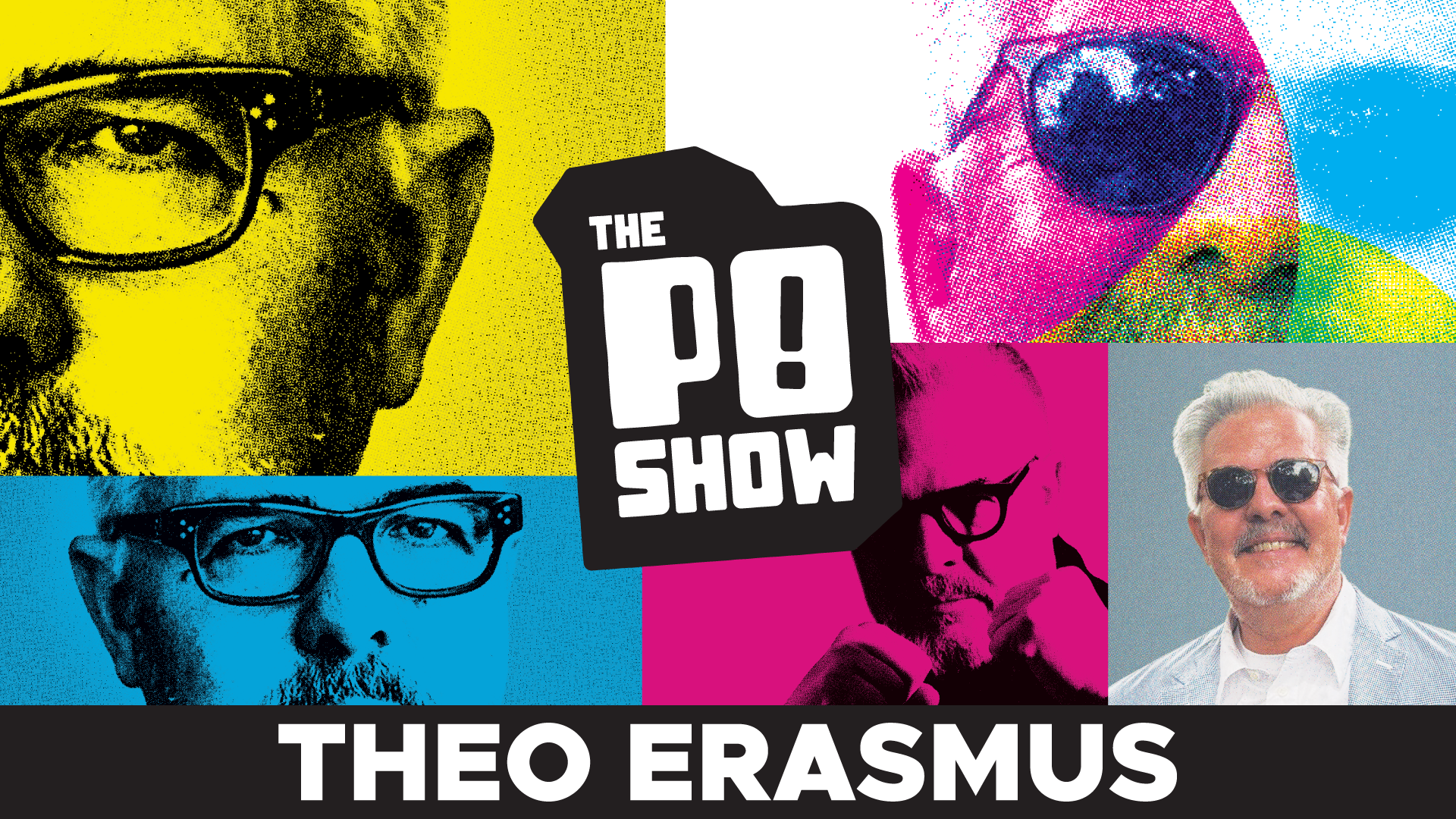
Theo Erasmus
Founder, Rare Beast • Co-owner, Swell
Episode #6 · October 7, 2026Serve as Well as Sell
Theo Erasmus has been a soldier and a conscientious objector, a prosecutor and a crime reporter, a strategist for Google and Johnnie Walker and a quiet ally to conservation groups and arts organizations.
Now he's here to make the case that marketing doesn't have to keep killing the patient it promised to cure.
Worth a look
Some of the goodies mentioned, just one click away.Guest’s Work
Rare Beast Editions (therarebeast.com)
Ideas & References Mentioned in the Episode
Technofeudalism by Yanis Varoufakis
The Creative Act by Rick Rubin
Brands Theo Loves
Brick Road, Japanese porcelain from his friend Mike
2 Ways to Listen, Wherever You Already Hit Play
The Brand BuilderFrom army recon officer to conscientious objector, junior prosecutor to crime reporter driving into Molotov cocktails, post-apartheid copywriter to dot-com New York and, eventually, Cincinnati, Theo's path to strategy is anything but a straight line. This one's the full story, and every stop on it shows up in how he works today.
The PO NotesThe cost test for spotting a company with real principles, why moral arguments lose to better alternatives, the work Theo won't take, and his one message for every marketer on earth. If you've only got fifteen minutes, start here.
Show Transcript
Introduction Phillip Oakley: Today's guest has worked with Google, Puma, Adidas, and Johnnie Walker, and spent his career trying to make cultural artifacts, not cultural landfill. He's also an activist who thinks capitalism may be devouring all value, and that marketing is helping it along. He's not here to burn it down. He's here to make it better.
Phillip Oakley: Theo Erasmus is head of strategy and the founder of Rare Beast, a multidisciplinary strategy studio built around one deceptively simple idea: put humans first. Not consumers, not eyeballs, not soulless data points counted as clicks. Humans. He's sharpened his thinking at some of the world's most recognized shops, like Ogilvy, DDB, TBWA, and Leo Burnett. But these days you're just as likely to find him working with nonprofits, conservation groups, and arts organizations as with a global brand. Theo also co-owns Swell, a social club for artists, workers, and idealists in Cincinnati, and through his collective, Timbuktu, he's been doing strategy for good companies and good causes for nearly a decade.
Phillip Oakley: He's a law and journalism graduate from the University of Stellenbosch — am I saying that correctly? — in South Africa,
Theo Erasmus: Yes, you are.
Phillip Oakley: where he was active in the anti-apartheid movement, which tells you loads about how seriously he takes the idea of brands carrying moral weight. Theo, welcome to The PO Show.
Theo Erasmus: Thank you for having me.
Wishlist Guest Phillip Oakley: Yeah, it's going to be fun. So, three kickoff questions. If you had your own podcast, who would be your top wishlist guest, and why?
Theo Erasmus: Well, the person that comes to mind first is Nelson Mandela, because I think he's probably had the greatest influence on my thinking of just about anybody. I met him a few times, and he was also terrifically charming. An absolute model of how to be a leader and a moral example, and how to think about humans, actually. He was very big on the idea of Ubuntu, the idea that we're only human through other humans, which is something I pretty much adhere to. Obviously he has so many stories to tell. So he would always be my number one. If it had to be a living person, I might just say Mark Ruckman [confirm spelling], because he's so smart and funny that every conversation with him is just a lot of fun.
Phillip Oakley: He is smart. He is really interesting. We'll have to get him on the show too.
Something Even People Close to You May Not Know Phillip Oakley: So tell me something about yourself that you feel everyone should know, but even the people close to you may not.
Theo Erasmus: Yeah, this is an interesting question, because I think people know a lot about me. But one aspect that I realized I don't talk about very much is this. Most people know I was in the army. I was a conscript. I did three operational tours. But I realized I almost never talk about the fact that I was a conscientious objector later. Which I've come to realize probably says a lot about how I see the world, because I don't want to do things that I find morally untenable.
Theo Erasmus: In this case, it was when the South African army was being deployed against South Africans. It was starting to be used in a sort of low-key civil war in South Africa, and the army was getting deployed to townships to essentially do riot control. It was very contentious. It was very violent.
Theo Erasmus: And it was actually quite hard for me. I identified a lot with my idea of myself in the army, as an intelligence and recon officer. I felt like I'd earned my rank and my medals and stuff. So it wasn't an easy thing to give up, but I'm glad I did. And I realized I talk about the army more often, mostly to people who've been there, because for anybody else it's kind of boring. But I very seldom talk about that, and I realize I'm probably a little conflicted about it. But it's very key to, I guess, who I am.
Phillip Oakley: Wow. That feeds directly into some of the conversation we're going to have later about giving something up because of a moral choice. That's great.
Three Favorite Brands Phillip Oakley: What are three of your favorite brands? How did you find out about them, and when did you last buy?
Theo Erasmus: This is an interesting question, because I think brands are fascinating, and they're always fascinating because they make so much sense. But I'm not a particularly brand-loyal person. There are certain things that I really like, though.
Theo Erasmus: I have a friend called Mike, Mike Faley [confirm spelling], who makes this incredible Japanese handmade pottery. It's called Brickroad. He literally went to Japan with this idea of finding the one great thing, and he sourced this from a small Japanese studio. He's now quite successful. I've actually never bought it. Obviously I got to know of it through Mike, but he's given me a full set, and I absolutely love it. I'm big on people putting a lot of love into something, and I think that love radiates out. The love is in this product, and in the way he talks about it. And he's also just such a great guy. I think that's what a lot of brands would love to get to: the sense that somebody cared about this thing. And I think most of them don't, for a variety of reasons. But that's a great brand, Brickroad.
Theo Erasmus: I kind of love everything Muji, because I'm a huge stationery fan, and I just love going to a Muji store. Almost everything is well made and affordable. I exclusively use their A4 notebooks. I've probably used hundreds of them, so I buy them very often. And then I also find a variety of other things, everything from their facial products to occasionally some pajamas, whatever. I'm completely about the brand, that kind of Japanese idea. They really embody that. And it shows you that you can be really great at scale. You can make it feel very good as an experience, and that's rare. The retail experience is really good.
Theo Erasmus: One more typical brand, more in the CPG space, is Davids toothpaste. For some reason I just love the design of it. It's a very muted light green, and the typefaces are good. I even have a matching toothbrush. I'm kind of Scandinavian in my aesthetic, and for something that sits on my marble bathroom counter, I kind of want it to be beautiful. Design is often a big thing I look at, and this is an incredibly well-designed toothpaste. I think it's a local toothpaste. I've never even looked at the story, but it fits into my aesthetic really well.
Theo Erasmus: And there are a few other things I just like. I like Tony's Chocolonely, just because I think they're a great brand. Tony's is really good.
Phillip Oakley: Yeah, we'll get into Tony's. We'll talk about Tony's soon.
Theo Erasmus: For some reason I also really like, and it's also partly a design thing, Minor Figures oat milk, because I think they have the funniest, quirkiest packaging. Oatly was good for a while, but then they started annoying me with writing too much stuff on their label.
Phillip Oakley: They went too far. They went past your Scandinavian, earn-a-space-on-my-countertop aesthetic.
Theo Erasmus: They went too far. It got a little overbearing after a while. And I think that's dangerous. You've got to watch your tone over time very carefully as a brand. I used to love Apple, but I really don't anymore, even though I still use Apple products exclusively. The design is great. The company, I have questions about. So yeah, those are my top three. And I could probably find more.
Phillip Oakley: Sounds like we could keep going. You've opened the box now. Fun note: do you know Rob Meyerson?
Theo Erasmus: No, I don't think I do.
Phillip Oakley: Good guy. I should introduce you two on LinkedIn. He's one of the world's most recognized names in brand naming, and one of the favorite brands he held up was actually a Japanese [unclear], and he had it on camera. That popped up when you were talking about Brickroad. You two will have to share your Japanese pottery stories.
Theo Erasmus: Yeah, the Japanese can teach us a lot about care. We really, really should.
Phillip Oakley: We should learn more from them too, yes.
Theo Erasmus: Many things, but there's almost never any doubt that anything that gets made there has a certain amount of care that goes into it. It's actually a very important thing. And this is something I've been talking about a lot with a few strategists in New York I've worked with, especially this idea that strategy is also a craft that needs care. Because typically now it's somewhat AI-fueled, which is the opposite of care. It flattens everything. And care requires a sort of discipline and a belief in something. The thing that I think will make strategy, and even companies, better is to really care about the thing they make and how it works for people, rather than, well, how much can I extract from these people?
The Meat From the Army to the Agency
Phillip Oakley: That's right. How did you find your way into strategy in the first place? We can move into your origin story with that.
Theo Erasmus: Yeah, it was interesting, because in South Africa in the mid-'80s, advertising would never have been on my radar. Literally. I went to university. I had great grades coming out of high school. I did my two years in the army. And in my parents' world, it was like, which profession do you want to follow? Those were the only choices, really. And I thought, well, law sounds like it has the most to do with language. So I followed that path, and it dovetailed a little bit with my activism.
Theo Erasmus: I did try law for a bit. I was a junior prosecutor. I absolutely hated it, for a lot of reasons. Then I actually got a job as a journalist, because a paper wanted somebody to work the courts, and they thought, well, you already kind of know what's going on there. That's a whole other story. I got a bursary to go back and do a postgraduate degree in journalism. Then I worked as a journalist, and at the time I was working as a crime journalist.
Phillip Oakley: Crime journalist, okay.
Theo Erasmus: Civil unrest was considered a crime. So I had to spend a lot of my time working in areas that were exceedingly dangerous. I'd go in with a little car, and people would be throwing Molotov cocktails at me.
Phillip Oakley: Oh my gosh.
Theo Erasmus: At the time, I didn't really think too much of it. I'd already been through years and years of activism, so this wasn't so unusual. But when I was working at the newspaper, I started feeling the strain of all those years. I was in the army, I was an activist, I was on an adrenaline high all that time, and I was back on an adrenaline high. I think I was starting to feel a kind of emotional burnout. I also used to look at the older editors at the newspaper, and I'm like, man, hard-bitten alcoholics. I don't want to be like that.
Theo Erasmus: And then a few friends of mine who worked in advertising said, you know what we do all day? We sit around and think of cool ideas. I said, maybe I should try that. That's literally it. I got in as a copywriter, because I had writing experience, and I went through the ranks and became a creative director. And I really only got into strategy when I moved to the US in 1999, partly because of the initial dot-com boom. I was like, this is really interesting stuff. I got into it as a writer initially, but I quickly figured out what this all meant, and what the impact of this new tool, the web, essentially, was. So I drifted into figuring that out, and I became a de facto strategist.
Theo Erasmus: From there on, I went back and forth between digital agencies, and then a string of brand agencies, with a few companies in between. But mostly it's been brand strategy, digital strategy, all the permutations we've gone through with social media and everything else, and AI. And then we ended up in Cincinnati, and I ended up having to do work mostly for the big CPG companies. I was transferred by WPP to work on Procter & Gamble and Smucker's and so on. And I was like, it's not really for me. So I think I got into a broader understanding of strategy that goes beyond brand strategy. Although I think most things can be reduced to brand strategy. There's a big overlap, really.
Creatives Make Excellent Strategists Phillip Oakley: Yeah, that's really interesting. I'm going to try to expand on your words, so tell me if I'm going too far. It wasn't something you really talked about until you got to the United States, and then it became a thing. What took you from the creative side? And for what it's worth, I believe strategists should be creative. I think we are creative. We have to see things other people don't. Talk to me about how you went from the writing and CD side over to strategy. What was that like? What introduced you to it?
Theo Erasmus: I kind of introduced myself to it, to some extent. It was sort of odd, because I started off never really having a strategy boss. Either I was at a company where it didn't exist, or, initially, at these digital companies, Sharp in New York and MTK in Austin [confirm agency names], there wasn't really a strategist around. There were technologists and coders and people who knew stuff. So I was a little bit self-taught in that way.
Theo Erasmus: But of course, creatives are actually excellent strategists. The good ones have a great understanding of how to persuade people and how to do stuff that people like, which is maybe more valuable than anything else, because I think one can overthink this whole strategy thing. For me, it's ultimately a creative thing. What we do is simple, but it's not easy. There are many variables. And I think training in law and journalism actually taught me a lot about strategy too.
Theo Erasmus: So it was an interesting leap, because I was already thinking about, well, what does this do? How does this work? At the beginning I didn't think about it as much, because I was just having fun making TV ads and hanging out in studios. But later on, I always got to the point of: how does this work? What's the impact of it? And this is also where the morality play maybe comes into it. If I do this, what impact does it have on the world? Now, companies are mostly interested in what impact it'll have on sales. But I don't think these things are mutually exclusive. If you do good things for people, and you serve them in a certain way, and you treat them in a certain way, that is enormously valuable.
Theo Erasmus: And the creative part of it is really the way in. I often call this the human operating system, as a kind of blueprint. I think about how people behave. What do they care about? And mostly it's not brands. They just don't really care about the idea of brand. But they do care about: are you good to me? Do I feel good about this? Are you solving a problem? Sometimes they don't have much choice. Sometimes they don't think about it very much, like with most CPG products, where being visible on the shelf and being ubiquitous is more important than anything else.
Theo Erasmus: The meaning-making around it is interesting. And obviously creativity is about meaning-making as well. It's about telling a story and figuring out why that story matters to people. Strategy is the same. There's a kind of story where you go, okay, this is why this matters to people, if you can imagine their real lives. Not some abstract idea, but their real lives. It's a little bit like what Rick Rubin said: in a way, you should just do it for yourself as well. You're also a human. You can over-predict what people might or might not like. We know what people mostly like. The same story has been playing out since the Greek tragedies. The story arcs are similar. So do more of that.
What Rick Rubin Actually Meant
Phillip Oakley: You know, the Rick Rubin thing is really interesting, and this is a little off track, so forgive me. I think we've all seen the clips floating around the internet, and several of us have read his book or listened to clips of it. He talks about not paying attention to the audience and what they want, but making something you want to give. And I've even seen it floating around on LinkedIn: see, you shouldn't do research, it's stupid. And I'm like, that's not his point. The guy's been in how many decades of recording studios and concerts, stood in crowds surrounded by people, and smoked peyote at Joshua Tree with people who've changed the world of music. He didn't get there sitting in a closet doing what he wanted to do. He was out there, absorbing so much of the real world and the real industry and how people interacted with the product and the skill. Then his intuition was able to give something fresh. It takes all of that to do the fresh creative.
Theo Erasmus: Exactly. No, it's absolutely right. And I think that's why people often misunderstand him. Also, whenever somebody is held up as a kind of guru, I think you need to ask some tough questions. What does it actually mean? I'm very suspicious of people just quoting. But you're right. I think we've stopped trusting some of the things we know to be true, and we've started over-researching some stuff. I read many research reports, and I'm like, that's exactly what I thought before I started reading the report.
Theo Erasmus: But the thing that's missing, which you've just pointed out, is that Rick Rubin has had a lot of embodied experience. He's had actual experience. He actually understands people. He understands how people respond. He has everybody meditate for a while, so he knows how to get people into that kind of space. He understands the conditions that are needed. Like you said, he's incredibly well informed.
Theo Erasmus: But because we work across such a broad range of industries, you're never going to have Rick Rubin-level understanding and intuition about any one industry unless you've spent 30 years in it. I never think I do. This is why you really have to spend time with people and figure this out, because there's definitely something there that you don't know. I spent many years working with alcohol brands, and still, every time a new brand comes up, I really have to immerse myself. It's good to actually think you don't know, because you really don't know. And the ways of knowing are a lot of what I think matters.
Theo Erasmus: I speak to friends now who work inside departments at big companies, and they say, I haven't spoken to a human being in two years. I'm like, okay. This is obviously AI. It works in certain instances of scale. There's value in that, I guess. Like everything in strategy, it depends. But I just don't think that's a good way to figure out what people really want.
Phillip Oakley: I think it's terrible. It's just going to lead to the great amalgam of all the tactics and ideas that people are expected to buy. It's awful. One last note about Rick Rubin: we're not shown the albums he worked on that failed. We don't know how many dozens or hundreds of albums he worked on that crashed and burned. We'll never find out.
Theo Erasmus: No, it's experimentation, for sure.
Killing the Patient We Promised to Cure Phillip Oakley: Absolutely. So let's talk a little more about the industry's moral problem. One of my favorite things about you is that you're able to open up and speak your mind, respectfully. There are a couple of stingers I've jotted down: that the marketing industry is too predatory and too extractive, and that we're killing the patient we promised to cure. Those are great. You've been in the industry for 30-plus years. When did you start feeling that? I think some of it came earlier in your life, before advertising. But what were the moments in advertising when you started really pulling back and seeing what was behind the curtain?
Theo Erasmus: Yeah, it takes a while. One of my forebears, apparently, is Desiderius Erasmus. He's the most famous. We actually share a name; it's my dad's first name. A humanist, mostly interested in human thriving.
Theo Erasmus: In the early days, when we were making funny television ads and radio ads and print and billboards, it just really wasn't that intrusive. It was intrusive in terms of television. But in South Africa, when I started in the industry, at TBWA and DDB and a few other agencies as a creative, it really seemed like a good thing. Post-apartheid, Black people actually had buying power for the very first time, and access to things for the first time. So it seemed like a good thing to empower them, for them to be able to participate in the economy. There was this huge new market that had opened up, of people who, I believe, had every right to want some of the things they'd never had before. So that was a big thing.
Theo Erasmus: And I was having so much fun in the early days. I was thinking about cool ideas all the time. It was very hard in some ways, it required lots and lots of work, but I worked in very creative agencies, and it was really, really fun. So I didn't think about it as much. And for a long time, I also believed in freedom of choice, because I'm really a capitalist in the freedom-of-choice sense. I hate rules, so I don't think I'd ever be a good socialist in any way. I don't want to tell people what to do with their stuff.
Theo Erasmus: Even when I came to America in '99 and worked for dot-com startups, there was a huge amount of optimism. I don't know if you remember The Cluetrain Manifesto, which was written at the time. It was a foundational document that was floating around, and it was all about this transfer of power. Now we're going to democratize power and information. Corporations were going to lose their stranglehold on information. It was going to be readily available, everybody was going to be able to do what they want, and this would empower people in amazing new ways. I've seen the arc of that. In the beginning, I was like, this is really going to be interesting. It's like the early promise of social media. It's going to start revolutions, the Arab Spring, all that kind of stuff.
Theo Erasmus: But over time, the capitalist arc and the marketing arc have been converging, to the point where everything has ultimately gotten to the Friedman doctrine. Shareholder value has become the dominant doctrine. And seeing this at play in America, seeing what it does to ordinary people. The most egregious example is obviously what the health insurance industry looks like, but many industries are working like that. Many of the big digital platforms quickly turned into something much more extractive. And they're so dominant. They kind of dominate the media right now. They might start off saying we're going to connect people, but that's obviously no longer the case.
Theo Erasmus: When I worked at Possible, there was this idea that everything needs to have a data point. This data idea, that we'd suddenly gotten to the point where we can talk with people all the time about everything. It almost seems to assume we're in consumer mode 24/7, and all we want to do is buy. Then there was the wealth inequality that happened, and how this started converging with politics.
Theo Erasmus: I think the biggest change was this. I didn't think about it as much when I lived in New York in the early 2000s. I went back to South Africa for a while, then went to Australia because of my wife's family, and we came back. And this was 2016, and then 2016 happened. You started seeing this concentration of power for corporations, and the enshittification of so many of these platforms. Everything has gotten worse and worse for consumers, really. These monopolies make capitalism not really work. Now you have companies with so much political power. I just think consumers are at a huge disadvantage. And I hate even calling them consumers. These subscription models, or whatever.
Phillip Oakley: Yeah, same.
Theo Erasmus: There's this Greek ex-finance minister, I forget his name now, who talks about technofeudalism. It's an extreme position, but it's essentially saying we do all the work, they extract all the data from us, and they do behavior change on us. And to some extent that is happening. Everybody's tracking everything you do all the time. AI is making it exponentially worse. And then they're selling you stuff based on that and putting you in echo chambers.
Theo Erasmus: There's a bigger issue, because I always think about these things not in isolation. Marketing can't be in isolation. It's connected to economics, to politics. And all these signs are showing me that something is awry. I see a lot of people suffering. I look at the numbers, and I go, Jesus. People are using credit cards to buy groceries. I work in many activist groups, and I see people really struggling. I'm like, this is just not right. This is the richest country in the history of the world. The classic statistic is that productivity has gone up 60% since the late '70s, but wages have gone up 15%. That extra productivity went straight to the top. It didn't come down to people at all. So now you have a system that doesn't feel like even a fair form of capitalism. And of course marketing is connected to this in a very profound way.
Theo Erasmus: So that's when I started thinking, okay, there's got to be a better way to do this. If you love something, like I enjoy strategy and stories and everything, you want it to be better. You don't want it to get to the point where it's running off a cliff.
Theo Erasmus: And there are so many things we could discuss about the industry. Holding companies have had a big part in it: the concentration of power, the chasing of every new shiny thing. They've become shareholder-driven businesses as well, so it becomes about extraction. Now, I think WPP is going to fire, I think it was 4,000 people, but they're paying their CEO 14 million. I'm like, okay, there you have it. That's the problem in a nutshell. Even the people I know who are working in advertising are like, we're not loving this anymore. The pressure is intense. All these different economic and social conditions are getting passed downstream, and it's becoming a de facto business model, which I really don't think is good for us.
Theo Erasmus: We've talked about this before, but this disconnect between what a company is and how it markets itself is a massive cognitive dissonance, and I think people are getting wise to it. There's a lot of Gen Z going, I can see what you're doing here. So I think we have to say, look, we have to be in service of people. We have to be a good thing in the world. We're never going to be a perfect thing. We are agents of capitalism. The idea that one can have some kind of purity test here is ridiculous. But there are better ways of doing this, because a virtuous circle is much better than a vicious circle. And I think we're getting into a bit of a vicious circle.
Purpose vs. Purpose-Washing Phillip Oakley: So there's a vicious circle. There are also a lot of black-and-white approaches and opinions out there. You and I have talked about this: a lot of the good stuff happens in the gray. Even going back to when we talked about capitalism and socialism 15 minutes ago. Purpose-driven marketing has had its moment too. It's been heavily pushed and heavily challenged by the marketing community. There's lots of purpose-washing out there, lots of people talking about purpose because it makes them feel better about selling chips off a shelf. How do you spot the difference between a company that's genuinely practicing conscious capitalism and one that's using purpose-washing to make a buck?
Theo Erasmus: Well, I think you can usually see it. People tend to look at the brand, but for me, the company is not separate from the brand. So I'll look at it and go, well, how are they behaving? What's their business model? How are they structured? How are they making money? Who are they giving money to? You clearly don't believe in purpose if you reverse your point of view when it becomes financially more precarious. Target is a perfect example. Okay, we were really benefiting from our association with certain groups, and now that it's maybe politically not as tenable, we're going to change our mind. So yes, you were doing it purely for the money.
Theo Erasmus: I was at an awards dinner last night where they were giving awards to companies that had not dismantled their DEI initiatives. One of the companies that came up was Costco. Costco was actually up for an award, but they say they don't accept awards. They just think it's the right thing to do, and they'll keep doing it. And there might actually be some pushback against that from people who don't like the idea.
Phillip Oakley: Love Costco. Yeah, absolutely.
Theo Erasmus: But this is where you know a company has principles: when it costs them something. If their business model is, for instance, that the CEO or the owner makes obscene amounts of money while their workers are peeing in bottles in warehouses, or they're busting unions while they talk a good game, then this is not a good company. The brand and the company are not the same thing. They might say all these good things, like Facebook in the early days: we connect communities. Probably never their intention. I'm not going to ascribe intentions to people, but they're making money. And I suspect the same is going to happen with AI. It's free, it's free, it's free, until they've got you all locked in, and then it's not free.
Phillip Oakley: Like how all shipping was free a few years back. That was the cost of admission. Everyone had to do it, thanks to Amazon, and now it's being reeled back.
Theo Erasmus: Right. So basically, you've got to look at what the company's earnings look like and who they associate with. We've had these chats around certain companies like Apple, which built its brand on being for creatives, for creativity, but is now very closely associated with somebody who's very anti-creativity. I work with a lot of nonprofits in that space. And they're doing this to the benefit not of their customers, but of their shareholders. Then you go, there are some questions to be asked here.
Theo Erasmus: And people are not stupid. They start seeing this. It's a little bit like gerrymandering. When you have a bad model, you start asking, can you rig the game? Can you build a monopoly? It's like the Ellisons buying every media station. We're no longer doing any good, but can we just rig the game and pretend we're still doing good? Can we control the media? So if somebody is looking for a monopoly or trying to control a certain sector, you have to ask, why is this happening? Who does the money go to? Do they invest the money back into the company?
Theo Erasmus: It's like AriZona Iced Tea. The guy said, look, this is never going to be more than, I think, 99 cents. I speak under correction; I can't remember exactly. He said, I make enough money, and I don't want people to pay more for my product, ever. I'm like, okay, I'm buying your product.
Phillip Oakley: Buying the product. Sure.
Theo Erasmus: You need to make money. You absolutely do, because you're in business. But maybe you need to go deeper rather than shallow. Maybe you need to say, let's support the people who have been supporting me by acting in their interest as much as I can. Because I think companies have to be part of the solution. They've become, I think, too powerful in America. They determine so much. They have so much political influence that I don't for a minute believe any one of these big tech companies can't stand up for people. They absolutely have the power to do so. They have more money than the government sometimes. So they can do good things, and sometimes they just choose not to. That's an opportunity wasted.
Theo Erasmus: Like I said, I'm more of a Keynesian capitalist than a Friedman one. I think there's a balance. If you want to be called a person, if you want the rights of a citizen, you can take on some of the responsibilities of a citizen as well. You can't just keep burning down the Amazon and get away with it.
Companies Getting It Right Phillip Oakley: It's not going to be there eventually. So you mentioned Costco, you mentioned AriZona. What are some other companies you think are getting it right?
Theo Erasmus: Many smaller companies, of course. But Dr. Bronner's, I have to say, is probably one of my favorite brands as well. They have a very activist brand. They're the Ben & Jerry's of soap. They pay their people well. Tony's Chocolonely is another example. Obviously Patagonia is an example. There are people trying to do interesting things at smaller companies, but it's harder to think of many big corporations. Everybody always says, well, Patagonia does it. You always have to come back to Patagonia.
Theo Erasmus: And there's Bob's Red Mill. Their oats are what I always have. When he passed away, he left the company to his employees. I want to support somebody like that. It feels good.
Phillip Oakley: It feels good, doesn't it?
Theo Erasmus: It feels good. And the thing is, it often happens with privately owned companies, because there's some control. When it gets into the shareholder world, it gets messier. This is what I'm saying about killing the patient. At some point it's a little bit like AI as well. You still need people to thrive to buy things. You need people to be happy.
Theo Erasmus: This is one of the things that always struck me when I lived in Australia. They have a really high minimum wage, and people have free healthcare. Especially where I lived, in Melbourne, there were so many small businesses. Coffee shops, no franchises really. Coffee shops that could seat like five people. And one of the reasons is that there was so much money in the middle class. The guy who mowed your lawn took his wife to Paris. I'm like, man, this is amazing. There are some downsides to it, but there's so much money in the system that everybody really wins. You can open lots of cafés. People have disposable income.
Theo Erasmus: I was reading a statistic the other day about how much disposable income is now just in the top 10%. I think it was something like 40%. There's a limited number of people who can buy stuff. You really want a lot of people who can spend money. I don't think they should spend money on certain things, but you want people who can spend money and keep the economy going. You want a big middle class for that to happen, which I think in the '50s it was like, really.
The Strategist's Role for Better Companies Phillip Oakley: I saw a story a few days ago, I can't remember which platform, that showed photos of what a Sears looked like in the late '80s and early '90s, versus the fact that it's dead now. Someone could work as a retail clerk selling tools or shoes and actually raise a family and pay a mortgage on that. And going back to what you've said, let's be clear, platforms like Amazon killed that store. But I also hear people say, well, it's a good thing, because the last time I went in there, I couldn't get any help. They couldn't train people. They couldn't pay people. The company was dying because we were all going for cheaper, faster, free shipping. It really does have long-term implications.
Phillip Oakley: We've talked about wanting better companies to win. That's kind of a string that runs through everything we've talked about in the last 20 minutes. What is a strategist's role, especially as an outside consultant, when you're working with one of these companies, versus a traditional brand engagement?
Theo Erasmus: I mean, it's sort of the same thing. You apply all the skills you learned working for for-profit companies to work for the company you want to win, maybe in opposition. Right now I'm working with a circular-economy startup out of Finland. They need to raise money, they need to create a value proposition, they need to find a space in the market, like everybody else. So the skills are not necessarily different. The intention and the outcome are different.
Theo Erasmus: The one thing I do often say to people, and this might be a little different: I've just been working with a bike-sharing organization.
Phillip Oakley: Where is that located? Sorry.
Theo Erasmus: It's called Red Bike, and it's in Cincinnati. They're friends of ours. It's a huge challenge for bike sharing, obviously, because it's a car culture, and the cities are built for cars. It's the thing I always say to sustainable fashion companies too: I don't think you're going to be able to persuade people on ethical and moral grounds. Make it a much better, much more desirable alternative. That's what I think does it.
Theo Erasmus: And that still comes down to creativity. How can you find something that really connects to people, that they really want to do? You have to create a better alternative. You need to be better than the other brands and companies. You can use the same tools, but you need to be better. You need to speak to something deeper, something that would make a difference.
Theo Erasmus: It's a little like when I work with arts organizations. They don't think they need a value proposition. I said, actually, you do. The perception of art as a social good has been declining in the US. So make a case for why this really matters. It's the same sort of thing, really, but you're trying to be more honest about it.
Theo Erasmus: So I say to people, if you do want to be a good company, there are certain things you'll have to do that might be difficult. You have to be transparent. You have to be fair. You probably have to pay your people very well, because there can't be a dissonance between the things you say about what you do and then not doing them. Your brand is a framework for everything you do. So if you say you're about this, you have to be about this. You can't be like Facebook, saying we're about connecting people when you're not, because then it's kind of propaganda. You're trying to put a human face on things.
Theo Erasmus: So you want to take a holistic approach and say, okay, if we're going to do this for people, if we want people to do bike sharing, what are the things that appeal to them? You can't just say cars are bad. What's great about this that people will love? That's how it works. It's got to be a business model, to some extent. It has to be clear. It has to be fair. It has to be transparent. Fair pricing. All of those things come into it if you really want to capture that. And I think that can be very successful.
Theo Erasmus: Even people who I think don't have the best intentions can sometimes do well with that. Tesla, for example. I'm not sure I can ascribe good intentions to Elon Musk anymore. But if he understood that maybe electric cars need to be sexy, need to be interesting, then he'll sell electric cars all day long. This is where it's kind of a gray area. Occasionally you might have issues with certain things, but the ultimate outcome, which is what you think about as a strategist, is good. You want the outcomes to be good for you and for your client, but you want to think a little broader than that. I'll tell clients, if the outcomes are good for you, make sure they're good for other people as well, because people will come on this journey with you if you truly see what their lives are like, rather than being predatory.
Theo Erasmus: And probably the worst examples of this, two things that have been relevant recently, are sports betting and prediction markets. Massively predatory, I think. I think they just shouldn't really be out there. I know they're spending a lot of money, and they won't hire me anytime soon, but I never want to work for them.
Phillip Oakley: Yeah, agreed. Me neither.
Theo Erasmus: These are the sort of companies that say, here's a weakness. Here's something people are struggling with. Here's some trauma. Let's really make money from people's trauma, or boredom, or whatever. And that's very unethical.
Nonprofits and the Palm-Up Problem
Phillip Oakley: Absolutely. I want to go back to something you said a moment ago about nonprofits understanding their value prop. We've had the pleasure of working with several small nonprofits in our area. And it's the same thing. You walk in, and everyone's talking about raising money, or which corporation they're going to go ask for money. Mara [confirm spelling], my wife and business partner, talks about it like this: they always go in with their hand palm up. Please give me, give me, give me.
Phillip Oakley: What we've tried to convince people over time is that there's value in the service they provide. If we turn the spotlight on that and on how they make an impact, then they're creating value. And if it's a unique value, if no one else is adding that value, and we show people how it makes a difference in our community, suddenly their hand's not on the bottom. It's on the top, because they're providing value and taking support or money in exchange for value. I've watched people go through mental gymnastics in a room, because they feel like, since it's a nonprofit, they can't do that, as opposed to saying, wow, we could actually meet our needs and serve more if we were doing more of this.
Theo Erasmus: No, you're exactly right. That's a great metaphor, because it's become almost a shell game. Most of the EDs I work with spend most of their time just raising money. And the fundraising strategies people have tend to be very much like growth-hacking strategies: we have a list, let's send people more stuff. I'm like, people are getting sent way too much stuff. You have to think about how this needs to be a value that's clear to people, without you constantly having to ask. People probably aren't going to come to you, but people also want to be associated with things that are valuable.
Theo Erasmus: Americans are actually exceedingly generous in charitable giving, and it's needed, because the government's not stepping in. So there is a desire to do good things. I think it's one of the great things about America, that there's a kind of impulse to give back. But that's also fading away a little bit. There's no Elon Musk Cancer Center anywhere. With a day's profit, he could solve so many problems.
Theo Erasmus: And there's a challenge now, because there was an older generation that was much more civically and philanthropically focused. And now you also live in a content world. If you're a contemporary art center, you have to ask, well, why would people come here when they could be on their phones, or go to this, or watch that? It's a very difficult thing, full of friction. Context really matters. You really have to think about what role you're playing in people's lives. That should be true for brands as well, but it's doubly true for nonprofits, because they often have such limited resources that they have to really get it right. They don't dominate a category the way a lot of big companies do, which can get it wrong a lot and still do well.
Human Moments vs. the Performance Dashboard Phillip Oakley: So let's keep talking about humans. In a previous conversation, you talked about summoning the soul, and about poetry, forest walks, salons, hammocks, and badminton. Things worth promoting. More human things, less technology. How do you make the argument to a CEO for these human moments when they're stuck staring at a performance dashboard?
Theo Erasmus: Well, the performance dashboard is part of the challenge, obviously. But I think the main thing is that we've gotten too stuck on certain performance metrics. You really want people to be happy and like your company. That's a very important metric. If you're constantly bombarding them with sales measures, I think you're measuring the wrong things. And this comes back to the short term versus the long term.
Theo Erasmus: Look, happy humans are maybe not the ideal situation for a capitalist system that wants to keep growing, because it wants people to buy things to make themselves happy. That's part of the emotional buying pattern. But I think there's ultimately a burnout around that. So you want to say, look, we want to be in some sort of partnership. I think you just need to measure some different things. Yes, there's a role for some of the metrics you're doing now, but the longer-term metrics you can consider are probably more important. And this is really long-term brand building.
Theo Erasmus: It's the fact that Patagonia is now the name on everybody's lips, with an association that's almost unassailable. And that comes from doing that. It's a little like what happened with Nike, too. They were all about the performance metrics all the time, until they started tanking, because they didn't understand that the value isn't actually there. The value is somewhere else. So you need to look at performance metrics and say, this measures this, but it doesn't measure that, and there's more value over there. I think there's more value in ideas. I think there's more value in having a connection with humans, and in your company being associated with something good, than in just meeting your numbers in the short term.
Theo Erasmus: I know this is a challenge, given the pressure many people are under, but I think you can do a combination of the two. You can look at some of these metrics. But if you get the story and the value proposition and the company wrong, you constantly optimize the wrong things. Part of it is optimizing the right things. Like Bhutan: let's optimize for happiness, rather than just profit.
Theo Erasmus: It's like Marco [confirm name] always says: capitalism leads to material wealth, but spiritual poverty. So put some of that spiritual wealth back into it. People will like you for it. You are a dominant force in America, especially. You put a lot out into the world. Why don't you just make the world a little bit better? Because eventually it's going to be beneficial to you.
Theo Erasmus: It's a little bit like AI. Okay, so we get rid of all the people. Who's going to buy the stuff AI makes when nobody has a job? You've got to think these things through. It's like, no profit on a dead planet. If companies just keep growing and growing and growing, in the end there's nothing left. So what are we going to do? You can't just be thinking about your profit. You have to think about people. It is definitely a virtuous circle. Otherwise you're just depleting and depleting and not putting anything back.
Theo Erasmus: I was reading something the other day about how much profit used to get put back into research. It was actually 40 to 60%, I think, in the '50s and '60s. It was very high. Not so much now. Companies would rather do stock buybacks, when there's a huge amount of money they could use to make their product better and pay their people more. Everybody's happier. The person you call on the phone to complain to is happier. Most companies are one phone call away from you hating them if you ever have a problem. And that's clearly not a sustainable model.
Phillip Oakley: And it kills me. Now it's a little different. People are saying you could have AI answering phones for you 24/7, with an infinite amount of information it can pull from to help people. I don't disagree with that. But I'm amazed at how many companies, over the last decade, have cheapened their customer service and removed more humans from helping humans. No matter how fantastic and futuristic the AI thing sounds, people really like to be helped by people. I'm really curious to see how people respond to some AI system helping them, and how they respond when they find out it's AI, or if they know it's AI.
Theo Erasmus: Yeah, I don't think it's going to go that well. I think there's a human thing, and this gets back to embodied human experience. When people have more embodied experience, they get to know more about other people. It also connects people to the things that actually make us happy. And I think that's not always great for companies trying to sell people lots of stuff. Personally, if I could spend my life sitting under a tree reading and watching birds, I'd be pretty happy. I don't really need to buy a lot of stuff. People forget that we live in a beautiful world.
Theo Erasmus: And that's one of the issues with conservation as well. A friend of mine lives up on the Minnesota Boundary Waters, and he's just been up there on a trip. They're going to put a mine there that is likely to destroy the most pristine water ecosystem in the US. I'm like, there's no comparison in terms of value. The value of this copper mine, or whatever it is, goes to only three or four people. Why would we, as humans, allow a company to destroy something that belongs to all of us? To all of us. It's irreplaceable.
Theo Erasmus: So I think there needs to be a sort of moral and spiritual realignment, to say there are things you can't buy and shouldn't buy. And that also comes down to the idea that there should be more places where you can interact and be in community without it costing you money. Like libraries. They're one of the only places you can go in America where somebody isn't trying to get money from you. Go to a sports stadium, and you're getting fleeced from the moment you walk in to the moment you walk out.
Phillip Oakley: Absolutely. And we say this before the World Cup opens up next month.
Theo Erasmus: Oh yeah, for sure. It's going to happen. That's what FIFA is there for.
Question from an Industry Friend Phillip Oakley: That's right. Great quote from Mark Ruckman [confirm spelling] a few minutes ago, which really fits, because he's also our question from a friend. This is from Mark: "Theo is a journalist, a pugilist, a man about town, an art collector, you name it. How does it all add to the broth that is strategy and culture?"
Theo Erasmus: Of course it all does. And I think the thing Mark and I share is that we think we have too narrow a focus in our business. There are a lot of people who apparently only read marketing books. And I'm like, you're not going to get to know anything about people that way. I think you're much better off reading novels, looking at art, and spending your time [unclear] walking around the city. Those sorts of experiences really inform you.
Theo Erasmus: This is ultimately a human business. It's about humans. It's about how humans behave. If you're curious about humans, these things are available to you. You can obviously speak to people, which is wonderful. But the amount of information available! All the stuff I see people occasionally writing about on LinkedIn, I'm like, this has been discussed a hundred times over in philosophy books and poetry. Just go read some of them. We know this stuff about people. We know how people behave. We've been around a very long time, and we've been recording this for a long time in various forms.
Theo Erasmus: And it's also just the sheer joy of it. It feels like it's gotten to be a really onerous and difficult thing, because we've been desperately trying to professionalize it. More and more people have to do more and more dashboards and more and more AI inputs, when you can really get a lot more out of spending time with people. I occasionally chat with my friend Heidi Hackemer [confirm spelling], and her favorite thing is, she's just been on her bike to Canada and back, hanging out in diners. I'm like, yeah, that's what I want to do.
Theo Erasmus: The reason I'm in this business is so I can hang around and talk to people. That's why I was a journalist. I want to talk to people. I want to hear what they really think. They don't tell you what they really think when you're doing research. You know what they really think when you watch them in other spaces, or you get into a long conversation, maybe over some bourbon, or you meet somebody in a unique space and they trust you. There's something that happens there.
Theo Erasmus: So for me, it's a little bit like what a writer or an artist would say: all of this contributes. And I think we should be saying it as strategists as well. All of this contributes to knowing something about humans, and that is absolutely essential in our business.
Closing Question Phillip Oakley: Love it. I love it. You know I subscribe to that. All right, closing question. If you could communicate one thing to every marketing channel in every city around the world simultaneously, what would that message be?
Theo Erasmus: I think that message would be: we're in the business of humans. I tend to think of this as human-centric brand strategy. We need to think about serving people as well as selling to them, because that is actually a virtuous circle. We need to think of this as one big ecosystem. We're not on a separate level, with people as the raw material we draw from. We're the same. The whole world is connected. Nature, all of this, is part of an ecosystem. We need to behave like we're part of an ecosystem that has limitations. It's finite. It has moral limitations, it has resource limitations, all of these things. We need to behave like good citizens, and we need to behave like we care about this ecosystem, because it's what sustains us. We are absolutely part of it. We're not separate from it. It's not just a resource to us. We're part of it, and we need to behave like we're part of it.
Sign Off Phillip Oakley: Love it. So: serve as well as sell, and behave as an ecosystem.
Theo Erasmus: Yeah, part of an ecosystem. Sure.
Phillip Oakley: Love it. Theo, great to see you. Thanks for spending so much time with me. It's always a pleasure, and I look forward to our next chat.
Theo Erasmus: Fantastic. Thank you very much. I really enjoyed that.
Keep It Coming